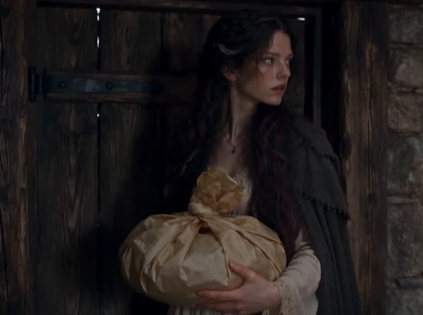
In a frozen mountain village where everyone seems to know everyone else’s business, keeping a secret is difficult.
Keeping a dragon secret is almost impossible.
That’s the situation facing Elara in The Mother’s Monster, an AI-generated fantasy story that begins with one of the strangest births imaginable.
Elara doesn’t give birth to an ordinary human child.
She gives birth to a dragon.
At first, even she struggles to understand what has happened.
The creature is small and vulnerable, but unmistakably different. It has scales, unusual features and the appearance of something the villagers would never accept as a normal child.
But to Elara, one fact matters more than anything else.
The creature is hers.
Whatever the rest of the world might call him — beast, monster or abomination — she sees her child.
And she decides to protect him.
That decision creates the central conflict of the story.
Elara lives in a remote mountain community covered in snow. It is the kind of place where traditions matter, rumors travel quickly and anything unusual can become a source of fear.
A dragon would be more than unusual.
It would be terrifying.
So Elara does what she believes she must do.
She hides the creature.
When people from the village approach her and ask about the baby, Elara gives them a heartbreaking explanation.
The child didn’t survive.
She tells them that she buried him in the mountains.
It’s a believable tragedy.
But some of the villagers aren’t completely convinced.
Why didn’t Elara ask anyone for help?
Why did she supposedly bury the child alone?
Why does something about her story feel wrong?
Those questions begin to create suspicion.
And Elara knows that suspicion is dangerous.
Because inside her home, the truth is alive.
The baby dragon needs her.
Once the villagers leave, Elara returns to the creature she’s hiding.
The contrast between the two sides of her life is striking.
Outside the house, she is a grieving mother whose child supposedly died.
Inside, she is caring for something the village would probably consider a monster.
But Elara doesn’t treat him like a monster.
She approaches him carefully.
She comforts him.
She tries to understand what he needs.
Then she encounters another problem.
Food.
A human baby can be fed in familiar ways.
A dragon apparently cannot.
Elara offers the little creature different things to eat.
He refuses.
She tries again.
Still nothing.
The creature is hungry, but Elara doesn’t yet understand what kind of hunger she’s dealing with.
Eventually, she discovers the answer.
Meat.
That’s what he wants.
And suddenly protecting her secret becomes much more complicated.
A growing dragon needs food.
A lot of food.
Elara can’t simply walk through the village buying enormous quantities of meat without attracting attention.
People will ask questions.
Where is all that food going?
Why does a woman supposedly living alone need so much?
What exactly is she feeding?
And the villagers are already suspicious.
The film gradually turns this simple problem into something much larger.
The dragon is growing.
The secret is becoming harder to hide.
And fear is beginning to spread through the community.
That’s what makes this section of The Mother’s Monster interesting.
The danger doesn’t initially come from the dragon.
It comes from what people believe the dragon might become.
The villagers don’t understand the creature.
They don’t know whether it’s dangerous.
They don’t know why it exists.
And when people don’t understand something, fear can quickly fill the gaps.
Elara sees the situation completely differently.
She doesn’t see a prophecy.
She doesn’t see a supernatural threat.
She doesn’t see a monster waiting to destroy the village.
She sees the creature she brought into the world.
That emotional conflict gives the fantasy story its central question:
What makes something a monster?
Is it appearance?
Is it power?
Is it what other people fear it might do?
Or does the answer depend on its actions?
To the villagers, the answer seems obvious.
Dragons are dangerous.
Therefore the creature must be dangerous.
Elara refuses to accept that logic.
Her bond with the dragon becomes stronger as she continues caring for him.
The creature eventually becomes known as Ember.
And Ember isn’t going to remain a tiny baby forever.
That creates a ticking clock beneath the story.
A small dragon can be hidden.
A larger dragon cannot.
Sooner or later, someone will discover the truth.
The movie’s snowy setting makes that sense of isolation even stronger.
Elara doesn’t have anywhere easy to run.
The mountains surrounding the village are beautiful but unforgiving.
The cold itself can kill.
Leaving the protection of the community could mean death.
Yet remaining there becomes increasingly dangerous too.
Every suspicious look matters.
Every missing animal matters.
Every unusual sound matters.
The villagers begin connecting events to Elara.
Rumors spread.
People watch her more closely.
The lie about her baby’s death becomes harder to maintain.
Eventually, the question is no longer whether the village will discover Ember.
It’s what they will do when they find him.
And the answer isn’t difficult to imagine.
Fear turns into hostility.
Hostility turns into accusations.
The villagers begin viewing Elara not merely as someone hiding a strange animal but as someone connected to something unnatural.
In a community ruled by superstition, that distinction is dangerous.
Soon Elara herself becomes part of the threat in their minds.
If she protects the creature, perhaps she is responsible for it.
If she gave birth to it, perhaps something is wrong with her.
If she refuses to surrender it, perhaps she’s their enemy too.
That’s where The Mother’s Monster shifts from a simple dragon story into something more emotional.
Elara has to choose between acceptance by her community and protecting the creature she considers her child.
For her, there isn’t really a choice.
She chooses Ember.
That decision eventually puts her directly against the village.
People arrive determined to deal with the creature before it becomes more dangerous.
But Elara stands between them and the dragon.
The image is simple but powerful.
A frightened community sees a monster.
A mother sees her child.
Both sides believe they’re protecting something.
The villagers believe they’re protecting their families and homes from a creature they don’t understand.
Elara believes she’s protecting an innocent life from people who have already decided what it is before giving it any chance to prove otherwise.
That conflict drives the rest of the story.
And Ember continues growing.
The creature that could once fit inside Elara’s home becomes increasingly powerful.
His existence can no longer remain a secret.
Eventually, mother and dragon are pushed away from the village and into a much larger struggle for survival.
The mountains that once surrounded Elara’s home become their refuge.
But exile doesn’t end the danger.
It only changes it.
That’s why the quiet section shown in this clip is so important.
Nothing enormous needs to happen.
There is no army.
No burning kingdom.
No massive dragon battle.
Instead, we watch a woman trying to protect a secret.
We watch neighbors beginning to question her story.
And we watch a tiny dragon that doesn’t yet understand why the world outside that house might hate him.
The audience already knows the secret can’t last.
That’s where the tension comes from.
Every conversation with a villager becomes dangerous.
Every piece of meat becomes evidence.
Every day Ember grows makes discovery more likely.
And Elara knows it.
She may have convinced the village that her baby died.
But eventually, the truth will become too big to hide.
Because her child isn’t human.
Her child is a dragon.
And when the village finally discovers what she’s been protecting, Elara will have to decide how far she’s willing to go to save him.
The answer becomes the heart of The Mother’s Monster:
As far as it takes.
The original film presents this as a story about maternal attachment, fear of the unknown and a community’s reaction to a creature it cannot understand. It was published by MYTHRA in September 2026 and explicitly identifies its visuals and voices as AI-generated.