Tombstone (1993): Curly Bill Shoots Marshal Fred White in One of the Film’s Most Shocking Scenes
Some of the most memorable moments in Western cinema happen when a dangerous situation suddenly gets out of control. In Tombstone (1993), a nighttime confrontation between the notorious outlaw Curly Bill Brocius and town marshal Fred White turns deadly in seconds.
What begins as a routine attempt to disarm a reckless gunman becomes a tragedy that exposes the growing lawlessness of Tombstone.
With Powers Boothe’s unpredictable performance as Curly Bill and a tense confrontation under the town’s streetlights, this sequence remains one of the film’s most disturbing moments.
Curly Bill Takes Over the Street
The scene unfolds at night in Tombstone, Arizona.
Curly Bill, wearing a bright red shirt, wanders through the street with revolvers in his hands.
He appears intoxicated and completely unconcerned about the danger he is creating.
His unpredictable behavior threatens everyone nearby.
Rather than hiding from the law, he acts as though the entire town belongs to him.
This attitude reflects the growing influence of the Cowboys, an outlaw group whose members repeatedly challenge the town’s authorities.
Curly Bill is not an ordinary troublemaker.
He is a powerful and feared figure who believes he can behave however he pleases.
His reckless display of gunfire makes that arrogance impossible to ignore.
Marshal Fred White Steps Forward
As Curly Bill continues causing trouble, Marshal Fred White approaches him.
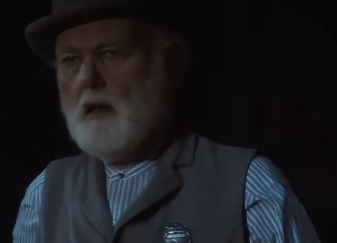
White is an older lawman, recognizable by his gray beard, vest, and hat.
Unlike the aggressive outlaw standing before him, White attempts to resolve the situation without unnecessary violence.
He asks Curly Bill to surrender his weapons.
It is a reasonable demand.
A man firing revolvers in a populated town represents an obvious danger.
Yet the marshal knows that confronting someone as unpredictable as Curly Bill carries enormous risk.
The contrast between the two men makes the encounter especially tense.
White represents public order.
Curly Bill represents lawlessness and intimidation.
For a moment, the entire situation depends on whether the outlaw will cooperate.
A Friendly Greeting Hides the Danger
One of the most unsettling details is Curly Bill’s apparently friendly response.
Instead of immediately refusing the marshal’s demand, he greets Fred with exaggerated familiarity.
His tone makes the encounter seem almost playful.
He appears willing to hand over his revolvers.
But the audience can see that the situation remains dangerous.
Curly Bill is still holding loaded weapons, and his movements are difficult to predict.
Fred approaches carefully, attempting to take control without provoking a fight.
The tension comes from the uncertainty.
Is Curly Bill genuinely cooperating?
Is he playing a cruel joke?
Or is he too intoxicated to understand what he is doing?
The film leaves the audience anticipating disaster.
The Gunshot That Changes Everything
The confrontation reaches its shocking conclusion when Curly Bill suddenly fires at Marshal Fred White.
The gunshot strikes White at close range.
The older lawman collapses onto the street.
The abrupt violence is especially disturbing because the encounter appeared to be moving toward a peaceful resolution.
Moments earlier, Curly Bill seemed ready to surrender.
Now Fred lies wounded on the ground.
Curly Bill’s reaction adds another layer of uncertainty.
He appears surprised by what has happened, raising questions about whether the shooting was deliberate or the result of his reckless behavior.
Regardless of his intention, the consequences are devastating.
A respected town marshal has been shot while performing his duty.
The Town Reacts in Horror
After the gunshot, the atmosphere changes immediately.
The confrontation is no longer a private exchange between an outlaw and a lawman.
People nearby realize that Fred White has been shot.
Alarm spreads through the street.
The incident exposes how fragile public safety has become.
A single armed man has turned a quiet nighttime street into a scene of violence.
The Cowboys’ reputation makes the situation even more dangerous.
Their influence allows men like Curly Bill to challenge authority with little apparent fear.
For the townspeople, the shooting becomes another reminder that ordinary citizens can suffer when violent outlaws dominate a community.
Powers Boothe’s Unforgettable Performance
Powers Boothe delivers a compelling performance as Curly Bill Brocius.
His character combines charm, arrogance, recklessness, and menace.
One moment, Curly Bill appears cheerful and almost amusing.
The next, he becomes terrifying.
That unpredictability is central to the character.
Boothe does not portray Curly Bill as a villain who constantly announces his intentions.
Instead, he creates a man whose casual attitude toward violence makes him especially dangerous.
The red shirt, confident movements, and unpredictable expressions all contribute to his memorable screen presence.
In this scene, Boothe demonstrates how quickly charm can turn into horror.
The Tragedy of Marshal Fred White
Marshal Fred White’s role in the sequence is equally important.
He approaches Curly Bill because someone must protect the town.
His decision is not motivated by personal revenge or a desire to prove himself.
He is simply trying to stop a dangerous disturbance.
That makes the outcome particularly tragic.
White’s calm approach contrasts with Curly Bill’s recklessness.
The scene shows that even an experienced lawman can be vulnerable when confronting someone who refuses to respect basic rules.
It also establishes why the conflict between the Cowboys and Tombstone’s authorities cannot continue indefinitely.
How the Shooting Changes Tombstone
The death of Fred White becomes an important turning point in the film’s larger story.
Wyatt Earp, portrayed by Kurt Russell, becomes involved in the aftermath and takes Curly Bill into custody.
But the situation is complicated by the anger of the townspeople and the threats from Curly Bill’s fellow Cowboys.
Wyatt must prevent both mob violence and interference from the outlaw gang.
The incident illustrates the difficult choices facing anyone attempting to enforce the law in Tombstone.
Justice cannot simply depend on whoever has the most guns.
Yet maintaining legal authority becomes increasingly difficult when powerful criminals refuse to cooperate.
Why This Scene Still Stands Out
The sequence works because its tension develops naturally.
The audience first sees Curly Bill behaving recklessly.
Then Marshal White approaches.
The outlaw appears to cooperate.
For a brief moment, a peaceful outcome seems possible.
Then a single gunshot changes everything.
This sudden reversal gives the scene its emotional impact.
It is not a traditional Western duel between two equally prepared gunslingers.
It is a tragedy involving a lawman who is attempting to restore order.
That distinction makes the violence feel especially unsettling.
Final Thoughts: One Gunshot, Lasting Consequences
Curly Bill’s confrontation with Marshal Fred White is one of the defining moments of Tombstone (1993).
The scene captures the dangerous atmosphere of a frontier town struggling against powerful outlaws.
Powers Boothe makes Curly Bill unpredictable and frightening, while Fred White’s attempt to enforce the law gives the confrontation genuine emotional weight.
The shooting also helps explain why Wyatt Earp and his allies eventually become deeply involved in Tombstone’s escalating conflict.
Was Curly Bill’s shooting of Fred White a terrible accident, or did he know exactly what he was doing?
That question makes this unforgettable Western scene even more chilling.
#Tombstone #Tombstone1993 #CurlyBill #FredWhite #PowersBoothe #WyattEarp #WesternMovies #ClassicWestern