The American Civil War was fought not only on battlefields but also through economic pressure, military planning, and political decisions. One of the Union’s most ambitious early strategies was the Anaconda Plan, designed to weaken the Confederate states by cutting off their access to international trade and controlling major transportation routes.
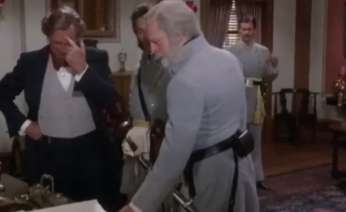
In this dramatic historical movie scene, Confederate leaders discuss the enormous challenge posed by the Union’s strategy.
With a large map spread before them, the officers confront a troubling reality: the North may be able to defeat the South without relying exclusively on major battlefield victories.
A War Room Filled With Uncertainty
The scene opens with a detailed map of the United States during the Civil War.
A military officer points toward the Southern coastline, explaining the geographic scale of the Union’s proposed blockade.
The map highlights the Atlantic and Gulf coasts, where Southern ports played a vital role in trade.
For Confederate leaders, these waterways were essential.
Cotton exports helped support the Southern economy, while overseas trade offered access to manufactured goods and military supplies.
A successful blockade could disrupt those connections.
As the discussion continues, the camera shifts toward Confederate officers listening to the presentation.
Their serious expressions reflect the magnitude of the challenge.
The threat is not a single enemy army approaching a battlefield.
It is a coordinated strategy aimed at weakening the Confederacy over time.
What Was the Anaconda Plan?
The Anaconda Plan is commonly associated with Union General Winfield Scott.
In 1861, Scott proposed a broad strategy for defeating the Confederacy through a combination of naval pressure and control of the Mississippi River.
The plan’s nickname came from the image of an anaconda constricting its prey.
Rather than relying entirely on a rapid invasion, the Union could gradually reduce the Confederacy’s ability to move goods, receive supplies, and maintain its economy.
The two central elements were straightforward.
First, Union naval forces would blockade Southern ports along the Atlantic Ocean and Gulf of Mexico.
Second, Union forces would seek control of the Mississippi River, separating Confederate territory and disrupting internal transportation.
Together, these operations could place enormous pressure on the Southern war effort.
The Challenge of Blockading the Southern Coast
The Confederacy possessed an extensive coastline with numerous ports, rivers, and inlets.
Enforcing a blockade across such a large area was an extraordinary undertaking.
At the beginning of the Civil War, the United States Navy did not have enough vessels to patrol every possible route effectively.
The Union needed to expand its fleet, organize supply stations, and coordinate operations over great distances.
Even then, blockade runners attempted to carry goods through the naval cordon.
Some succeeded, particularly during the early years of the conflict.
However, as Union naval strength increased, the blockade became more effective.
Southern ports faced growing difficulties maintaining regular commercial traffic.
The economic pressure intensified as the war continued.
Why the Mississippi River Mattered
The Mississippi River was one of North America’s most important transportation routes.
It connected agricultural regions, commercial centers, and military positions across a vast area.
Control of the river could determine how efficiently armies moved supplies and reinforcements.
For the Confederacy, losing the Mississippi would make communication between its eastern and western territories much more difficult.
For the Union, gaining control would open an important transportation corridor and weaken Confederate logistics.
This objective eventually became one of the most significant achievements of the Northern war effort.
In July 1863, Union victories at Vicksburg and Port Hudson secured control of the Mississippi River.
The Confederacy was effectively divided along this crucial route.
Robert E. Lee and the Confederate Military Challenge
Robert E. Lee became one of the Confederacy’s most prominent military commanders.
He is especially associated with the Army of Northern Virginia and major campaigns in the Eastern Theater.
Lee’s military reputation was built on battlefield leadership, maneuver, and his ability to challenge larger Union forces.
However, the broader Confederate war effort faced challenges that battlefield victories alone could not solve.
The North possessed greater industrial capacity, a larger population, and substantial naval resources.
Those advantages made a prolonged war especially difficult for the Confederacy.
The Anaconda Plan sought to exploit these differences.
It placed pressure on Southern resources while Union armies continued fighting across multiple fronts.
Jefferson Davis and the Burden of Leadership
Jefferson Davis served as president of the Confederate States of America from 1861 to 1865.
His government faced the enormous task of organizing a new military structure while fighting an increasingly demanding war.
Davis had to balance competing priorities.
Different Confederate states needed protection.
Commanders requested reinforcements.
Transportation networks struggled under wartime pressure.
Meanwhile, the Union blockade threatened the South’s economic connections.
The challenge was not simply deciding where to send soldiers.
Confederate leadership also needed to consider food, weapons, ammunition, industrial production, and international diplomacy.
The scene’s discussion of strategy reflects the kind of interconnected military and political problems that shaped the war.
The Limits of Confederate Strategy
Confederate commanders won several important battlefield victories, particularly during the early and middle years of the war.
Yet tactical success did not automatically resolve the Confederacy’s larger disadvantages.
A military victory might delay a Union offensive without reopening a blockaded port.
A successful defense could preserve territory while leaving supply shortages unresolved.
This distinction between battlefield performance and long-term strategy is central to understanding the Civil War.
The Union did not need to win every engagement to increase pressure on the South.
Over time, its control of waterways, expanding industrial production, and ability to replace military losses became increasingly important.
The Anaconda Plan represented an early recognition of those advantages.
How the Anaconda Plan Influenced the War
The Union never followed Scott’s original proposal as a single, unchanging blueprint.
Military operations evolved in response to political decisions, battlefield developments, and changing commanders.
Nevertheless, two of the plan’s central ideas remained important throughout the conflict.
The blockade restricted Confederate overseas trade.
Union campaigns along the Mississippi eventually secured the river.
These achievements complemented major land operations and contributed to the Confederacy’s defeat in 1865.
The blockade was not completely effective at every stage, and the Mississippi campaign required years of fighting.
But together they demonstrate the importance of logistics and economic warfare.
The Civil War was not decided by battlefield courage alone.
Resources, transportation, and industrial strength also mattered enormously.
Why This Historical Scene Is So Compelling
The clip captures a fundamental tension in military history.
Commanders often focus on defeating enemy armies, but the outcome of a war can depend on factors far beyond the battlefield.
The map provides a visual explanation of the Union’s strategic ambitions.
The officers’ reactions reveal the seriousness of the threat.
And the discussion of the coastline emphasizes the enormous geographic scale of the conflict.
The scene also encourages viewers to consider how military leaders respond when an opponent possesses significant material advantages.
A successful strategy must account for more than troop movements.
It must address the economic and logistical foundations of warfare.
Final Thoughts: The Strategy That Helped Shape Union Victory
The Anaconda Plan remains one of the best-known strategic concepts of the American Civil War.
Its emphasis on blockading Southern ports and controlling the Mississippi River reflected the Union’s ability to apply pressure across multiple fronts.
Although the actual war developed in ways that went beyond the original proposal, these strategic objectives played important roles in the eventual Union victory.
The dramatic discussion between Confederate leaders offers a reminder that major historical turning points often begin with difficult decisions made around a map.
Could the Confederacy have survived a prolonged Union blockade, or was its defeat increasingly likely once the North began exploiting its naval and industrial advantages?
#AmericanCivilWar #AnacondaPlan #RobertELee #JeffersonDavis #CivilWarHistory #MilitaryHistory #AmericanHistory #HistoryMovies