Gettysburg (1993): General John Buford and the Strategic Decision That Helped Shape the Civil War
Some of the most important moments in military history happen before the fighting begins. Commanders must study the landscape, recognize opportunities, and make decisions without knowing exactly what the enemy will do.
In the historical war film Gettysburg (1993), General John Buford demonstrates that kind of battlefield awareness.
Portrayed by Sam Elliott, Buford recognizes the importance of a small Pennsylvania town where several major roads converge. His understanding of the terrain helps establish the strategic significance of Gettysburg before one of the bloodiest battles in American history.
A Conversation Before the Battle
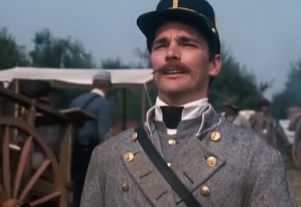
The scene takes place in a military camp surrounded by horses, wagons, and soldiers preparing for the approaching conflict.
A younger cavalry officer speaks with General Buford, who stands beside his horse.
The conversation initially appears casual, but it gradually turns toward a much larger question.
Why would two enormous armies end up fighting around this particular town?
The officer’s confident manner contrasts with Buford’s more experienced and thoughtful personality.
As they discuss the surrounding roads and landscape, the importance of Gettysburg becomes increasingly clear.
The town may look ordinary, but its location makes it impossible to ignore.
Ten Roads and One Important Town
Gettysburg occupied a valuable position within the road network of southern Pennsylvania.
Several routes connected the town with surrounding communities and important transportation corridors.
For armies moving through unfamiliar territory, these roads mattered enormously.
Soldiers needed reliable routes for marching.
Supply wagons required passable roads to deliver food, ammunition, and equipment.
Commanders needed to move reinforcements quickly when fighting began.
A town located at the intersection of multiple routes could therefore become strategically significant.
Controlling Gettysburg meant influencing how troops moved through the surrounding region.
This helps explain why the location attracted the attention of both Union and Confederate forces during the summer of 1863.
Sam Elliott’s Powerful Performance as John Buford
Sam Elliott brings a distinctive presence to the role of Union cavalry commander John Buford.
With his weathered appearance, deep voice, and deliberate manner, Elliott portrays Buford as an experienced soldier who understands the realities of war.
He does not need dramatic speeches to communicate authority.
His expressions suggest a commander who has witnessed enough battles to recognize danger before others fully understand it.
In this scene, Buford’s calm behavior contrasts with the uncertainty surrounding the approaching armies.
He listens, considers the terrain, and responds with the perspective of someone who knows that military decisions have serious consequences.
Elliott’s understated performance makes the character particularly memorable.
Why High Ground Was So Important
The roads around Gettysburg were only part of the strategic picture.
The surrounding hills and ridges were equally important.
During the Civil War, elevated ground could provide major defensive advantages.
Artillery positioned on hills could observe and fire across open fields.
Infantry defending slopes could force attacking soldiers to advance uphill under enemy fire.
Commanders occupying strong terrain also had better opportunities to observe approaching movements.
Buford understood these advantages.
He recognized that allowing Confederate troops to seize the most favorable positions could create serious problems for the Union army.
His decision to resist the Confederate advance helped buy time for Union reinforcements to arrive.
The Confederate Army Approaches Pennsylvania
In the summer of 1863, Confederate General Robert E. Lee led the Army of Northern Virginia into Pennsylvania.
The campaign followed significant Confederate successes, including the Battle of Chancellorsville.
Lee hoped that operations on Northern soil would relieve pressure on Virginia and potentially influence the political direction of the war.
Union forces, meanwhile, moved to locate and confront the Confederate army.
Major General George G. Meade had recently assumed command of the Army of the Potomac.
Both sides were maneuvering across a large area, and neither had originally planned the entire campaign around a battle at Gettysburg.
The convergence of their movements made the town increasingly important.
Buford’s Cavalry Makes a Critical Stand
On June 30, 1863, Buford’s cavalry arrived at Gettysburg and identified Confederate forces approaching the area.
He recognized that the enemy could soon occupy strategically valuable ground.
Rather than simply withdrawing, Buford prepared his cavalry to delay the Confederate advance.
On July 1, his soldiers engaged Confederate infantry west of the town.
The Union cavalry fought while waiting for reinforcements from Major General John F. Reynolds and the First Corps.
Their resistance helped slow the Confederate advance during the opening stages of the battle.
Although the fighting was costly and the Union eventually withdrew through Gettysburg, the delay contributed to the Union army’s ability to establish positions on important high ground south of town.
The Importance of Military Geography
The Gettysburg campaign demonstrates why geography is often as important as the size of an army.
A commander must consider roads, hills, rivers, forests, and available defensive positions.
A location that appears insignificant on a civilian map may become crucial during a military campaign.
Gettysburg’s road network made it a natural gathering point for moving forces.
Its surrounding ridges and hills offered valuable defensive opportunities.
Together, these features helped shape the battle.
The film’s conversation about the town encourages viewers to recognize that major battles are influenced by the physical environment long before soldiers begin firing.
The Battle That Changed the War
The Battle of Gettysburg took place from July 1 to July 3, 1863.
It became one of the Civil War’s most significant engagements.
After three days of intense fighting, Lee’s Confederate army withdrew from Pennsylvania.
The Union victory ended the immediate Confederate invasion and became a major turning point in the war.
The battle involved enormous losses on both sides and left a lasting mark on American history.
Months later, President Abraham Lincoln delivered the Gettysburg Address at the dedication of the Soldiers’ National Cemetery.
His speech helped give the battlefield an enduring place in the nation’s understanding of sacrifice, freedom, and the meaning of the Union.
Why Gettysburg (1993) Still Resonates
Directed by Ronald F. Maxwell, Gettysburg features an ensemble cast including Tom Berenger, Martin Sheen, Jeff Daniels, and Sam Elliott.
The film is known for its large-scale battle scenes, historical subject matter, and attention to the decisions made by military commanders.
But its quieter conversations are also important.
They show that the Civil War was shaped by planning, uncertainty, personality, and difficult judgments.
Buford’s discussion of the town reminds viewers that understanding the battlefield can be just as important as fighting on it.
Final Thoughts: The General Who Recognized the Danger
The scene from Gettysburg (1993) captures an essential lesson in military history.
A small town can become strategically important because of its roads, geography, and surrounding terrain.
General John Buford understood that Gettysburg could become the center of a major confrontation.
His decision to delay the Confederate advance helped shape the opening day of a battle that would become one of the most famous in American history.
Sam Elliott’s performance gives the moment weight, reminding audiences that experienced commanders often recognize the consequences of a decision before anyone else.
Was John Buford’s early stand at Gettysburg one of the most important decisions of the Civil War?
#Gettysburg #Gettysburg1993 #JohnBuford #SamElliott #AmericanCivilWar #CivilWarHistory #MilitaryHistory #AmericanHistory