Some movie scenes need explosions, huge sets, or complicated special effects to become unforgettable.
This one needed a dance floor, a great song, two actors, and a few wonderfully strange dance moves.
More than three decades after Pulp Fiction arrived in 1994, the moment John Travolta and Uma Thurman step onto the floor at Jack Rabbit Slim’s remains one of those rare pieces of movie history that instantly brings a smile to people’s faces.
Vincent Vega looks almost reluctant.
Mia Wallace looks completely confident.
Then the music starts.
And suddenly, nothing else in the restaurant seems to matter.
The YouTube clip of the sequence, titled “Pulp Fiction Legendary Dance Scene (John Travolta + Uma Thurman),” has continued attracting millions of viewers, proving that this strange, stylish dance still connects with audiences who may not even have been alive when the movie first reached theaters. YouTube
THE NIGHT VINCENT VEGA WAS SUPPOSED TO KEEP THINGS SIMPLE
Nothing about Vincent Vega’s evening with Mia Wallace feels particularly safe.
Vincent, played by John Travolta, has been asked to entertain the wife of his powerful boss, Marsellus Wallace. Mia, played by Uma Thurman, is unpredictable, confident, and clearly interested in making the evening memorable.
They eventually arrive at Jack Rabbit Slim’s, the film’s wildly stylized retro restaurant.
It is the perfect setting for what comes next.
The restaurant feels like an exaggerated version of American pop-culture nostalgia, packed with vintage imagery and the atmosphere of another era.
Then Mia learns there is a twist contest.
For Vincent, this is not exactly welcome news.
For Mia, there is apparently no discussion.
She wants that trophy.
A licensed Movieclips description of the scene summarizes the setup simply: Mia convinces Vincent to join her on the dance floor for the twist contest. YouTube
What follows is anything but ordinary.
THEN THE MUSIC STARTS
The song is Chuck Berry’s “You Never Can Tell.”
Vincent and Mia stand opposite one another.
There is no enormous choreographed ensemble waiting behind them.
No dancers suddenly appear from backstage.
No spectacular lighting transformation announces that an iconic movie moment is about to happen.
They simply begin moving.
And that simplicity is exactly what makes the scene work.
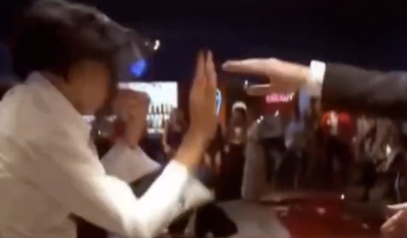
Travolta bends his knees, twists his feet and throws his hands through the air with a strangely relaxed coolness. Thurman answers him with sharp, playful movements of her own.
Sometimes they mirror each other.
Sometimes they seem to be dancing entirely in their own worlds.
But somehow, it fits.
Professional choreographers analyzing the sequence for Vanity Fair noted that the scene takes place during a twist contest inside the fictional 1950s-style Jack Rabbit Slim’s restaurant. Their discussion highlights something viewers instinctively understand: the scene’s appeal comes less from technical virtuosity than from character, attitude and the unusual chemistry created between the two performers. Vanity Fair
That is why the dance is so much fun to watch.
It does not look polished into lifeless perfection.
It looks spontaneous.
It looks cool.
Most importantly, it looks like Vincent and Mia.
JOHN TRAVOLTA’S DANCE HISTORY MAKES THE MOMENT EVEN BETTER
There is also another reason audiences cannot separate this scene from John Travolta himself.
By the time Pulp Fiction arrived, moviegoers already had a powerful association between Travolta and dancing.
For an earlier generation, Travolta on a dance floor immediately recalled Saturday Night Fever and Grease.
Those performances helped make him one of Hollywood’s defining stars of the late 1970s.
But Vincent Vega is not Tony Manero.
He is not Danny Zuko either.
That is what makes the Pulp Fiction sequence so clever.
Travolta does not simply repeat the dancing persona audiences remembered from his younger years.
Instead, that history seems to hover quietly behind the scene.
Viewers know Travolta can dance.
Travolta knows they know.
Yet Vincent performs with a wonderfully restrained awkwardness that belongs completely to this particular character.
There is confidence, but there is also hesitation.
There is rhythm, but there is nothing overly polished about it.
The result feels both nostalgic and completely new.
It is almost as though the movie briefly reminds the audience of the John Travolta they once knew — without ever allowing Vincent Vega to stop being Vincent Vega.
UMA THURMAN MAKES THE SCENE IMPOSSIBLE TO FORGET
Travolta may carry decades of dance nostalgia into the scene, but Uma Thurman is every bit as important to its success.
Mia Wallace does not behave as though she is performing for approval.
She dances because she wants to dance.
That confidence gives the entire moment its strange magnetism.
Her famous black bob, oversized white shirt and bare feet create a visual image that became inseparable from the movie itself.
The choreography feels almost mischievous.
Mia points.
She twists.
She throws her hands across her face.
Vincent responds.
Neither performer appears desperate to impress the other.
Instead, they communicate through movement.
Their relationship temporarily becomes easier to understand without dialogue.
That is especially striking in a movie famous for conversation.
Pulp Fiction is filled with memorable exchanges, long stories and characters discussing everything from crime to food to everyday trivia.
And yet one of its most famous sequences works with hardly any talking at all.
For a few minutes, movement does the storytelling.
A SIMPLE DANCE SCENE INSIDE A VERY UNUSUAL MOVIE
Released in 1994, Pulp Fiction was written and directed by Quentin Tarantino and stars John Travolta, Samuel L. Jackson, Uma Thurman and Bruce Willis among its ensemble cast. Paramount currently describes the film as a story of violence and redemption built around an iconic group of characters, while Miramax lists Travolta and Thurman among its principal stars. Paramount+
The movie famously tells interconnected stories rather than following a straightforward conventional timeline.
That structure gives Pulp Fiction an unpredictable rhythm.
Danger may suddenly become comedy.
A casual conversation may become terrifying.
A criminal situation may pause long enough for two characters to debate something completely ordinary.
And in the middle of that world, the movie makes room for Vincent Vega and Mia Wallace to dance.
That contrast is essential.
The audience knows Vincent’s world is dangerous.
We know the evening carries consequences.
Yet for the duration of the song, those pressures seem to disappear.
There is only the floor.
The music.
And two people trying to win a trophy.
WHY THE SCENE NEVER NEEDED COMPLICATED CHOREOGRAPHY
Modern dance sequences can involve enormous crews, precision choreography, rapid editing and spectacular camera movement.
The Pulp Fiction dance succeeds almost by doing the opposite.
The camera gives Travolta and Thurman room.
Their bodies remain visible.
Their expressions matter.
The audience can actually watch the performance instead of having every movement fragmented into dozens of shots.
That gives the sequence an unusually relaxed quality.
Nothing appears rushed.
Nothing seems desperate to convince you that what you are watching is iconic.
That status came naturally.
The dancers move.
The camera watches.
The audience decides.
And audiences have been watching ever since.
The enduring interest is visible even in contemporary screenings and retrospectives. The Music Box Theatre, for example, specifically highlights the Jack Rabbit Slim’s twist contest when presenting Pulp Fiction, describing Vincent and Mia dancing to Chuck Berry beneath the restaurant’s retro atmosphere.
THE DANCE BECAME BIGGER THAN THE SCENE ITSELF
Certain movie images eventually escape the movie that created them.
Travolta and Thurman dancing is one of those images.
Even people who have never watched all of Pulp Fiction may recognize the pose.
The black suit.
The white shirt.
The fingers moving across the eyes.
The twisting feet.
The effortless cool.
The moment has been referenced, recreated and celebrated for decades because it is incredibly easy to understand visually.
You do not need to remember every plot detail.
You do not need to understand the film’s nonlinear structure.
You do not even need dialogue.
Show someone Vincent and Mia dancing and the image communicates immediately.
That is one reason true movie nostalgia can be so powerful.
Sometimes an entire era can return through one small movement.
For viewers who first saw Pulp Fiction in theaters, the scene can instantly bring back the 1990s.
For younger audiences discovering the movie later, it feels like an introduction to something that somehow remains cool without trying to imitate modern trends.
THE MOVIE ITSELF BECAME A LANDMARK
The dance scene is only one part of the film’s larger legacy.
Pulp Fiction won the Palme d’Or at the 1994 Cannes Film Festival. The official Cannes archive lists the film as that year’s Palme d’Or winner, while Miramax records its later Academy Award victory for Original Screenplay. Festival de Cannes
Those honors help explain the movie’s place in cinema history.
But awards alone do not explain why individual moments continue circulating decades later.
That comes from something less measurable.
Personality.
Style.
Timing.
Memory.
The dance possesses all four.
It is immediately recognizable without feeling manufactured for recognition.
That distinction matters.
SOMETIMES THE SIMPLEST MOMENTS LAST THE LONGEST
Perhaps that is the real lesson of the Jack Rabbit Slim’s sequence.
It does not need to announce itself as important.
It simply happens.
Mia wants to dance.
Vincent reluctantly joins her.
Chuck Berry starts playing.
They twist.
They smile.
And cinema history quietly happens around them.
Three decades later, audiences are still pressing play.
Still watching those strange little hand movements.
Still copying the twist.
Still debating whose moves were better.
And still remembering exactly how John Travolta and Uma Thurman looked standing across from each other on that dance floor.
Some movie scenes impress you the first time you watch them.
Others become memories you carry around for years.
Vincent Vega and Mia Wallace dancing at Jack Rabbit Slim’s somehow became both.
And the moment that music starts, it is almost impossible not to watch.