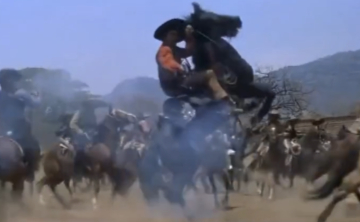
The American Western has produced some of cinema’s most unforgettable battles, but few capture the spirit of courage, sacrifice, and unity as powerfully as The Magnificent Seven (1960). Directed by John Sturges, this classic film follows seven gunfighters who agree to defend a poor Mexican village against a ruthless bandit leader and his men. In the Village Shootout scene, the struggle reaches a dangerous turning point as the villagers and their protectors confront the violence that has threatened their homes and families.
More than a simple exchange of gunfire, this sequence represents the central conflict of the film: whether ordinary people can overcome fear and stand against those who use violence to control them. With tension building, weapons drawn, and the fate of the village hanging in the balance, the shootout delivers the kind of suspense that helped establish The Magnificent Seven as one of the most influential Westerns of its era.
A VILLAGE THAT REFUSES TO LIVE IN FEAR
At the heart of The Magnificent Seven is a community pushed to the edge. The villagers are hardworking people who want little more than the opportunity to live peacefully, raise their families, and protect the land that sustains them. Yet their lives have been repeatedly disrupted by Calvera and his gang, whose raids leave the community frightened and powerless.
The bandits rely on intimidation to maintain control. Their repeated attacks have taught the villagers to expect danger whenever the gang returns. For a long time, resistance seems impossible because the villagers lack the weapons, training, and confidence needed to challenge their oppressors.
Everything begins to change when seven American gunfighters agree to help defend the settlement. Each man brings a different personality, skill set, and understanding of danger. Some are motivated by money, others by pride, and some by a deeper desire to do something meaningful with their abilities.
Their arrival does not immediately erase the villagers’ fear. Instead, it creates an opportunity for the community to imagine a different future. The Village Shootout brings that possibility into sharp focus, transforming the struggle from a story about helplessness into a battle over dignity and freedom.
THE TENSION BEFORE THE GUNFIRE
One of the defining strengths of classic Western filmmaking is its ability to build suspense before the first shot is fired. The Village Shootout uses the threat of violence to create an atmosphere in which every movement matters.
The audience understands that the conflict cannot continue indefinitely. The bandits have established their reputation through brutality, while the gunfighters know that defending the village will require more than simply appearing brave. They must remain alert, understand their surroundings, and respond quickly when the situation changes.
The anticipation makes the action more meaningful. Rather than presenting the gunfight as a random burst of excitement, the film connects it to the characters’ decisions and the community’s struggle to survive.
Every confrontation carries consequences. A mistake can expose a vulnerable position, while hesitation may give the enemy an advantage. The gunfighters must rely on experience and cooperation, but they also have to consider the villagers whose lives depend on the outcome.
This balance between suspense and action is part of what makes The Magnificent Seven so effective. The shootout is not merely about who can shoot fastest. It is about who can remain composed when fear threatens to overwhelm everyone involved.
SEVEN GUNFIGHTERS AGAINST A RUTHLESS ENEMY
The central appeal of the film lies in its seven heroes. Chris Adams, played by Yul Brynner, serves as the group’s calm and authoritative leader. He understands that the mission requires discipline, careful planning, and a willingness to accept personal risk.
Vin Tanner, portrayed by Steve McQueen, brings confidence and resourcefulness to the group. His movements and reactions help create the impression of a gunfighter who can adapt quickly when circumstances become dangerous.
Bernardo O’Reilly, played by Charles Bronson, offers another dimension to the story. His growing connection with the village’s children reveals that the gunfighters are not simply hired weapons. They are individuals capable of developing genuine affection for the people they have agreed to protect.
The remaining members also contribute their own strengths and vulnerabilities. Together, they form a team whose effectiveness depends on more than individual marksmanship. They must coordinate their actions, trust one another, and recognize that no single gunfighter can protect every part of the village alone.
The Village Shootout highlights the importance of this cooperation. Each man may possess remarkable skills, but the enemy’s numbers make the situation dangerous. Success depends on the group’s ability to work together under pressure.
This collective struggle reinforces one of the film’s most enduring ideas: courage becomes more powerful when people use their abilities for a purpose greater than themselves.
THE VILLAGERS BECOME PART OF THE FIGHT
Although the seven gunfighters attract much of the audience’s attention, the villagers remain essential to the story. Their suffering gives the conflict its emotional weight, and their willingness to resist determines whether the community can begin to reclaim its future.
At first, many villagers struggle with the idea of confronting Calvera. Their fear is understandable. They have experienced repeated raids and know that standing up to the bandits could bring terrible consequences.
The gunfighters cannot simply erase that fear through their presence. Instead, they help create conditions in which the villagers can begin to believe that resistance is possible.
The shootout therefore represents more than a contest between armed men. It becomes a test of the community’s determination to stop accepting oppression as an unavoidable part of life.
This theme gives the film an emotional foundation that extends beyond the excitement of the action. The villagers are not fighting because they desire violence. They are fighting because the alternative is to continue living under someone else’s control.
Their struggle also challenges the traditional image of the lone Western hero. The seven gunfighters are important, but their actions matter because they help ordinary people defend something they value. The village itself becomes a symbol of the human desire to live without fear.
WHY THE SHOOTOUT FEELS SO INTENSE
The Village Shootout demonstrates the effectiveness of clear staging, dramatic pacing, and physical action. The audience must understand where the danger is coming from, how the characters respond, and what each confrontation means for the larger battle.
Classic Westerns often build their action around geography. Streets, buildings, doorways, and open spaces become part of the conflict. The arrangement of the village determines where characters can move and which positions offer protection.
These details help make the action feel immediate. A gunfighter cannot simply concentrate on the opponent directly in front of him. He must remain aware of the wider situation and recognize that danger may come from another direction.
The scene also benefits from the contrast between stillness and sudden movement. Moments of anticipation allow the tension to build, while bursts of action release that pressure. This rhythm gives the shootout its dramatic force without requiring constant movement.
The result is a sequence that feels connected to the story rather than inserted merely to entertain the audience. The gunfire has meaning because the characters have something to lose, and the village’s future depends on the choices they make.
COURAGE, SACRIFICE, AND THE PRICE OF FREEDOM
One of the most powerful themes in The Magnificent Seven is that doing the right thing does not guarantee an easy victory. The gunfighters understand that defending the village could place their lives in danger. They have accepted a responsibility that extends beyond their own survival.
Their courage is not the absence of fear. It is the decision to act despite knowing that the consequences could be severe.
The film also examines the difference between fighting for money and fighting for a cause. The seven men initially arrive for practical reasons, but their experiences gradually complicate their motivations. Their relationship with the villagers gives the mission a personal significance that cannot be measured solely in financial terms.
The Village Shootout brings these ideas together. Every act of resistance carries a cost, and every decision reveals something about the characters’ values. The heroes must decide whether their skills will serve only their individual interests or whether they will risk themselves to protect others.
That moral dimension gives the film its lasting emotional power. The gunfighters are memorable not simply because they are skilled with weapons, but because they choose to use their abilities against those who exploit the weak.
A CLASSIC WESTERN THAT STILL INSPIRES
Released in 1960, The Magnificent Seven became a landmark of Western cinema through its memorable characters, dramatic storytelling, and exploration of heroism. Its influence reaches beyond the genre because its central conflict is universal: a community faces oppression, and a group of unlikely defenders helps it discover the courage to resist.
The Village Shootout captures the film’s essential qualities. It combines action with emotional stakes, individual skill with teamwork, and the danger of violence with the hope of a better future.
The scene also demonstrates why the film’s heroes remain memorable. Chris Adams and his companions are not presented as men who can solve every problem without consequences. They are individuals who choose to face danger because they believe the villagers deserve a chance to live freely.
Their struggle reminds viewers that freedom is rarely protected by good intentions alone. It requires difficult choices, mutual trust, and the willingness to stand firm when fear makes surrender seem easier.
Ultimately, the Village Shootout is more than an exciting moment from The Magnificent Seven. It is a defining expression of the film’s belief in courage, solidarity, and the enduring desire for justice. Through John Sturges’s direction and the performances of its remarkable cast, the battle becomes a powerful reminder that even a small community can challenge overwhelming force when people refuse to abandon one another.
That is why The Magnificent Seven continues to resonate with Western fans. Its action remains exciting, its characters remain iconic, and its central message remains clear: the fight for freedom becomes meaningful when courage is used to protect those who cannot stand alone.