Before Jim Carrey became one of Hollywood’s biggest comedy legends, he played an overconfident martial arts instructor who claimed to know everything about self-defense. But the moment his students put his skills to the test, his entire reputation came crashing down in spectacular fashion!
Imagine paying good money to attend a self-defense class taught by a former world karate champion.
You expect to learn powerful techniques, build confidence, and discover how to protect yourself in dangerous situations.
Instead, your instructor gets stabbed during his own demonstration, makes increasingly ridiculous excuses, and somehow expects everyone to believe he’s still a martial arts master.
Welcome to one of Jim Carrey’s funniest early television performances.
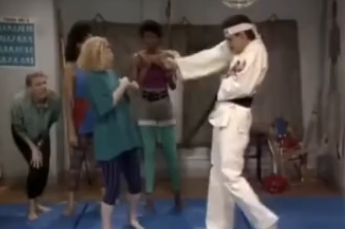
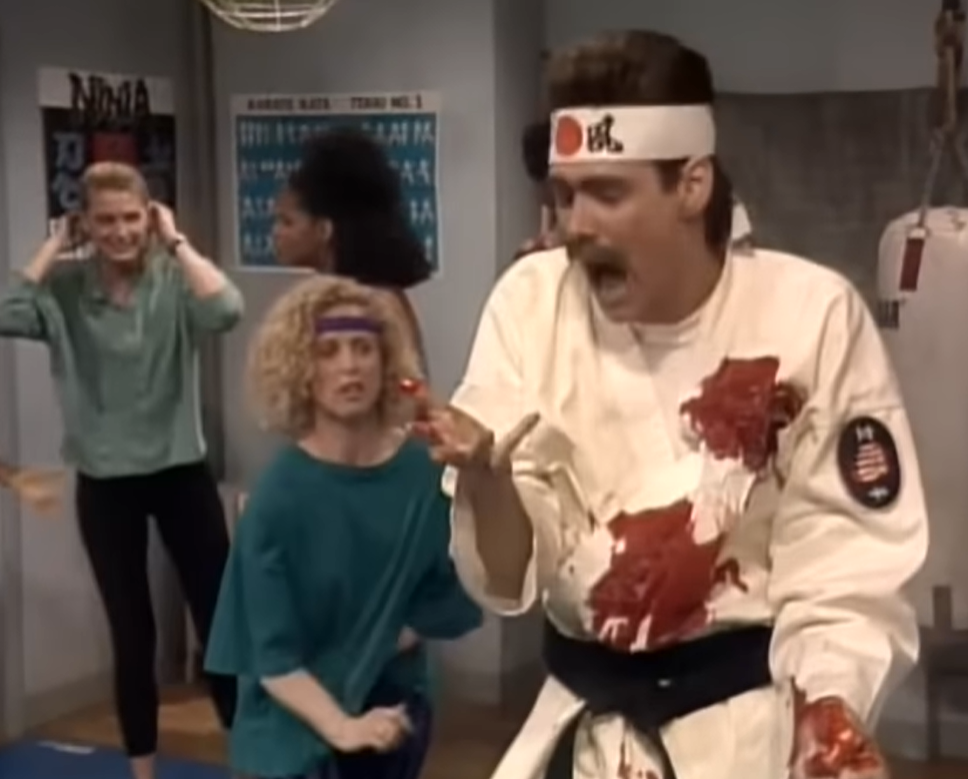
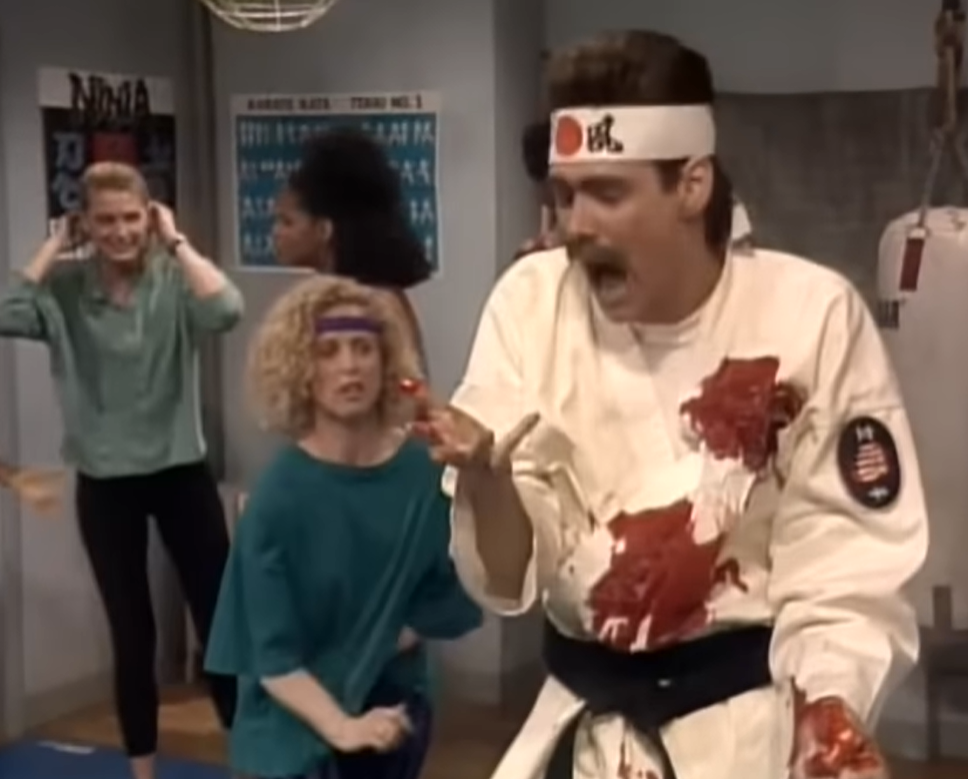
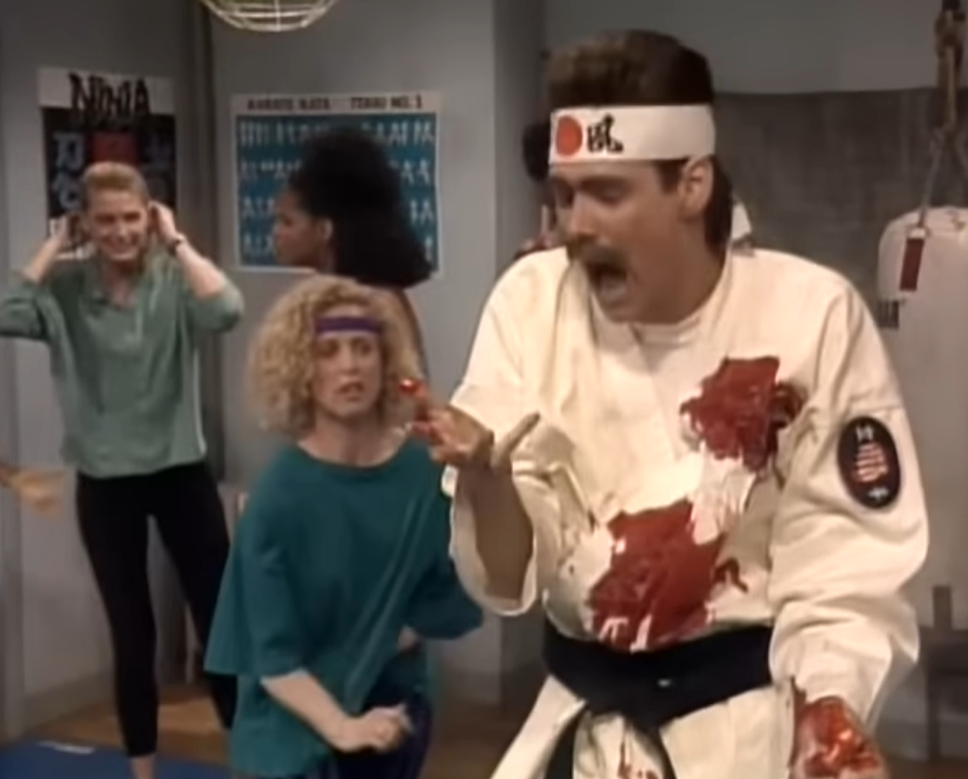
In the classic In Living Color sketch commonly known as “Bad Karate Class,” Carrey plays Bob Jackson, a ridiculously confident karate instructor whose impressive claims quickly fall apart when his students begin testing his abilities.
What starts as an ordinary martial arts lesson transforms into a masterclass in physical comedy, outrageous excuses, and perfectly timed humiliation.
And the funniest part?
The more obvious it becomes that Bob doesn’t know what he’s doing, the harder he tries to convince everyone he’s an expert.
Meet Bob Jackson: The Man Who Thinks He Can Defeat Anyone
The scene opens inside a self-defense classroom.
A group of women has gathered to learn how to protect themselves, and their instructor introduces himself with the confidence of someone who believes he’s the greatest martial artist alive.
His name is Bob Jackson.
According to Bob, he’s a black belt in karate, has studied martial arts for more than 20 years, and is a former world champion.
That’s quite an impressive résumé.
He also makes it clear that his training course costs more than others, but promises that his students will never have to fear violence again.
Everything about his introduction screams authority.
He speaks confidently, moves dramatically, and acts as though every word coming out of his mouth should be treated as unquestionable wisdom.
There’s just one problem.
Bob’s actual fighting abilities don’t seem to match his extraordinary claims.
And it won’t take long for his students to find out.
Jim Carrey’s performance is immediately hilarious because he captures that familiar personality: the self-proclaimed expert who believes confidence can substitute for actual ability.
Bob is so convinced of his greatness that the audience can already sense disaster approaching.
The First Question Takes an Unexpected Turn
Before beginning his demonstration, Bob asks his students what concerns them most.
It’s a perfectly reasonable question for a self-defense class.
But one woman has a slightly different idea about what she wants to learn.
Rather than asking about escaping an attacker or defending herself on the street, she brings up discovering that her husband has another wife and children.
Then she wants to know how to kill him in his sleep.
Suddenly, Bob finds himself dealing with a question that wasn’t exactly covered in the imaginary karate handbook.
His confidence briefly loses its rhythm.
Instead of providing an answer, he redirects the class toward a more conventional lesson.
Knife defense.
It seems like a sensible decision.
After all, what could possibly go wrong with an experienced world champion demonstrating how to defend himself against someone holding a knife?
As viewers quickly discover, just about everything.
The Knife Demonstration That Goes Terribly Wrong
Bob asks for a volunteer to demonstrate a knife attack.
One of the students eagerly responds.
And, remarkably, she already has a real knife in her purse.
That alone should have been enough to make a sensible instructor reconsider the entire exercise.
But Bob Jackson is not a sensible instructor.
He’s Jim Carrey playing a man who thinks he’s invincible.
The student hesitates because she’s concerned about using a real knife.
Bob reassures her.
He acts like an experienced master who could neutralize an attacker without breaking a sweat.
Then comes the moment that turns the entire sketch upside down.
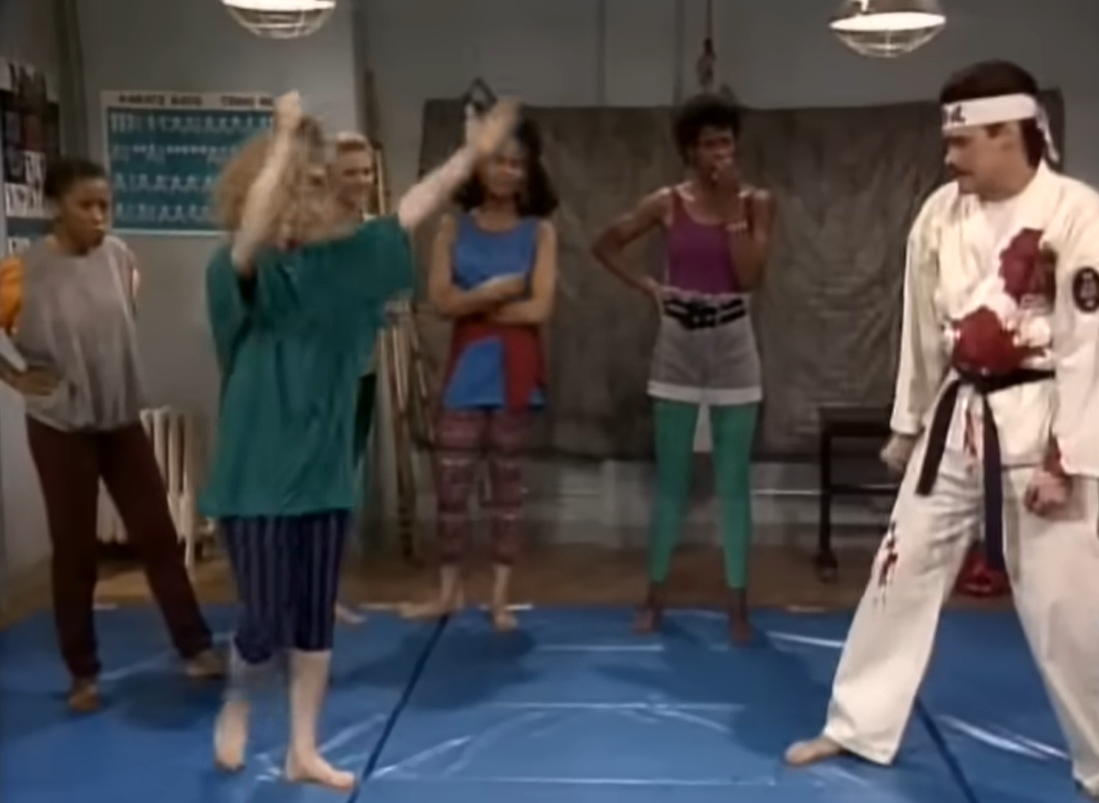
The demonstration goes wrong, and Bob gets stabbed.
His reaction is absolutely priceless.
The supposed martial arts expert suddenly discovers that his years of training have not made him quite as untouchable as he imagined.
The student is understandably horrified.
But instead of admitting that something has gone terribly wrong, Bob immediately invents a ridiculous explanation.
He claims he moved his internal organs to avoid serious injury.
Yes, really.
Apparently, his martial arts training is so advanced that he can rearrange his own anatomy whenever necessary.
It’s an excuse so absurd that it instantly becomes one of the funniest moments in the performance.
And Jim Carrey delivers it with complete conviction.
When the Instructor Blames the Student
Most people would probably end the lesson after being stabbed during a demonstration.
Not Bob Jackson.
He somehow manages to turn his own failure into a teaching opportunity.
According to Bob, the problem wasn’t his inability to defend himself.
The problem was the student’s technique.
She attacked him incorrectly.
He insists that she should approach the demonstration differently, as if adjusting the angle of the attack will magically transform him into the champion he claims to be.
So he asks her to try again.
The comedy becomes even more outrageous because the audience already knows what’s coming.
Bob is determined to preserve his reputation.
The student is worried about hurting him.
And every attempt to correct the situation only makes Bob look increasingly ridiculous.
Even as his physical condition deteriorates, his enormous ego refuses to surrender.
Carrey’s timing makes the sequence hilarious.
He switches between exaggerated confidence, sudden pain, nervous recovery, and renewed authority with incredible precision.
Every reaction makes Bob’s desperation more obvious.
And every excuse makes his supposed expertise less believable.
The More He Talks, the Worse It Gets
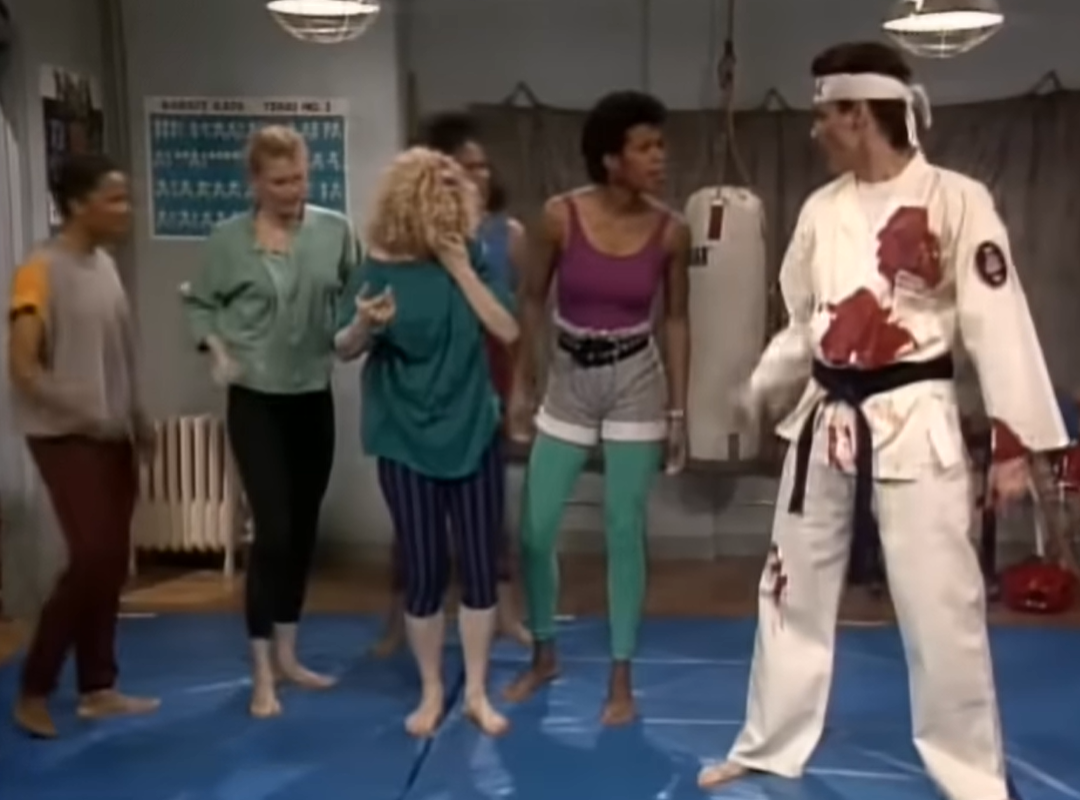
One of the greatest pleasures of watching this sketch is seeing how Bob reacts whenever reality contradicts his claims.
A normal instructor would recognize that the demonstration has failed.
Bob simply rewrites the explanation.
If he gets hurt, it’s because the student moved incorrectly.
If he appears weak, he’s actually using an advanced technique.
If he struggles to continue, it’s all supposedly part of the lesson.
His excuses become funnier because they’re delivered with the seriousness of a professional defending his life’s work.
Jim Carrey understands exactly how to play this type of character.
Bob isn’t trying to be funny.
In his own mind, he’s an extraordinary martial artist demonstrating superior knowledge.
That sincerity is what makes the performance so entertaining.
Carrey doesn’t play Bob as a comedian telling jokes.
He plays him as a man who genuinely believes every ridiculous statement he makes.
And the audience gets to enjoy the enormous distance between Bob’s self-image and reality.
The Students Finally Realize Something Is Wrong
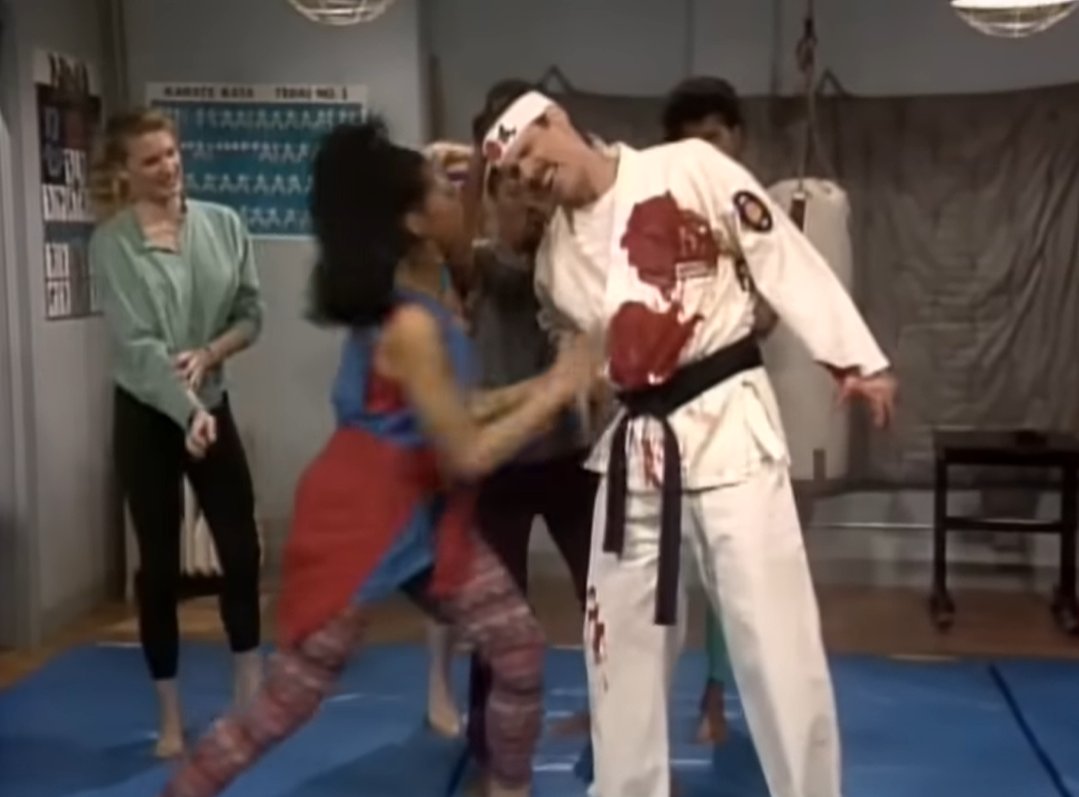
Eventually, the women begin questioning whether they’ve made a terrible investment.
They came to the class expecting practical self-defense lessons from a qualified instructor.
Instead, they’ve witnessed a supposedly experienced martial arts champion fail his own demonstrations.
Their patience begins to disappear.
One student openly demands her money back.
Others agree.
Then someone brings up an inconvenient detail about Bob’s claim to have been a world champion.
She points out that Chuck Norris held a world championship title during the period Bob claims to have been at the top.
For a moment, Bob’s carefully constructed reputation faces another serious challenge.
But once again, he refuses to back down.
He argues that there were plenty of champions.
And then he makes an even more ridiculous claim.
He says he sparred with Elvis Presley.
At this point, Bob has moved from questionable martial arts instructor to a man whose entire résumé seems to depend on increasingly unbelievable stories.
The students have every reason to doubt him.
But their skepticism only pushes the comedy toward another outrageous moment.
Chuck Norris, Elvis Presley, and One Ridiculous Karate Lesson
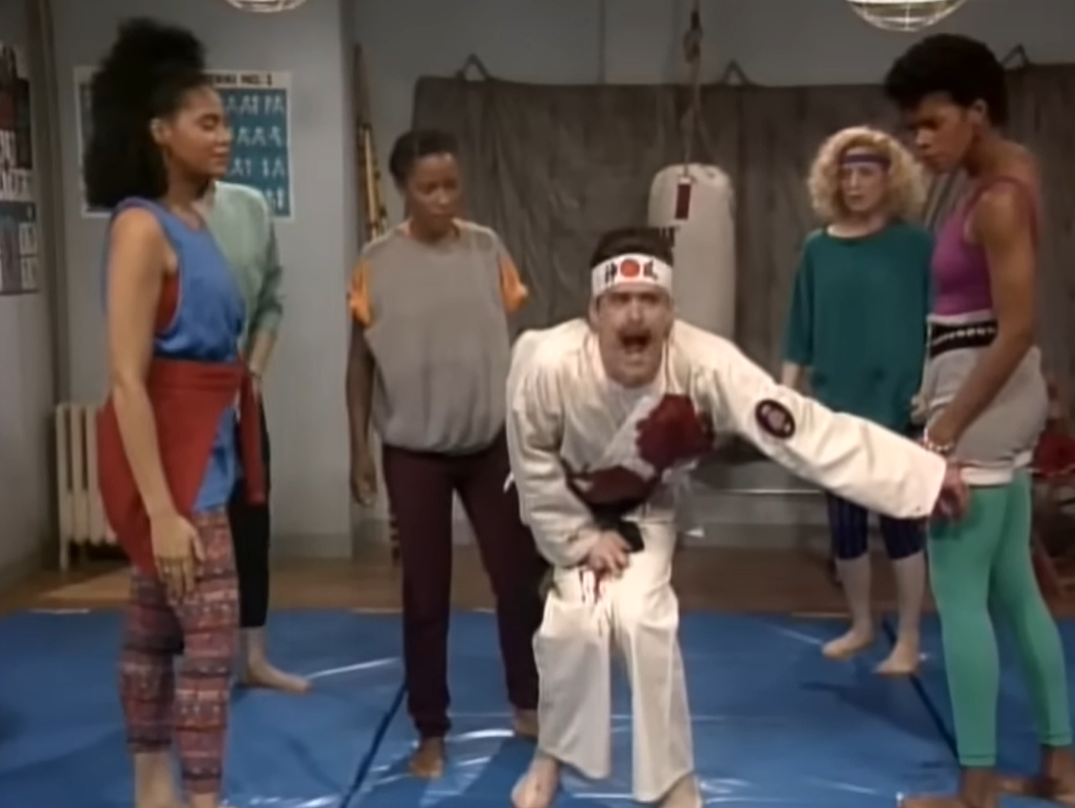
The references to Chuck Norris and Elvis Presley are especially entertaining when viewed through the lens of American pop culture.
Chuck Norris was already famous for his martial arts achievements and action-film career.
Elvis Presley, meanwhile, had a well-known interest in karate.
By casually dropping these names into the conversation, Bob attempts to borrow credibility from two recognizable celebrities.
It’s a classic trick of an insecure character.
When actual skill fails to impress people, impressive-sounding connections become the next line of defense.
Of course, Bob doesn’t have much luck with that strategy either.
Carrey turns the name-dropping into another source of embarrassment.
The references sound less like evidence of Bob’s expertise and more like desperate attempts to escape responsibility.
By the end of the sketch, the gap between what Bob claims and what the audience sees has become impossible to ignore.
And that’s exactly why the character works.
Jim Carrey’s Facial Expressions Steal the Show
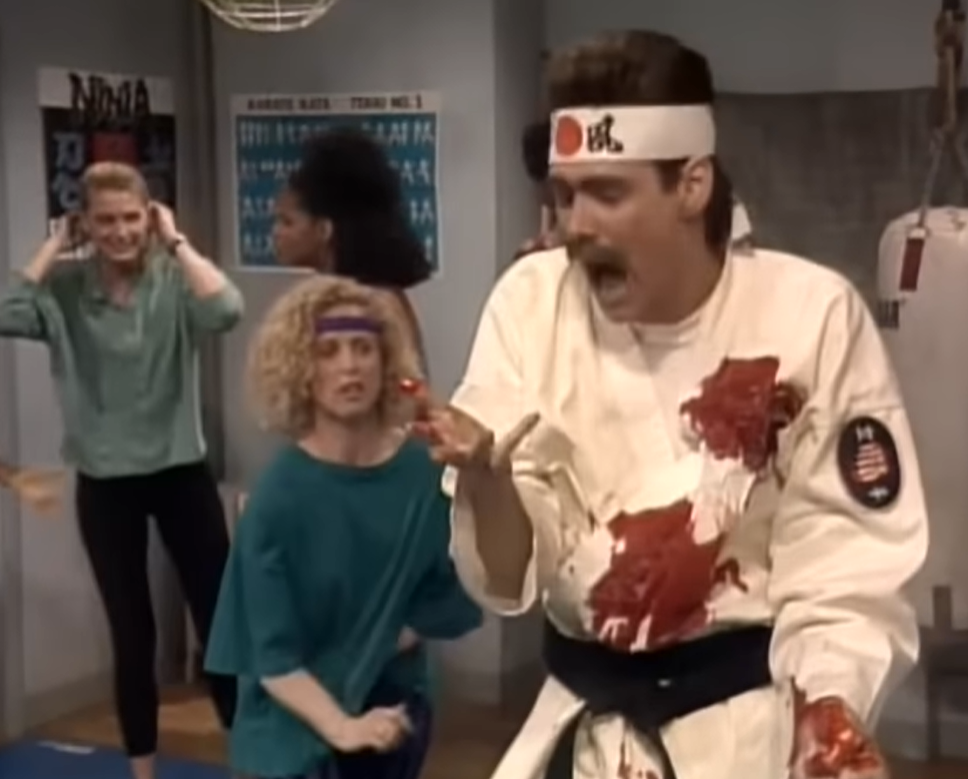
While the writing provides the foundation for the humor, Jim Carrey’s performance elevates everything.
His facial expressions are almost impossible to describe.
One moment, he’s wearing the confident expression of a respected martial arts master.
The next, his face twists into a look of extraordinary pain.
Then, almost instantly, he returns to pretending that everything is under control.
It’s a remarkable display of physical comedy.
Carrey uses his entire body to communicate what Bob refuses to admit.
His mouth may insist that he’s perfectly fine, but his expressions tell a completely different story.
And the contrast is hilarious.
Few comedians have ever possessed Carrey’s ability to turn simple physical movements into memorable jokes.
His face seems to operate independently from the rest of his body.
His voice changes dramatically.
His movements become exaggerated without losing their comic precision.
All those talents are on full display in this early performance.
Before Ace Ventura, Jim Carrey Was Already a Comedy Genius
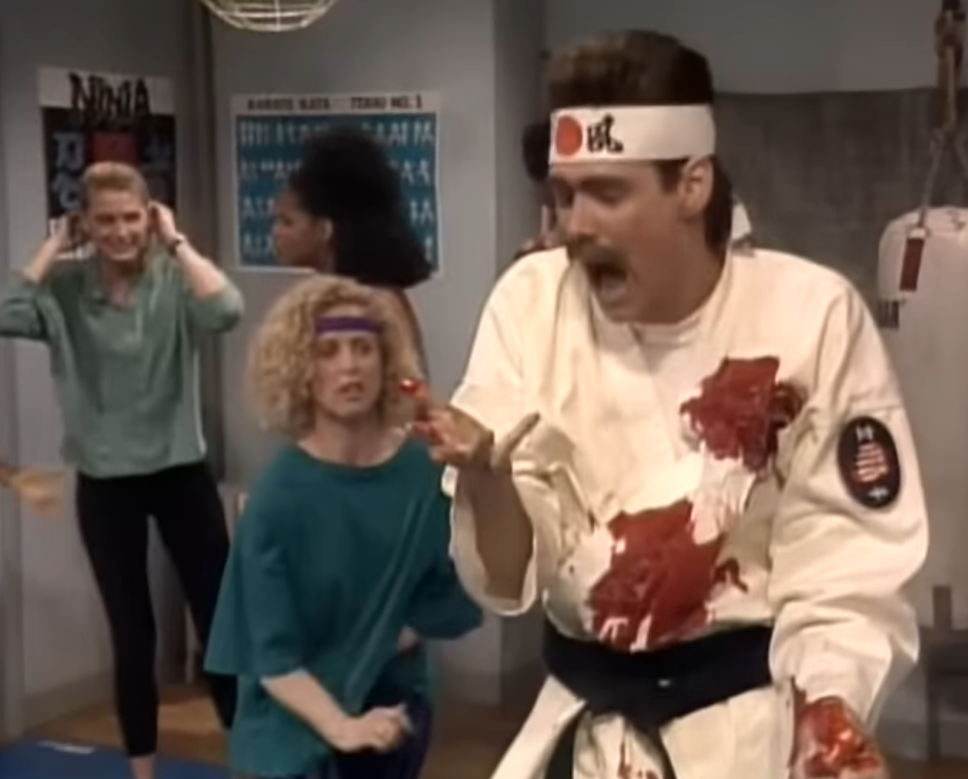
When this sketch aired on May 19, 1990, Jim Carrey had not yet achieved the enormous Hollywood success that would define his career.
He was still developing his reputation through television appearances and comedic performances.
But his potential was already unmistakable.
The exaggerated movements, wild expressions, and fearless commitment seen in Bob Jackson would later become familiar features of Carrey’s most famous movie characters.
In 1994, Carrey experienced an extraordinary breakthrough with Ace Ventura: Pet Detective, The Mask, and Dumb and Dumber.
Those films helped establish him as one of America’s most recognizable comedy stars.
Yet anyone familiar with his early In Living Color work could see the foundations of that success years earlier.
Bob Jackson is an excellent example.
Carrey doesn’t need an elaborate costume, complicated special effects, or an enormous movie budget.
He simply needs a ridiculous character, a strong comedic premise, and enough room to unleash his imagination.
The result is unforgettable.
Why In Living Color Was Such a Special Comedy Show
Premiering on Fox in April 1990, In Living Color introduced television audiences to a fresh and energetic form of sketch comedy.
Created by Keenen Ivory Wayans, the series featured an extraordinary ensemble of performers, including Damon Wayans, Kim Wayans, David Alan Grier, Tommy Davidson, T’Keyah Crystal Keymáh, and Jim Carrey.
The show blended celebrity impressions, cultural satire, musical performances, and outrageous original characters.
What made it distinctive was its willingness to experiment.
It didn’t always rely on traditional punchlines.
Sometimes the funniest moments came from watching an absurd personality collide with an ordinary situation.
The karate instructor sketch demonstrates that approach beautifully.
A self-defense class is a perfectly normal setting.
A confident martial arts teacher is a familiar character.
But placing Jim Carrey in the instructor’s role and revealing that the supposed expert cannot defend himself transforms the ordinary premise into something hilarious.
It’s a simple idea executed with extraordinary energy.
The Secret Behind the Sketch’s Perfect Comedy Timing
Great sketch comedy often relies on escalation.
A small problem appears.
The character attempts to solve it.
That solution creates an even bigger problem.
And the situation continues getting worse until the entire premise collapses.
Bob Jackson’s self-defense lesson follows this formula perfectly.
His confident introduction establishes expectations.
The first demonstration challenges them.
His ridiculous excuses make the situation funnier.
The students become increasingly suspicious.
And finally, his reputation begins to fall apart.
Each development builds naturally on what came before.
Just when viewers think Bob cannot embarrass himself any further, he finds a new way to make the situation even more ridiculous.
That structure is what makes the performance so satisfying.
The audience isn’t merely laughing at a series of unrelated jokes.
They’re watching a spectacularly overconfident character slowly lose control of the image he’s created for himself.
And Carrey makes every stage of that collapse entertaining.
Why This 1990 Comedy Sketch Still Feels Hilarious Today
More than three decades later, the humor still works because the character represents something everyone recognizes.
We’ve all encountered someone who speaks with enormous confidence despite having questionable expertise.
Someone who refuses to admit mistakes.
Someone who always has an explanation for why things went wrong.
Bob Jackson takes those familiar personality traits and exaggerates them into absurdity.
His inability to acknowledge his failures becomes the driving force behind the comedy.
And the audience doesn’t need detailed knowledge of martial arts to understand the joke.
The instructor claims to be unstoppable.
The students discover otherwise.
He keeps making excuses.
It’s a beautifully simple comedic formula.
The sketch also provides a wonderful reminder of the early 1990s, when television audiences regularly discovered outrageous characters through weekly sketch shows.
For longtime fans, watching Carrey as Bob Jackson brings back an era when In Living Color was helping redefine American television comedy.
For younger viewers, it’s an opportunity to discover the incredible talent that made Jim Carrey famous.
Final Thoughts: The Worst Karate Instructor Might Be One of Jim Carrey’s Funniest Characters!
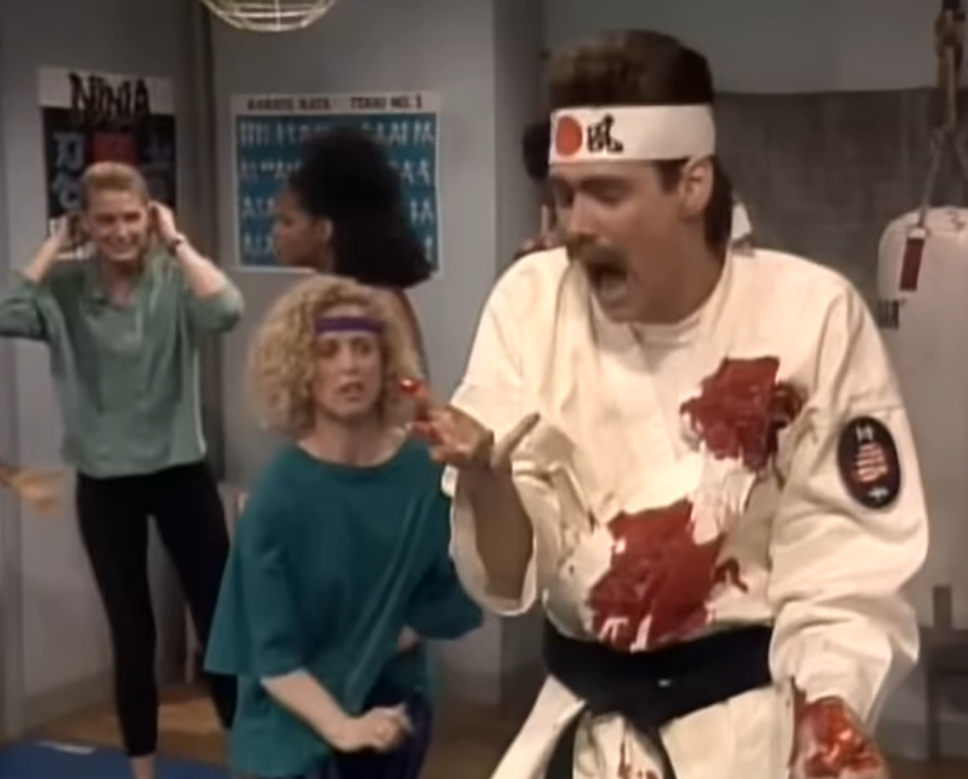
Jim Carrey’s performance as Bob Jackson proves that sometimes the funniest characters are the ones who take themselves far too seriously.
Bob believes he’s an extraordinary martial arts master.
He thinks his experience makes him unbeatable.
And he expects his students to admire his incredible abilities.
Unfortunately for him, reality has other plans.
The result is a wonderfully ridiculous self-defense lesson filled with physical comedy, outrageous excuses, and unforgettable reactions.
What makes the sketch especially entertaining is Carrey’s complete dedication to the character.
He never abandons Bob’s overconfidence, even when the evidence against him becomes overwhelming.
And that’s where the biggest laughs come from.
One self-proclaimed karate champion. One classroom full of skeptical women. And a demonstration that goes hilariously wrong.
It’s the perfect recipe for classic In Living Color comedy.
Whether you grew up watching Jim Carrey on television or discovered him through his Hollywood movies, this early sketch deserves a place on your must-watch list.
Because long before he became Ace Ventura or Stanley Ipkiss, Jim Carrey was already proving that he could turn an ordinary situation into a comedy masterpiece.
Watch the FULL karate instructor sketch and see why this disastrous self-defense class remains such a hilarious reminder of Jim Carrey’s early genius!
And here’s the question every fan should answer:
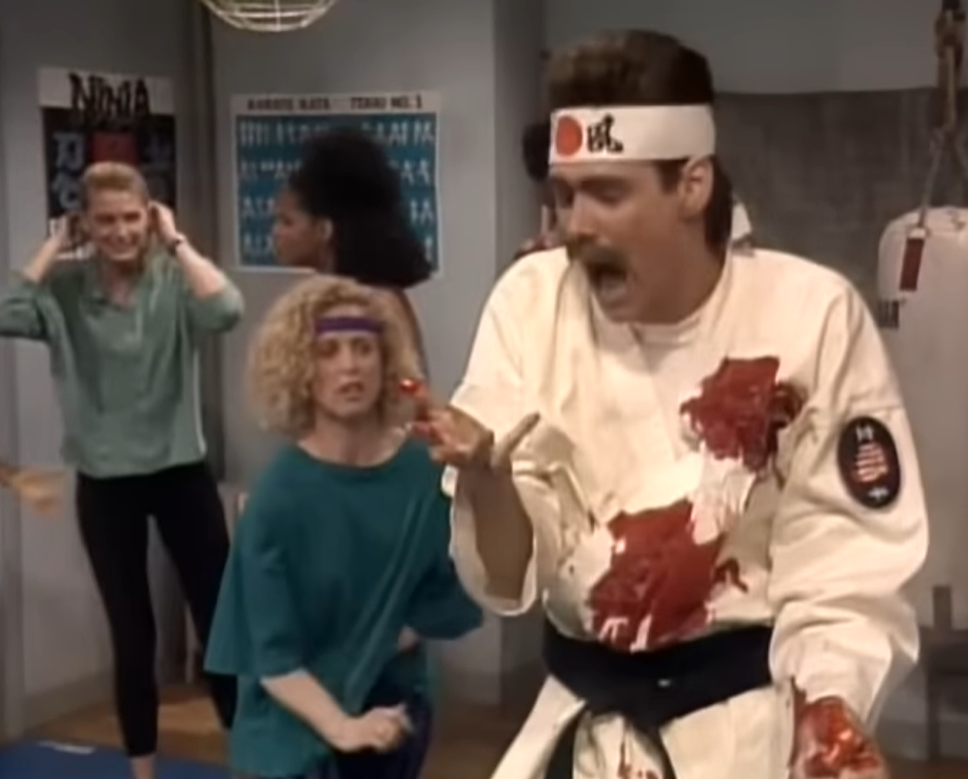
Was Bob Jackson Jim Carrey’s most ridiculous In Living Color character, or does Fire Marshal Bill still hold the championship belt?
#JimCarrey #InLivingColor #KarateInstructor #BobJackson #ClassicComedy #90sComedy #JimCarreyFans #ComedyLegend #FunnyMoments #90sNostalgia #OldSchoolComedy #ClassicTV #AmericanComedy #RetroComedy #ComedyGold #HollywoodLegends #MustWatch