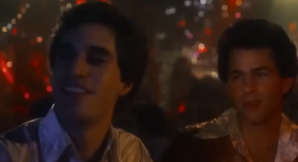
The moment John Travolta steps onto the dance floor alone in Saturday Night Fever, Tony Manero stops being an ordinary young man from Brooklyn and becomes the most important person in the room.
No speech announces it.
Nobody needs to explain it.
The crowd simply moves away.
The floor opens.
The music takes over.
And Tony begins to dance.
For the next few minutes, everything we need to understand about Tony Manero is communicated through movement.
Outside the nightclub, Tony’s life is frustratingly limited.
He works at a paint store.
He argues with his family.
He spends time with friends who are themselves trying to figure out what adulthood is supposed to look like.
His future isn’t clearly defined.
His confidence can sometimes feel larger than his actual circumstances.
But inside the disco, none of that matters.
On this floor, Tony knows exactly who he is.
That is what makes the famous solo much more than a showcase for John Travolta’s dancing.
It is character development without dialogue.
Tony doesn’t simply enjoy dancing.
He needs dancing.
The dance floor is the place where his confidence becomes real.
And Travolta makes us believe that transformation instantly.
Look at his posture.
The Tony who walks through ordinary Brooklyn and the Tony who controls the disco floor are recognizably the same person, but their relationship with the world feels completely different.
Here, Tony isn’t reacting to somebody else’s expectations.
Everybody else is reacting to him.
The nightclub becomes Tony’s kingdom.
People watch.
Friends stand aside.
Women notice him.
Other dancers give him space.
The lights seem to belong to him.
Tony may not have much authority anywhere else in his life, but the moment the music begins, he has status.
John Travolta understood that the scene couldn’t simply look like an actor performing memorized choreography.
Tony had to look as though these movements belonged to him.
That distinction required enormous preparation.
Travolta already had an instinct for movement, but preparing for Saturday Night Fever pushed him into much more demanding dance training.
Deney Terrio played an important role in building that vocabulary.
Travolta trained extensively with Terrio before filming.
The objective wasn’t merely to memorize fashionable disco steps.
The movement needed personality.
Tony Manero couldn’t dance like a professional Broadway performer who had wandered into a Brooklyn nightclub.
He needed to look like Tony.
Then choreographer Lester Wilson helped transform those individual movements into cinematic performance.
That contribution is crucial.
Dancing well in a room and dancing effectively for a movie camera are different challenges.
The movement has to communicate through framing.
Transitions matter.
Silhouettes matter.
The relationship between the dancer and the surrounding crowd matters.
Wilson helped give the dance an internal structure.
Travolta later explained that he needed an idea behind his dancing.
That makes perfect sense when watching the sequence.
The solo doesn’t feel like a random collection of impressive moves.
It has progression.
Tony enters.
Establishes control.
Builds momentum.
Changes direction.
Shows another side of his movement.
Then pushes further.
Every section tells us that Tony knows the audience is watching.
This isn’t private dancing.
Tony is performing.
And he loves performing.
That slight awareness of the crowd gives the scene its swagger.
Then there is the famous pointing gesture.
One arm up.
The other direction down.
The hips following the rhythm.
It became one of the most recognizable dance images of the 1970s.
You can reduce the silhouette to a few simple lines and people still recognize it.
That is visual-icon territory.
But the gesture works because Travolta commits completely to it.
There is no irony.
Tony isn’t joking about disco.
He isn’t embarrassed by the movement.
He believes in it.
That sincerity is enormously important.
Modern audiences sometimes view disco through decades of parody and nostalgia.
The clothes.
The lights.
The hairstyles.
The music.
The dance moves.
They have been copied and exaggerated so many times that it can be easy to forget how seriously Saturday Night Fever treats Tony’s relationship with dancing.
The movie doesn’t present the dance floor merely as a joke about the 1970s.
For Tony, this matters.
The nightclub is one of the few places where effort produces immediate recognition.
If he dances well, people see it.
If he owns the floor, the room acknowledges it.
There is clarity here that doesn’t exist elsewhere in his life.
That is why the crowd surrounding the floor is so important.
They aren’t just background extras.
They create Tony’s status.
Their attention tells us what his dancing means inside this community.
Tony isn’t imagining that he is special here.
Everyone else behaves as though he is.
Director John Badham understands that Travolta’s entire body has to remain central to the sequence.
Dance loses much of its power if the viewer cannot understand the performer’s relationship with space.
Tony’s footwork matters.
His shoulders matter.
His hips matter.
His arms matter.
The transitions between them matter.
We need the whole performer.
Travolta reportedly cared deeply about exactly that issue.
He had worked too hard on the dancing for the performance to become merely a collection of close-ups.
He wanted audiences to see that he was actually doing it.
That insistence was important.
The scene works because we believe the body.
There is no separation between Tony and the dance.
Travolta doesn’t appear to be waiting for editing to make him look impressive.
He has to carry the sequence physically.
That creates credibility.
And credibility is what allows the dance to reveal character.
If viewers were distracted by obvious cinematic tricks, the sequence would become spectacle.
Instead, we watch Tony.
The dance tells us something about him.
His style combines control with aggression.
Tony isn’t floating gently around the floor.
His movements have attack.
He hits positions.
He changes levels.
He uses his shoulders and torso.
He travels across the space confidently.
There is masculine swagger in the performance that matches the character’s personality.
Yet there is also elegance.
That combination is one reason Travolta became such a compelling screen dancer.
He could make athletic movement look smooth.
He could transition between strong gestures and lighter footwork without appearing to become a different performer.
Travolta’s face is performing too.
This is sometimes overlooked because the body attracts so much attention.
Tony doesn’t look frightened by the crowd.
He doesn’t appear to be counting steps.
He looks comfortable.
That expression sells the illusion that dancing is simply something Tony does.
The preparation disappears inside the character.
That is one of the great paradoxes of performance.
The more work required to make something look effortless, the less the audience should notice the work.
Travolta trained.
Practiced.
Repeated.
Refined.
Then Tony simply dances.
The music is equally inseparable from the sequence.
“You Should Be Dancing” supplies exactly the kind of propulsion Tony needs.
The Bee Gees’ rhythm doesn’t merely accompany the scene.
It helps define its identity.
Movie and music became so culturally intertwined that separating them now is almost impossible.
That relationship between the Bee Gees and Saturday Night Fever helped create one of cinema’s most famous soundtrack identities.
The music gives the film a pulse.
But Travolta gives that pulse a body.
That is the exchange.
You hear the beat.
Then Tony shows you what the beat looks like.
The scene also demonstrates why John Travolta became a movie star rather than simply a television actor who happened to get a successful film role.
Movie stardom is difficult to define.
It isn’t identical to acting ability.
It isn’t identical to attractiveness.
It isn’t identical to charisma.
It is some strange combination of presence, timing and the camera’s fascination with a person.
During Tony’s solo, the camera is fascinated with Travolta.
So is the audience.
He can hold the frame without dialogue.
That is star power in one of its purest forms.
Travolta was only in his early twenties when he made the film.
Yet the performance doesn’t feel tentative.
He commits to Tony’s confidence completely.
That confidence became essential because the character himself depends on the difference between how powerful he feels inside the disco and how uncertain his life becomes outside it.
The brighter Tony shines on the dance floor, the more complicated the rest of his world becomes.
That contrast prevents Saturday Night Fever from becoming simply a feature-length celebration of disco.
The dancing is exhilarating.
Tony’s life isn’t always.
The movie needs both realities.
If Tony were equally confident everywhere, the dancing wouldn’t mean as much.
If he had an exciting career, complete emotional maturity and a clear future, the nightclub would simply be entertainment.
Instead, it becomes escape.
Identity.
Recognition.
Possibility.
The dance floor offers Tony a version of himself that he wants to believe can exist beyond the club.
That is why the solo contains a subtle sadness underneath all its excitement.
The audience sees someone completely in control.
But we know that control has boundaries.
The music will stop.
The lights will come up.
Tony will have to leave.
For these few minutes, however, none of that exists.
There is only rhythm.
Confidence.
Movement.
Attention.
Tony controls the present moment completely.
That is perhaps the most seductive fantasy inside the entire disco sequence.
Not fame.
Not romance.
Not even dancing itself.
Control.
Tony knows exactly what to do next.
Life rarely provides that feeling.
A choreographed dance can.
The sequence also captures something important about the cultural energy of disco.
The dance floor allowed ordinary people to become performers.
You didn’t need to be a professional entertainer.
The club itself provided the stage.
Lights transformed the room.
Music transformed movement.
Clothing became costume.
For a few hours, identity could become theatrical.
Tony Manero embodies that possibility more dramatically than almost anyone.
His famous white suit would eventually become the defining costume associated with the film, but even before that climactic image, Travolta establishes Tony as someone who understands the nightclub as performance space.
He enters it differently.
He walks differently.
He moves differently.
Tony isn’t simply attending the disco.
Tony is appearing at the disco.
There is a difference.
The scene’s influence became enormous because the movie turned a particular moment in dance culture into a universally understandable image.
Even people who have never watched the entire film often recognize Travolta’s pose.
The image escaped the movie.
It became posters.
Parodies.
Television references.
Advertisements.
Halloween costumes.
Dance-floor imitations.
But cultural familiarity can sometimes hide how good the original performance actually is.
When an image has been copied thousands of times, we stop looking at it carefully.
Return to the original sequence and watch Travolta rather than the icon.
The precision becomes visible again.
Notice how confidently he changes direction.
Notice how he uses the available floor.
Notice how movements flow into one another.
Notice how rarely he appears to be preparing for the next step.
Notice how the upper body continues performing even when the feet are doing the complicated work.
That is not accidental coolness.
It is practiced coolness performed so effectively that it appears accidental.
That may be one of the best definitions of movie-star dancing.
The sequence also owes something important to dance traditions beyond the simplified popular image of disco.
The creative influences surrounding Travolta’s performance included modern, jazz and street-dance traditions.
Lester Wilson brought significant professional experience to the film, while Terrio helped develop Travolta’s individual movement vocabulary.
Tony’s dancing emerged from that mixture.
That history makes the sequence richer than the stereotype it later became.
The pointing pose may be remembered as “the disco move,” but the full performance contains far more variety.
Watch the entire body rather than waiting for the famous pose and a much more sophisticated dance performance appears.
Travolta himself deserves enormous credit for turning all that instruction into character.
Technique alone isn’t enough.
Tony Manero has to emerge from the technique.
And he does.
You can imagine another character dancing the same choreography and producing an entirely different scene.
Tony dances with hunger.
He wants the room.
He wants attention.
He wants admiration.
Perhaps more deeply, he wants evidence that he matters.
On the dance floor, he receives it.
That emotional hunger connects the solo to the rest of the film.
Tony isn’t simply showing off.
Showing off is part of how he constructs identity.
The clothes matter.
The hair matters.
The walk matters.
The dancing matters.
Presentation gives Tony a form of power.
That famous opening walk through Brooklyn and the dance-floor solo are therefore closely related.
In both scenes, Travolta communicates through movement before dialogue becomes important.
Tony walks as though the street belongs to him.
Later, he dances as though the club belongs to him.
The difference is that on the dance floor, everyone else seems to agree.
That is where John Travolta becomes inseparable from Tony Manero.
The character needed an actor who could communicate arrogance without becoming completely unlikable.
Vulnerability without becoming weak.
Physical confidence without looking professionally polished beyond the character’s world.
Travolta found that balance.
And audiences responded.
The film transformed him from an already popular young performer into an international movie star and earned him an Academy Award nomination for Best Actor.
But statistics and awards only explain part of what happened.
The dance explains the rest.
Movie history occasionally produces scenes where an actor and a role seem to arrive at exactly the right cultural moment.
Travolta.
Tony Manero.
Brooklyn.
Disco.
The Bee Gees.
Change any one of those ingredients and the result might have been different.
Together, they became iconic.
Nearly half a century later, Tony’s solo still doesn’t need explanation.
The crowd clears.
The music starts.
Travolta steps forward.
Within seconds, we understand the hierarchy of the room.
Tony Manero may spend much of Saturday Night Fever wondering where he belongs in the world.
But during this dance, there is absolutely no uncertainty.
For a few unforgettable minutes, Tony doesn’t need to find his place—he owns it.