
Some Western movie scenes need spectacular gunfights, dramatic music, and dozens of armed cowboys to create unforgettable tension. But sometimes, all it takes is one familiar face walking through a doorway.
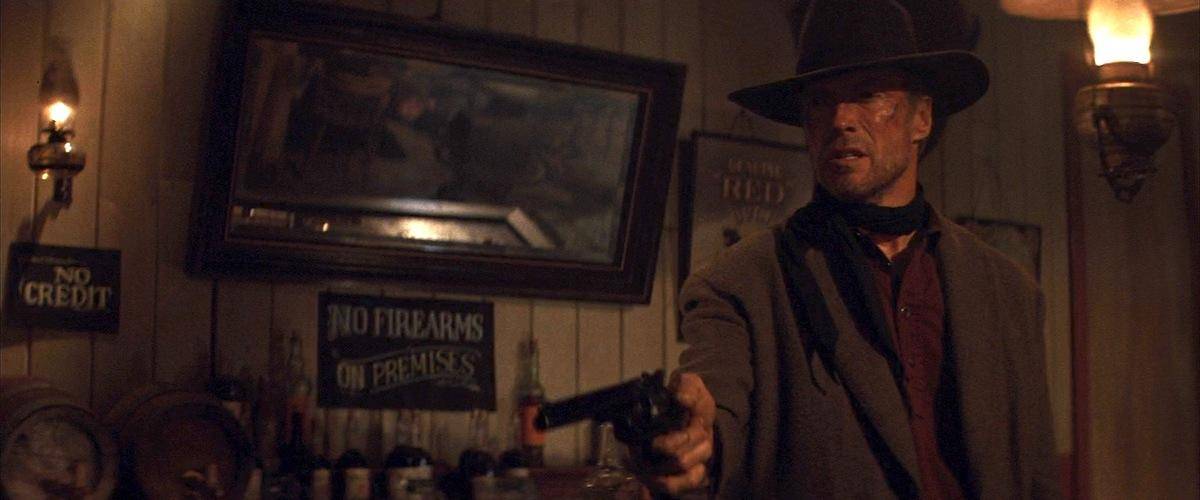
That is exactly what happens in Unforgiven (1992), when Clint Eastwood’s William Munny enters a saloon during a violent storm. Carrying a shotgun and wearing an expression that reveals almost nothing, he immediately changes the atmosphere inside the room.
Nobody welcomes him. Nobody celebrates his arrival. Instead, the men inside slowly realize that the dangerous outlaw they have heard about is standing right in front of them.
Waiting for him is Little Bill Daggett, played brilliantly by Gene Hackman. The sheriff believes he has control over the town and everyone living in it. But when Munny arrives, that confidence is about to be tested.
More than three decades later, this confrontation remains one of the most powerful moments in Western movie history.
William Munny Was Supposed to Be a Different Man
At the beginning of Unforgiven, William Munny is hardly the legendary gunfighter audiences might expect from a Clint Eastwood Western.
He is an aging farmer struggling to raise his children after the death of his wife. His farm is unsuccessful, his physical condition is deteriorating, and his former reputation as a ruthless outlaw seems like something from another lifetime.
Munny repeatedly acknowledges that his late wife helped him become a better person. He abandoned drinking and violence, attempting to build a peaceful life far away from the brutal world he once inhabited.
However, financial difficulties eventually push him toward one final bounty assignment.
Initially, Munny struggles with almost everything. He has difficulty controlling his horse, his shooting abilities appear rusty, and even riding across the countryside becomes a challenge.
The transformation is deliberately slow.
Director Clint Eastwood wants viewers to believe that the old gunfighter has genuinely changed.
But the past is never completely buried.
The Death of Ned Logan Changes Everything
One of the most important relationships in the movie is the friendship between William Munny and Ned Logan, portrayed by Morgan Freeman.
Ned accompanies Munny on the bounty mission, but the two men approach violence differently. While Munny is willing to return to his old profession, Ned eventually becomes uncomfortable with what they are doing.
Their journey takes a tragic turn when Little Bill’s men capture Ned.
The sheriff subjects him to brutal punishment, and Ned eventually dies from his injuries.
When Munny learns what happened to his friend, the peaceful farmer disappears.
The news brings back memories of the violent man he once was. He begins drinking again, picks up his weapons, and prepares to confront the people responsible.
This is the turning point that makes the final saloon sequence so powerful.
Munny is no longer simply a man looking for money.
He has come for revenge.
The Saloon Door Opens—and the Entire Room Changes
The final confrontation takes place during a storm in Big Whiskey.
Inside the saloon, Little Bill and several other men are gathered together. The atmosphere is tense, but nobody expects the situation to change dramatically.
Then William Munny walks through the door.
There is no elaborate entrance or dramatic announcement. Eastwood relies on his character’s appearance and the reaction of everyone inside the room.
Munny carries himself differently now.
His movements are controlled, his expression is cold, and his voice carries the unmistakable confidence of someone who has already accepted the consequences of what he is about to do.
He asks who owns the establishment.
After learning the answer, he makes his intentions unmistakably clear.
“I’m here to kill you, Little Bill.”
The line is delivered without unnecessary shouting or theatrical excitement.
That restraint makes it even more intimidating.
Munny is not trying to impress anyone. He has come to finish something, and the people standing between him and Little Bill are about to discover how serious he is.
A Gunfight That Refuses to Look Like a Hollywood Fantasy

One of the most remarkable aspects of Unforgiven is its treatment of violence.
Traditional Western movies often portrayed gunfighters as almost invincible characters. They could draw weapons in an instant, defeat multiple opponents, and walk away from spectacular shootouts without suffering serious consequences.
Eastwood deliberately challenges that image.
The saloon gunfight is chaotic, frightening, and unpredictable.
Men struggle to find their weapons. Shots are fired in panic. People hesitate, and the confined space makes every movement dangerous.
There is no graceful choreography that makes violence appear beautiful.
Instead, viewers experience the confusion and brutality of a real confrontation.
Munny’s experience gives him an advantage, but he is not presented as a superhero. He is a man who understands what happens when guns are drawn and who knows that hesitation can be fatal.
This grounded approach makes the sequence far more disturbing than an ordinary action scene.
Clint Eastwood’s Expression Says More Than a Thousand Words
By 1992, Clint Eastwood had already become one of Hollywood’s most recognizable Western icons.
Audiences knew him from Sergio Leone’s legendary Dollars Trilogy and from his unforgettable portrayal of Inspector Harry Callahan in the Dirty Harry films.
His screen presence was built around quiet confidence, controlled movements, and an ability to communicate danger without saying very much.
William Munny takes those qualities in a darker direction.
He is older than many of Eastwood’s previous action heroes, and his history makes him more complicated.
When Munny enters the saloon, Eastwood does not need exaggerated expressions to communicate his intentions.
A look beneath the brim of his hat is enough.
His low voice and deliberate movements create an atmosphere of genuine danger.
The audience understands that the man standing in front of Little Bill is not simply another cowboy looking for trouble.
He is someone whose reputation has been earned through years of violence.
Gene Hackman Makes Little Bill a Worthy Opponent

The final showdown would not have the same impact without Gene Hackman’s outstanding performance.
Little Bill Daggett is more than a typical Western villain. He is the sheriff of Big Whiskey, a man who believes that maintaining order sometimes requires extreme brutality.
He considers himself capable of recognizing dangerous men and controlling them.
Throughout the movie, Little Bill demonstrates his authority by humiliating and punishing people who challenge him.
He has little respect for the romantic stories surrounding famous gunfighters.
But William Munny is different.
When the two finally face each other, Little Bill discovers that the reputation he dismissed may have been more accurate than he imagined.
Hackman plays the sheriff with a mixture of arrogance, intelligence, and desperation.
His performance earned him the Academy Award for Best Supporting Actor, one of four Oscars awarded to Unforgiven.
The film also won Best Picture and Best Director for Clint Eastwood, cementing its place among the greatest Westerns ever made.
“Deserve’s Got Nothing to Do With It”
After the gunfight, one of the movie’s most unforgettable exchanges takes place.
Little Bill is wounded and knows that his situation is hopeless.
He tells Munny that he does not deserve what is happening to him.
Munny responds with a sentence that has become one of the defining lines of Western cinema:
“Deserve’s got nothing to do with it.”
The statement is short, but its meaning is enormous.
Throughout Unforgiven, almost every character has a personal explanation for their actions.
Little Bill believes his brutality is necessary to maintain order. Munny accepts the bounty job because he needs money. Later, revenge becomes the driving force behind his return to violence.
Nobody sees themselves as entirely responsible for the suffering they cause.
Munny’s response cuts through those excuses.
In his world, consequences do not disappear simply because someone believes they had a reason.
It is a chilling reminder that violence creates damage that cannot easily be repaired.
The Ending Is as Powerful as the Shootout
After the confrontation, Munny does not celebrate his victory.
He leaves the saloon and warns the remaining townspeople against threatening him or his family.
The storm continues, and the town remains silent.
There is no traditional heroic celebration, no cheering crowd, and no suggestion that everything has suddenly become right.
Munny rides away, leaving Big Whiskey behind.
His victory feels unsettling because viewers understand what it cost him to return to the person he once was.
He has avenged Ned, but he has also abandoned the peaceful identity he spent years building.
That emotional complexity is what separates Unforgiven from many conventional Westerns.
Why William Munny’s Final Showdown Still Gives Audiences Chills
More than 30 years after its release, Unforgiven continues to attract fans because its strongest moments depend on character rather than spectacle.
The saloon confrontation has everything a memorable movie scene needs: an unforgettable entrance, an intimidating villain, powerful performances, genuine tension, and dialogue that stays with viewers long after the credits roll.
Clint Eastwood proves that a legendary Western character does not need to be young, invincible, or constantly pulling a gun to command attention.
Sometimes, the most frightening character in the room is the one who barely moves.
Gene Hackman provides the perfect opponent, while the film’s realistic approach to violence gives the confrontation emotional weight.
Ultimately, William Munny’s arrival is not simply the return of an old gunslinger.
It is the return of a man who knows exactly what he has become—and is no longer pretending otherwise.
The saloon door opens, the room falls silent, and Clint Eastwood reminds everyone why his name became synonymous with the American Western.
Some legends never need an introduction. They simply walk through the door.