
Some of the greatest moments in Western movie history do not begin with a gunshot. They begin with an insult, a knowing smile, and a man who refuses to let disrespect go unanswered.
That is exactly what makes Clint Eastwood’s unforgettable encounter in A Fistful of Dollars (1964) so remarkable. In a film filled with dangerous outlaws, ruthless criminals, and unpredictable confrontations, one seemingly ordinary exchange involving a mule becomes a defining moment for one of cinema’s most recognizable Western heroes.
More than six decades later, the scene still carries an extraordinary amount of attitude. Its combination of dark humor, quiet confidence, and explosive action demonstrates why Eastwood’s Man with No Name became such an enduring figure in popular culture.
A Stranger Who Refuses to Play by the Rules
When the mysterious gunslinger arrives in the lawless town of San Miguel, he quickly discovers that respect is something rarely offered to outsiders.
The town is controlled by two rival families, the Baxters and the Rojos, whose violent competition has turned everyday life into a dangerous struggle for survival. Most people avoid getting involved, knowing that even a small disagreement can end in bloodshed.
But the stranger is different.
He does not appear interested in following anyone’s rules, and he certainly has no intention of allowing a group of arrogant gunmen to intimidate him.
The trouble begins when several men decide to make fun of him. Instead of confronting the stranger directly, they fire their weapons near his mule, frightening the animal and turning the situation into a public joke.
For them, it is harmless entertainment.
For the stranger, however, it becomes an opportunity to demonstrate exactly why underestimating him is a terrible mistake.
The Power of Saying Very Little
What makes this sequence so entertaining is how calmly Eastwood approaches the confrontation.
Rather than immediately reaching for his revolver, he returns to the men with an almost amusing explanation. His mule, apparently, does not appreciate being laughed at.
It is an unusual excuse, delivered with a completely straight face.
The humor comes from the contrast between the seriousness of the situation and the ridiculous reason Joe gives for confronting the gunmen. Everyone watching understands that the mule is not really the issue. The real problem is that these men have mistaken his silence for weakness.
Eastwood’s performance makes the exchange even more effective. His expression barely changes, his voice remains controlled, and his movements are deliberate.
He never needs to announce how dangerous he is.
That confidence is precisely what makes the character intimidating. While the gunmen rely on their numbers and their reputation, Joe seems entirely comfortable standing alone.
Sergio Leone’s Masterclass in Western Tension
Director Sergio Leone understood that a great Western confrontation did not need constant movement or endless dialogue.
Sometimes, the most exciting part of a gunfight happens before anyone draws a weapon.
In A Fistful of Dollars, Leone uses pauses, facial expressions, camera angles, and carefully controlled pacing to make even the smallest interaction feel significant.
The camera repeatedly draws attention to the characters’ eyes, forcing viewers to study every reaction. A slight change in expression can suddenly feel more important than an entire conversation.
This approach became one of the defining characteristics of the Spaghetti Western.
Unlike many traditional American Westerns, which often presented heroes and villains through clearer moral distinctions, Leone’s films embraced morally complicated characters and a harsher frontier atmosphere.
His protagonists were not necessarily noble defenders of justice. They were survivors who understood the value of timing, intelligence, and self-preservation.
Joe perfectly represents this new kind of Western hero.
Three Coffins and a Deadly Sense of Humor
Perhaps the most memorable part of the sequence comes when Joe approaches the local undertaker.
With remarkable calmness, he requests three coffins, suggesting that the confrontation has already been decided in his mind.
It is a wonderfully dark joke.
The undertaker has every reason to be confused, but Joe behaves as though he is simply arranging an ordinary delivery. His casual attitude makes the prediction even more chilling.
Then the violence finally erupts.
The gunmen discover that their confidence has been misplaced. Joe moves with extraordinary speed, drawing his revolver and dispatching his opponents before they can properly respond.
The entire confrontation is over almost as quickly as it began.
But Leone saves one final moment for the audience.
As Joe passes the undertaker, he realizes that his original estimate was incorrect. There is one additional body to account for.
His brief correction about needing another coffin transforms an already memorable gunfight into a perfectly timed cinematic punchline.
It is not simply a clever line. It is the final expression of the character’s personality: dangerous, observant, sarcastic, and completely unbothered.
Clint Eastwood Created a Different Kind of Western Icon

Before A Fistful of Dollars, Western heroes were often associated with traditional ideas of courage, morality, and justice.
Eastwood helped introduce something different.
His Man with No Name was mysterious, unpredictable, and difficult to understand. He rarely explained his motivations, and audiences were left to interpret his actions through his behavior rather than his words.
That mystery became a major part of his appeal.
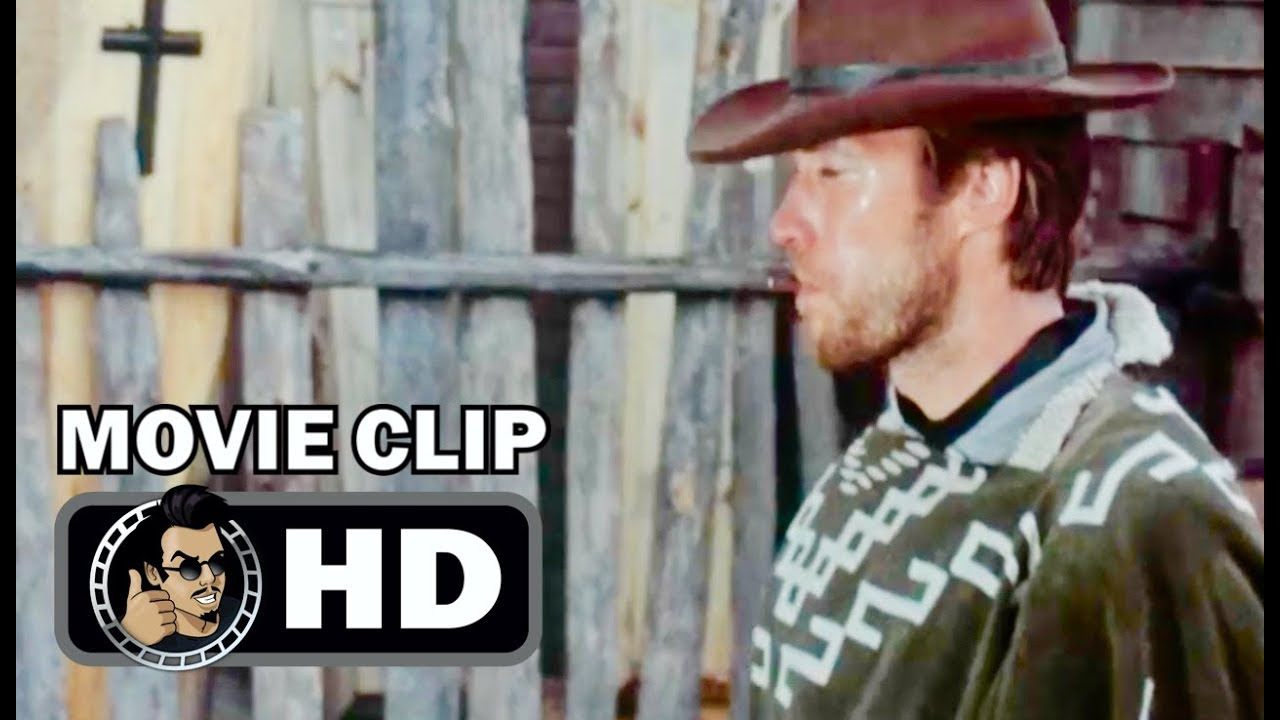
His distinctive appearance, including the weathered poncho, cigarillo, and unmistakable squint, helped establish an image that would become synonymous with the Spaghetti Western.
More importantly, Eastwood demonstrated how much personality an actor could communicate through restraint.
A raised eyebrow, a brief pause, or a subtle movement toward his holster could completely change the atmosphere of a scene.
It was a style of performance that influenced generations of action heroes.
Why the Scene Still Works for Modern Audiences
The lasting appeal of the mule confrontation goes beyond nostalgia for classic Western cinema.
Its structure is remarkably effective even by modern storytelling standards.
First, the audience sees an act of disrespect. Then comes the stranger’s unexpected response, followed by a gradual increase in tension. Finally, the confrontation delivers an explosive payoff and a humorous final line.
Everything happens for a reason, and nothing feels unnecessary.
This is also why the scene works so well when shared through short video clips on platforms such as YouTube, TikTok, and Instagram. Even viewers unfamiliar with the entire movie can immediately understand the situation.
The stranger has been mocked, he calmly returns, and the people responsible quickly discover that they have chosen the wrong target.
There is something universally satisfying about watching an arrogant group lose its confidence when confronted by someone who refuses to be intimidated.
Modern films and television continue to explore similar characters: quiet individuals whose abilities become obvious only when circumstances force them into action. The influence of Eastwood’s Western persona can be felt across countless stories featuring mysterious loners, reluctant heroes, and highly capable outsiders.
A Small Moment That Became Western Movie History

The genius of A Fistful of Dollars is that it understands the importance of character.
Joe does not need a lengthy introduction or an elaborate explanation of his past. Within a single encounter, viewers understand his humor, his confidence, and the danger hidden beneath his relaxed exterior.
That is the real achievement of the mule scene.
It takes an apparently insignificant incident and transforms it into a defining moment for a legendary movie character.
Sergio Leone’s direction, Clint Eastwood’s minimalist performance, and the film’s distinctive sense of dark humor combine to create a sequence that remains entertaining decades after its original release.
The Western genre has produced countless famous gunfights, memorable heroes, and unforgettable one-liners. Yet this particular confrontation continues to stand out because it proves that the most intimidating person in the room is not always the loudest.
Sometimes, all it takes is a quiet stranger, an offended mule, and a perfectly timed remark to remind everyone who really controls the situation.
And that is exactly why Clint Eastwood’s legendary Western attitude never gets old.