Few movie scenes have managed to capture the imagination of audiences quite like John Travolta and Uma Thurman’s unforgettable dance in Pulp Fiction (1994). What began as a playful moment inside a fictional retro restaurant eventually became one of the most recognizable sequences in Hollywood history.
But there is something even more entertaining about the story behind the dance. Years after the film became a cultural phenomenon, Travolta returned to the movements during a television appearance, proving that he had not forgotten a single step.
Instead of simply reminiscing about his famous role as Vincent Vega, the actor decided to become a dance instructor. His demonstration turned an ordinary talk-show conversation into a hilarious lesson in classic dance moves.
And for fans who grew up watching Travolta on the big screen, it was a wonderful reminder of why his connection to dancing remains so special.
The Magic Behind Vincent And Mia’s Dance
The original sequence takes place at Jack Rabbit Slim’s, an unusual restaurant filled with vintage Hollywood references and retro entertainment.
Vincent Vega accompanies Mia Wallace to the restaurant, where the two eventually enter a dance contest.
What follows is not a traditional Hollywood musical performance.
There are no elaborate formations or complicated dance combinations. Instead, Travolta and Thurman perform a series of playful movements while maintaining the personalities of their characters.
Their expressions remain relatively serious, even as their bodies move to the music.
That contrast creates much of the scene’s humor.
Professional dancers and choreographers Lauren Yalango-Grant and Christopher Grant later analyzed the sequence, highlighting how the performers respond to one another rather than simply following a fixed routine.
One movement inspires another.
A gesture becomes a reaction.
The performers continually exchange energy, creating something that feels like a physical conversation.
This interaction is one of the reasons the dance remains so entertaining decades after its release.
Why Quentin Tarantino Chose John Travolta
Casting Travolta as Vincent Vega was an inspired decision.
Long before Pulp Fiction, the actor had already established himself as one of Hollywood’s most recognizable dancing stars.
His performance as Tony Manero in Saturday Night Fever (1977) made him an international sensation. His portrayal of Danny Zuko in Grease (1978) further demonstrated his ability to combine charisma, music, and movement.
However, Vincent Vega was a completely different character.
He was a criminal, not a musical performer. He approached life with a relaxed attitude and rarely appeared impressed by anything around him.
That made the sudden appearance of his dancing ability particularly surprising.
Tarantino understood that Travolta could bring something unique to the scene. The actor had the experience to perform the movements naturally while making them feel appropriate for Vincent.
Rather than looking like a traditional dance routine, the sequence became an unexpected expression of the character’s personality.
It was familiar enough to remind audiences of Travolta’s earlier career, yet unusual enough to feel completely different.
Uma Thurman Brought Her Own Personality To The Dance
Travolta deserves plenty of credit, but Uma Thurman was equally important to the success of the sequence.
As Mia Wallace, Thurman brings a playful confidence that immediately changes the atmosphere.
Mia is interested in dancing, and she encourages Vincent to participate.
She does not simply copy his movements or follow his lead. Instead, she contributes her own gestures and expressions, creating a natural exchange between the characters.
Their chemistry makes the performance believable.
Travolta’s movements are energetic and playful, while Thurman’s reactions give the scene an additional layer of humor.
Neither performer seems overly concerned with looking perfect.
They are simply enjoying the music.
That relaxed interaction is what makes the sequence feel like a genuine moment between two characters rather than a dance inserted solely to entertain the audience.
Chuck Berry’s Music Completed The Scene
Another essential ingredient was the song.
The sequence features Chuck Berry’s classic rock-and-roll track, “You Never Can Tell.”
Its upbeat rhythm and nostalgic sound fit perfectly with the atmosphere of Jack Rabbit Slim’s.
The music provides a foundation for the performers without overwhelming their movements.
It also reinforces the film’s fascination with popular culture from earlier decades.
Travolta and Thurman do not need to perform an elaborate routine to hold the audience’s attention. The music, their expressions, and the unusual choreography work together naturally.
It is a simple combination, but the result is unforgettable.
Even hearing the opening of the song can immediately bring Vincent and Mia’s dance floor performance to mind.
When John Travolta Became The Dance Instructor
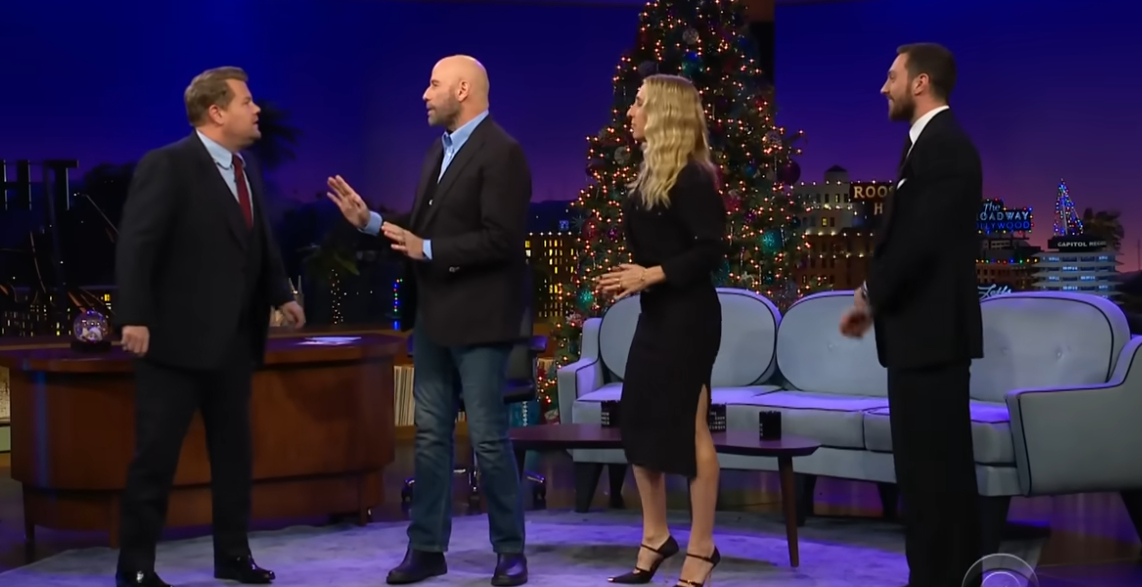
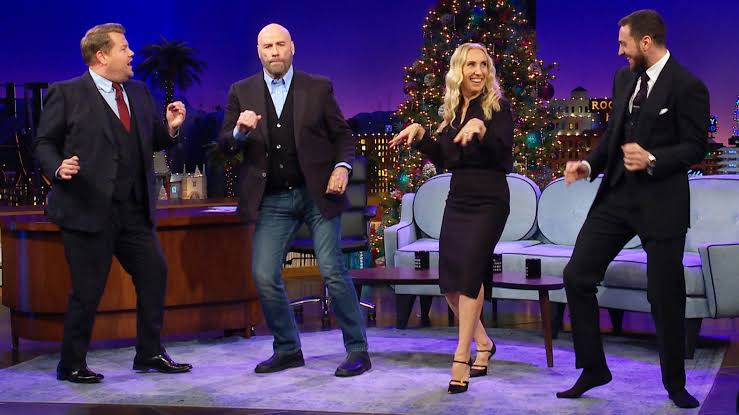
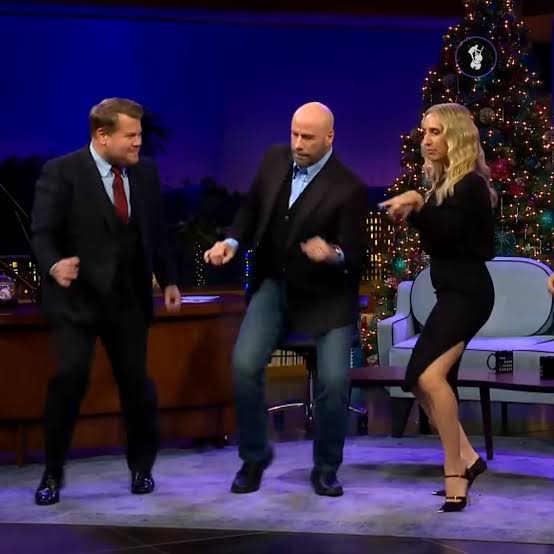
Years after the film’s release, Travolta revisited the famous movements during a 2019 appearance on The Late Late Show with James Corden.
The conversation turned toward Pulp Fiction, and naturally, the subject of the dance sequence came up.
The actor was asked whether he still remembered the moves.
Travolta made it clear that he did.
Then came the moment that made the segment particularly entertaining.
He offered to teach the audience.
Rather than simply explaining the choreography, Travolta began demonstrating the movements himself.
He started with the Twist before introducing several other familiar novelty dances, including the Jerk, the Hitchhiker, the Mashed Potatoes, and the Batman.
The other participants attempted to follow his instructions, creating a lively and amusing dance lesson.
For viewers, the appeal was immediate.
The person demonstrating these movements was not just another television guest. He was the same actor who had helped turn the dance at Jack Rabbit Slim’s into a cinematic legend.
Travolta Made Every Move Look Effortless
Perhaps the most enjoyable part of the television appearance was how naturally Travolta performed the movements.
He did not appear embarrassed about revisiting a famous moment from his past.
Instead, he seemed genuinely enthusiastic about sharing the dances with everyone in the room.
His confidence reflected years of experience as a performer.
The movements came naturally, and his explanations made the steps feel accessible rather than intimidating.
There was also something nostalgic about watching him demonstrate the dances.
Audiences could see the connection between the young Travolta who became famous through Saturday Night Fever and the older actor who could still move comfortably in front of a live audience.
His performance reminded everyone that dancing was never simply an occasional part of his career.
It was one of the things that helped define him as an entertainer.
A Few Minutes Of Dancing Became Pop Culture History
The influence of the Pulp Fiction dance scene has extended far beyond the original film.
Vincent Vega and Mia Wallace have become instantly recognizable Halloween costume choices.
Movie fans recreate the movements at parties, dance events, and online videos.
The sequence has also inspired countless references in television, advertising, comedy, and popular entertainment.
What makes this particularly remarkable is that the original performance lasts only a few minutes.
There are no spectacular special effects or complicated musical arrangements.
Just two actors, a memorable song, and a collection of playful dance movements.
Yet those ingredients were enough to create something that audiences continue celebrating more than three decades later.
The scene has become a reminder that sometimes the smallest moments in a movie can have the longest cultural lives.
https://youtu.be/5bvl0nU9uFQ?si=13Oe1xocloMKTa8V
The Story Behind The Dance Makes It Even Better
One of the most interesting details about the sequence is how Travolta’s personal experience helped shape it.
The idea was influenced by the novelty dances that were popular during earlier decades.
Tarantino wanted the Twist, and Travolta was familiar with the dance movements of that era.
He brought additional ideas to the director, helping develop the playful collection of steps that eventually appeared in the film.
This background makes the 2019 television demonstration even more enjoyable.
Fans are not simply watching an actor recreate an old performance.
They are seeing him share some of the history and inspiration behind it.
The famous dance was not built around complicated technical skills. It grew from an appreciation of music, movement, and the kind of entertainment that encourages people to participate.
That personal connection helps explain why Travolta could return to the routine years later with such ease.
John Travolta Still Knows How To Entertain
Many actors have memorable scenes that audiences associate with their careers.
However, relatively few can revisit those moments decades later and demonstrate exactly what made them special.
Travolta is one of them.
His television dance lesson brought together nostalgia, humor, and a fascinating glimpse into the creative process behind Pulp Fiction.
It also reminded viewers of the extraordinary range of his career.
From the disco floor in Saturday Night Fever to the musical numbers in Grease and the unexpected dance contest in Pulp Fiction, Travolta has repeatedly shown that movement can be just as expressive as dialogue.
The Vincent Vega routine may have been filmed in 1994, but its appeal has never disappeared.
And watching Travolta teach those familiar steps again proves that some performances are simply timeless.
If you could join John Travolta for a personal dance lesson, which classic move would you choose first: the Twist, the Hitchhiker, the Mashed Potatoes, or the Batman?