William Wallace’s Final Moments — The Braveheart Scene That Proves Freedom Is Worth More Than Life
A wounded warrior lies before his executioners. A crowd watches as his final moments approach. And in the middle of an overwhelming tragedy, William Wallace delivers one of the most powerful messages in movie history: the human spirit cannot always be conquered by force.
Few films have left audiences with an ending as emotional as Braveheart (1995).
Directed by and starring Mel Gibson, the historical epic follows a dramatized version of Scottish warrior William Wallace and his struggle against English rule.
The film is remembered for its enormous battles, passionate speeches, and unforgettable characters.
But its final execution sequence is different.
There are no armies charging across the battlefield.
No swords clashing between opposing warriors.
Instead, the film focuses on a man whose physical strength is almost gone, but whose determination remains unbroken.
It is a moment that continues to move audiences decades after the movie’s release.
A Warrior Who Has Reached His Final Battle
Throughout Braveheart, William Wallace faces extraordinary danger.
He leads Scottish fighters against powerful English forces.
He survives brutal battles and experiences devastating personal losses.
His courage inspires ordinary people who have spent their lives under the authority of powerful rulers.
But Wallace’s journey eventually brings him into captivity.
His enemies believe they have finally defeated him.
He is no longer leading an army.
He cannot escape through strength or military strategy.
And he is surrounded by people who control his fate.
Yet the film makes one thing clear.
Wallace’s greatest strength was never simply his ability to fight.
It was his refusal to abandon what he believed in.
The Execution Scene Changes Everything
The sequence takes place before a large crowd gathered to witness Wallace’s punishment.
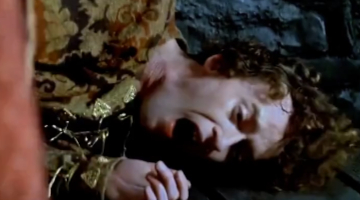
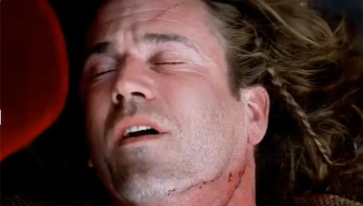
He lies on a wooden platform, visibly injured and exhausted.
His face bears the marks of suffering.
Around him, spectators watch with expressions ranging from curiosity to discomfort.
The atmosphere is tense.
The executioners have physical control over Wallace.
But the emotional power of the scene comes from his resistance.
Even when he can no longer fight back, he refuses to give his captors the surrender they want.
This contrast makes the moment unforgettable.
His body has been weakened.
His spirit has not.
The Crowd Begins to Understand
One of the most powerful aspects of the sequence is the reaction of the people watching.
At first, the gathering resembles a public spectacle.
But as Wallace’s suffering continues, the atmosphere begins to change.
Faces in the crowd reveal growing discomfort and sympathy.
Some spectators appear deeply affected by what they are witnessing.
The film shifts attention away from the executioners and toward the ordinary people.
Their expressions become an essential part of the storytelling.
Wallace’s suffering is no longer just a punishment carried out before an audience.
It becomes a moment that forces the witnesses to confront his courage.
The crowd may have gathered to watch a condemned man.
But they are witnessing someone who refuses to abandon his beliefs.
Mel Gibson’s Most Emotional Performance
Mel Gibson’s portrayal of William Wallace is filled with dramatic intensity.
During the battle sequences, he communicates anger, confidence, and determination.
He becomes a commanding figure capable of inspiring hundreds of warriors.
But in the execution scene, his performance is far more vulnerable.
Wallace is physically helpless.
His breathing is strained.
His face reveals tremendous pain.
And yet his eyes continue to communicate resolve.
The contrast between suffering and determination gives the scene its emotional power.
Gibson does not portray Wallace as someone who is unaffected by pain.
He portrays him as someone who experiences fear and suffering but refuses to surrender his deepest convictions.
That distinction makes the character feel human.
The Meaning of Freedom
Freedom is the central theme of Braveheart.
For Wallace, it is not simply a political slogan.
It represents the right of people to live without domination and to determine their own future.
Throughout the film, he repeatedly risks his life for that belief.
The execution sequence brings his commitment to its ultimate test.
He is offered the possibility of ending his suffering through submission.
But he refuses to give up the principle that has defined his journey.
His famous cry of “Freedom!” becomes the emotional climax of the film.
It is a single word that expresses everything he has fought for.
And it transforms a moment of apparent defeat into an unforgettable act of defiance.
The People Who Witness His Sacrifice
The film also shows how Wallace’s fate affects those connected to his struggle.
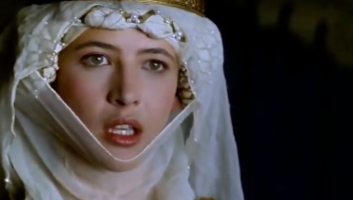
Robert the Bruce appears burdened by the consequences of earlier decisions and the responsibility of Scotland’s future.
His expressions suggest a man confronting the meaning of courage and loyalty.
The crowd, meanwhile, becomes a reminder that Wallace’s actions have reached far beyond the battlefield.
People who never fought beside him can still be moved by his determination.
His sacrifice becomes something others must remember.
This is an important part of the film’s emotional message.
A person may lose the ability to continue fighting, but the ideas that inspired the struggle can survive.
A Moment of Love and Memory
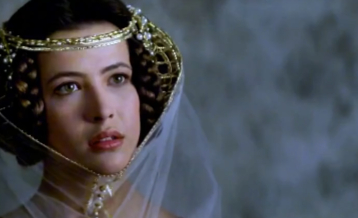
As Wallace approaches death, the film connects his final moments with memories of the people he has loved.
His relationship with Murron has shaped much of his journey.
Her loss helped turn his personal grief into resistance.
The emotional imagery surrounding the ending reminds viewers that Wallace is more than a warrior.
He is also a man who has experienced love, loss, and longing.
Those memories give the sequence a deeply personal dimension.
The struggle for Scotland’s freedom may have become larger than his individual life.
But his humanity remains at the center of the story.
The audience is reminded of everything he has sacrificed along the way.
Why the Ending Is So Heartbreaking
Many heroic films conclude with the main character defeating an enemy and returning home victorious.
Braveheart takes a different approach.
Wallace does not survive to enjoy the freedom he has fought for.
His personal story ends in tragedy.
Yet the film refuses to present his death as meaningless.
Instead, it suggests that courage can influence people long after a person’s life has ended.
His determination becomes a source of inspiration.
His refusal to surrender becomes a symbol.
And his final moments leave an emotional impression that the film’s battle sequences alone could never achieve.
The Legacy of William Wallace
The historical William Wallace was a Scottish leader who resisted English rule during the Wars of Scottish Independence.
Although Braveheart takes significant liberties with historical events, its cinematic portrayal has introduced generations of viewers to his story.
The movie’s version of Wallace represents courage, sacrifice, and the desire for independence.
These themes help explain why the film continues to attract audiences.
Viewers may remember the battles.
They may admire the speeches.
But many are most deeply affected by the ending.
Because the final scene asks a question that reaches beyond the film itself.
What does a person truly believe in when everything else has been taken away?
They Could End His Life, But Not His Legacy
The final moments of William Wallace are among the most memorable scenes in 1990s cinema.
The wooden platform, the watching crowd, the exhausted warrior, and the emotional reactions all contribute to an unforgettable conclusion.
Wallace can no longer command an army.
He cannot defeat his captors through force.
But he can still refuse to surrender the belief that has guided his life.
And that is why the scene remains so powerful.
THEY COULD SILENCE WILLIAM WALLACE’S VOICE… BUT THEY COULD NEVER SILENCE THE DREAM OF FREEDOM HE LEFT BEHIND.
Did William Wallace’s final scene bring tears to your eyes? And do you think Braveheart has one of the most powerful endings in movie history? Share your thoughts in the comments!
#Braveheart #WilliamWallace #MelGibson #Freedom #EpicMovies #MovieLegends #90sCinema