John Travolta Traded Disco for Cowboy Boots — And Made the Texas Two-Step Unforgettable! 🤠❤️🔥
One legendary Hollywood star. One crowded Texas honky-tonk. And a dance floor filled with cowboy hats, country music, and irresistible nostalgia. In Urban Cowboy (1980), John Travolta proved that his dancing charisma wasn’t limited to disco. Sometimes, all it takes is a pair of cowboy boots and the right rhythm to create movie magic.
When the Disco King Became a Texas Cowboy
By 1980, John Travolta was already one of Hollywood’s most recognizable stars.
His performances in Saturday Night Fever and Grease had established him as an actor who could command attention through music and movement.
But Urban Cowboy offered something different.
Instead of performing beneath a disco ball, Travolta entered the world of country music, western fashion, and Texas dance halls.
He played Bud Davis, a young man who moves to the Houston area and becomes immersed in the nightlife surrounding Gilley’s, a famous honky-tonk.
For Bud, the club is more than a place to relax.
It becomes the setting for friendships, romantic encounters, jealousy, and important personal decisions.
And the dance floor is where much of that world comes alive.
Gilley’s: The Heart of Urban Cowboy
One of the most memorable elements of Urban Cowboy is its setting.
Gilley’s feels like a real social world rather than a carefully arranged movie backdrop.
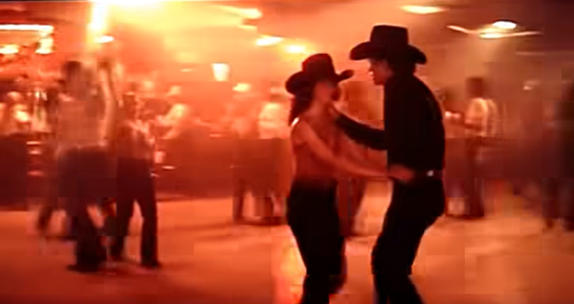
Cowboy hats fill the room.
Friends gather around the bar.
Live music sets the rhythm.
And couples move across the dance floor with the familiarity of people who have spent countless evenings dancing together.
The atmosphere is lively without feeling overly polished.
The crowded room gives the film a sense of authenticity.
Every conversation seems to happen within a larger community.
Every dance feels like part of a familiar tradition.
And every song has the potential to change the mood of the evening.
One Conversation Before the Music Takes Over
The scene begins near the bar, where Bud exchanges looks and words with a woman in western clothing.
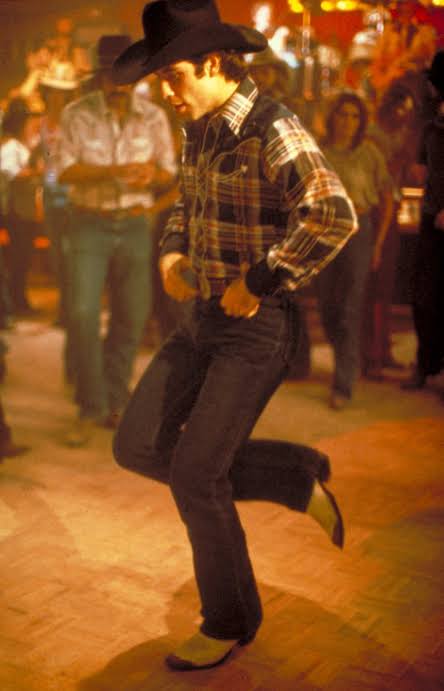
Travolta wears a dark shirt and black cowboy hat, giving his character an unmistakably confident appearance.
But the encounter isn’t simply romantic.
There is tension beneath the conversation.
The characters’ expressions suggest emotions that are not fully explained by their words.
Around them, the bar remains busy.
Other patrons talk, move through the room, and enjoy the evening.
That constant background activity makes the exchange feel natural.
It is one personal moment unfolding inside a crowded nightlife setting.
And that is part of what makes Urban Cowboy distinctive.
The film blends intimate relationship drama with the energy of a place that never seems to stop moving.
When the Fiddle Starts Playing
As the focus shifts toward the musicians, the atmosphere begins to change.
A fiddle player appears, emphasizing the importance of live country music to the scene.
The music isn’t simply background decoration.
It brings people together.
It gives the dancers a shared rhythm.
And it transforms the room from a collection of separate conversations into one lively social experience.
Country music has always played an important role in the film’s identity.
Its soundtrack helps establish the world Bud enters and the culture surrounding him.
When the dancing begins, the connection between music and community becomes unmistakable.
The Magic of the Texas Two-Step
Unlike the dramatic solo choreography audiences associated with Travolta’s earlier dance films, the Texas two-step is built around partnership.
Couples move together across the floor, adjusting their steps to the music and to one another.
The basic rhythm is approachable, but experienced dancers can add turns, variations, and individual style.
That flexibility makes the dance visually appealing.
No two couples move in exactly the same way.
Some dance closely.
Others create more space.
And the entire floor becomes a shifting pattern of movement.
In Urban Cowboy, the dancing feels social rather than theatrical.
The pleasure comes from watching people share a rhythm.
It isn’t about one person dominating the room.
It is about the energy created when everyone joins in.
Cowboy Hats, Boots, and an Unforgettable Look
The film’s western fashion is just as important as its music.
Black and white cowboy hats stand out against the warm lighting.
Western shirts, denim, and boots create a distinctive visual identity.
These details immediately communicate the culture of the honky-tonk.
The clothing isn’t simply decorative.
It reflects the environment and the people who belong to it.
When the camera moves across the dance floor, the hats and shoulders create recognizable silhouettes.
The result is an atmosphere that feels unmistakably Texan.
Urban Cowboy helped bring this western look to mainstream audiences in 1980.
Its influence extended beyond movie theaters, contributing to renewed interest in country music, western clothing, and honky-tonk dancing.
The Warm Glow of a Classic Dance Floor
One of the most beautiful aspects of the scene is its lighting.
As couples begin dancing, orange and red tones fill the room.
The warm colors create an inviting atmosphere.
Cowboy hats catch the light.
Dancers move through shadows.
And the crowded floor seems to glow with energy.
The camera alternates between closer moments and wider views of the dance hall.
That contrast allows viewers to appreciate both the personal interactions and the larger atmosphere.
A close-up reveals a character’s expression.
A wide shot reveals the entire room moving together.
Together, they create a sense of place that is difficult to forget.
Why John Travolta’s Presence Still Matters
Travolta’s performance connects Urban Cowboy to an important period in Hollywood history.
He had already become famous for portraying characters whose identities were closely connected to music and dancing.
But Bud Davis was different from Tony Manero in Saturday Night Fever.
Bud’s world revolves around country traditions, personal pride, and complicated relationships.
His dancing is part of a social environment rather than a solo performance designed to impress a crowd.
That difference gives Urban Cowboy its own identity.
Travolta remains charismatic, but he is no longer simply the center of the dance floor.
He is part of a larger world filled with people, music, and shared experiences.
Why Urban Cowboy Still Feels Special
More than four decades after its release, Urban Cowboy continues to evoke nostalgia for a particular style of American nightlife.
The film captures the excitement of crowded dance halls, live country music, and the relationships that develop in those spaces.
Its dance scenes are memorable because they feel accessible.
Viewers can imagine themselves standing near the bar.
They can imagine hearing the band begin another song.
And they can imagine stepping onto the floor with someone special.
That sense of participation makes the movie’s atmosphere timeless.
Sometimes the Best Movie Magic Is Simple
Not every unforgettable movie moment needs spectacular choreography or dramatic action.
Sometimes, a scene works because it captures the feeling of being somewhere special.
Urban Cowboy does exactly that.
It brings together a lively honky-tonk, a talented cast, memorable country music, and the unmistakable charisma of John Travolta.
The result is a dance sequence that celebrates more than movement.
It celebrates community, romance, and the joy of sharing a moment through music.
JOHN TRAVOLTA MAY HAVE BECOME FAMOUS ON THE DISCO FLOOR… BUT HE BROUGHT JUST AS MUCH MAGIC TO THE TEXAS HONKY-TONK! 🤠❤️🔥
👀 WHICH TRAVOLTA ERA DO YOU LOVE MORE — SATURDAY NIGHT FEVER OR URBAN COWBOY? AND CAN YOU DANCE THE TEXAS TWO-STEP? 💃👇
#UrbanCowboy #JohnTravolta #TexasTwoStep #CountryMusic #ClassicMovies #80sCinema #CowboyCulture #HollywoodLegends