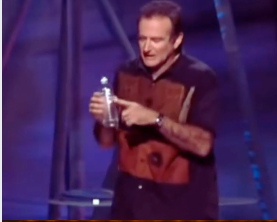
His physical movements made his characters even more entertaining. Robin Williams understood that comedy was not only about words, but also about the way a character moved, reacted, and occupied a scene. His body could become another important part of his performance, allowing him to communicate emotions before he even said a single word. A simple gesture, sudden turn, exaggerated expression, or unusual movement could instantly make an ordinary moment much funnier.
One of the most impressive aspects of his physical comedy was his ability to move with incredible energy. He could suddenly change his posture, facial expression, or body language to match the personality of the character he was playing. These changes often happened so quickly that audiences had to pay close attention to catch every detail. His movements were rarely random because they usually reflected the personality, emotions, or situation of the character.
Williams also knew how to use exaggeration without completely losing the sense of realism. When a character became nervous, excited, confused, or surprised, his physical reactions could become much larger than those of an ordinary person. This exaggeration created a visual layer of comedy that made his performances easy to remember. Even when the dialogue was simple, his body language could turn the scene into something much more dynamic.
His facial expressions were especially important to this style of comedy. His eyes could become wide with surprise, his face could suddenly change from serious to ridiculous, and his expression could communicate confusion without requiring any explanation. These tiny changes often worked together with his movements to create a complete comedic performance. Viewers could understand what his character was feeling simply by watching his face.
Another strength was his ability to use sudden changes in movement. Williams could remain relatively still for a moment and then explode into energetic action. That contrast made his physical comedy even more effective. The audience might expect a normal reaction, only to see him respond with an exaggerated gesture or unexpected movement. The surprise itself became part of the joke.
He also used physical movement to make his characters feel different from one another. Instead of giving every character the same body language, he adjusted his movements according to the role. Some characters appeared restless and energetic, while others could seem awkward, nervous, or completely unpredictable. This attention to physical detail helped each character develop a distinct identity.
His performances often demonstrated how much information can be communicated without dialogue. A character walking into a room, sitting in a chair, looking around, or reacting to another person could become a comedic moment in his hands. Williams could turn ordinary physical actions into memorable pieces of performance because he understood timing and exaggeration. He knew when to move quickly and when to slow down for maximum comic effect.
This talent was particularly effective when combined with his improvisational ability. Because he was comfortable reacting spontaneously, his physical movements could appear completely natural even when they were highly exaggerated. He seemed willing to follow an unexpected idea wherever it led. A small movement could become a larger reaction, and that reaction could develop into an entire comedic sequence.
Robin Williams also understood the importance of rhythm. Physical comedy depends heavily on timing, and he had an extraordinary sense of when to pause, accelerate, stop, or suddenly change direction. Sometimes the funniest moment came from the fraction of a second before he reacted. That brief pause allowed the audience to anticipate something before he delivered an unexpected physical response.
His body language could also make emotional scenes more powerful. Although he was famous for comedy, his physical acting was not limited to jokes. A quiet posture, hesitant movement, or subtle change in expression could reveal vulnerability and uncertainty. This demonstrated that his physical performance had depth beyond simple slapstick humor.
Ultimately, Robin Williams’ physical movements became an essential part of his identity as a performer. His comedy worked because his voice, face, body, timing, and imagination often seemed to operate together as one expressive instrument. He could make audiences laugh through a sentence, a facial expression, or even a completely unexpected movement. That remarkable physical energy helped transform his characters from scripted roles into vivid personalities that audiences could remember long after the performance ended.