Some television pairings don’t need an elaborate sketch to be entertaining.
Put two naturally funny people together, give them a question, and simply wait.
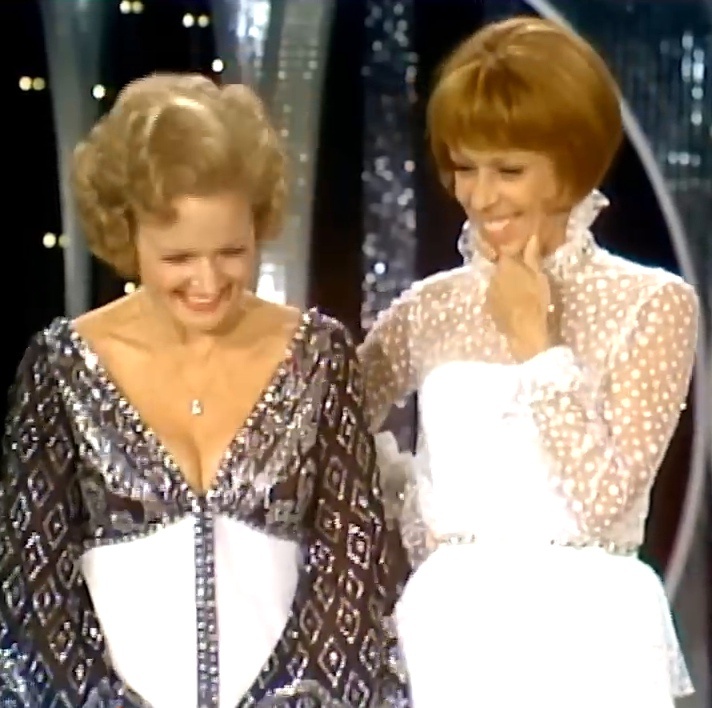
That’s exactly the kind of magic that happened whenever Carol Burnett and Betty White shared a stage.
Both women became television legends, but their comedy styles weren’t identical. Carol could be huge, physical and wonderfully expressive. Betty possessed another weapon: she could deliver something mischievous while looking completely innocent.
When those styles met, the results could be irresistible.
Two Comedy Legends, One Stage
Seeing Carol and Betty standing beside each other feels special today because both women came to represent an enormous part of American television comedy.
But their relationship wasn’t merely professional.
In a later interview preserved by PBS’s American Masters, Betty remembered watching The Carol Burnett Show and described it as essential Saturday-night television. She also recalled how much fun she had when Carol first invited her onto the program.
Most importantly, Betty said that after they met, they became “real good friends.”
That friendship helps explain the ease visible when they’re together.
They aren’t fighting for attention.
They’re playing.
Betty White Understood Carol’s Greatest Strength
Betty had particularly insightful things to say about Carol’s relationship with her audience.
She believed television worked best when performers remembered they weren’t really speaking to an enormous crowd at home.
They were speaking to individuals.
According to Betty, that warmth was one of Carol’s greatest strengths: viewers felt as though Carol was right there in the room with them.
That observation gets to the heart of The Carol Burnett Show.
Carol wasn’t simply performing at people.
She made viewers feel included.
The Famous Audience Q&A
One of the show’s signature devices was Carol’s interaction with the studio audience.
The questions weren’t merely decoration before the “real” entertainment began.
They became entertainment themselves.
Carol couldn’t know exactly what someone would ask.
That uncertainty created genuine spontaneity.
In an interview, Carol recalled initially being nervous about the concept: she worried both that nobody would ask anything and that somebody actually would. Once the show had been running for several weeks, however, audiences began arriving prepared with questions.
The result was something difficult to manufacture with a script.
Real surprise.
Betty Appreciated That Risk
Betty specifically praised these Q&A segments.
She explained that they gave viewers the opportunity to see Carol Burnett herself, rather than only Carol playing a funny character.
And because nobody knew exactly what would be asked, audiences could enjoy watching Carol figure out how to respond.
That’s an important distinction.
A written punchline can be rehearsed.
A spontaneous reaction cannot.
You either have the instinct or you don’t.
Carol had it.
And Betty certainly had it too.
Betty White’s Secret Weapon
Betty’s comedy often depended on contrast.
She could look warm.
Friendly.
Perfectly respectable.
Then she would say something completely unexpected.
That gap between appearance and dialogue became one of her greatest comic tools.
You could see the punchline coming and still laugh because Betty’s delivery made it feel effortless.
Or, even better, you wouldn’t see it coming at all.
She Didn’t Need to Shout
Some comedians signal the joke.
Their voice changes.
Their expression announces that something funny is coming.
Betty often did the opposite.
She could remain almost completely composed.
That’s what made the eventual line land.
The audience wasn’t simply responding to the words.
They were responding to Betty White saying those words as though nothing unusual had happened.
Carol Knew How to Set Up Another Performer
Another quality that made Carol extraordinary was her generosity onstage.
A star doesn’t always need to have the final punchline.
Sometimes the funniest thing a performer can do is create the opportunity for somebody else to deliver it.
Carol understood that.
Her variety show was filled with performers whose individual strengths were allowed to shine.
She later rejected the idea that her supporting cast should be considered “second bananas,” describing the program instead as a true repertory company in which different performers could take the spotlight depending on the sketch.
That philosophy explains a lot about the show’s chemistry.
The Friendship Makes It Better
There’s also something enjoyable about watching two performers who genuinely like each other.
You can often sense it before anyone says anything funny.
There’s less tension about who gets the laugh.
Instead, one performer creates something and the other builds on it.
Carol and Betty could do that naturally.
Betty’s later recollections of their friendship reinforce what viewers can see onscreen: the affection wasn’t merely part of a television performance.
Two Very Different Paths to a Laugh
Carol was famous for physical comedy.
Her face could become a punchline.
Her body language could transform a simple entrance.
Put her in an absurd Bob Mackie costume and she could generate laughter before speaking.
Betty often worked differently.
She could stand almost perfectly still.
Smile.
Wait.
Then destroy the room with one sentence.
Neither method is inherently better.
Together, they created contrast.
Why Their Comedy Has Aged So Well
Many television jokes are tied closely to the year in which they were written.
A celebrity reference disappears.
A political reference becomes obscure.
A trend stops being recognizable.
But personality lasts longer.
The humor of watching Carol and Betty interact doesn’t depend entirely on understanding 1970s popular culture.
You can watch the expressions.
You can hear the timing.
You can understand the relationship between setup and response.
That’s why short clips featuring performers like these continue to find audiences decades later.
Betty’s Innocence Was Often a Trap
One of the funniest things about Betty White was how effectively she could use her wholesome image against an audience.
People saw sweetness.
Betty knew they saw sweetness.
Then she could exploit that expectation.
A mischievous remark becomes twice as funny when delivered by someone who looks as though she couldn’t possibly have meant anything naughty.
That became an essential part of Betty’s comedic identity.
Carol Could Play the Perfect Straight Woman
Carol was obviously capable of being the wildest performer in a sketch.
But she also knew when not to do that.
If Betty had the joke, Carol didn’t need to compete.
She could react.
A raised eyebrow or quick glance could be enough.
That skill is easy to underestimate.
Great comedy isn’t simply knowing how to get a laugh.
It’s knowing whose laugh the moment belongs to.
The Show Allowed Real Personalities Through
This is one reason Betty admired Carol’s Q&A format.
The audience got glimpses of the actual performers behind the costumes.
Betty later explained that this format allowed people to see Carol not merely as “the funny lady,” but as herself and to watch how she responded in real time.
That made viewers feel closer to her.
It also meant that when a guest like Betty joined her, audiences could enjoy something different from a conventional scripted sketch.
Before Social Media, Television Had Moments Like This
Today, audiences love short unscripted exchanges.
They become Reels.
TikToks.
YouTube Shorts.
Millions of people watch a celebrity’s ten-second reaction rather than an entire interview.
The technology is new.
The appeal isn’t.
Classic variety television already understood that sometimes the most memorable moment isn’t the elaborate production.
It’s the moment when something unexpected happens and a naturally funny person responds.
That’s Why This Clip Works as a Reel
Your clip has a major advantage for Facebook:
Carol Burnett + Betty White are immediately recognizable to the target nostalgia audience.
Then the headline promises a question for Betty.
That creates curiosity.
What will she say?
The viewer doesn’t need complicated background information.
They simply need to stay long enough to hear Betty’s response.
That’s exactly the kind of structure that works for a short nostalgia clip.
Betty’s Own Words Explain the Magic
Years later, Betty described Carol as someone who made viewers feel like friends invited into the room.
That’s a beautiful description of what made this era of television special.
There was spectacle, certainly.
There were enormous costumes, musical numbers and elaborate sketches.
But there was also intimacy.
A performer could stand in front of an audience and simply talk.
And if the performers happened to be Carol Burnett and Betty White, that could be more than enough.
Two Legends Having Fun
That’s ultimately what makes these moments worth revisiting.
We aren’t only watching famous television stars.
We’re watching two gifted comedians who understand timing, audience expectations and each other.
Carol creates the opening.
Betty waits.
The audience listens.
And then comes the response.
No elaborate set is necessary.
No complicated premise is required.
Just Carol Burnett, Betty White and impeccable comic timing.
Sometimes that’s all television needs. 😂❤️