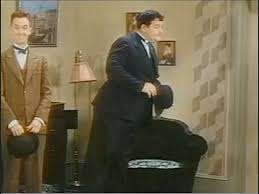
Unaccustomed As We Are (1929) is one of the most memorable early films featuring the legendary comedy duo Stan Laurel and Oliver Hardy. Released during an important transitional period in Hollywood history, the film captures Laurel and Hardy at a fascinating moment as silent-era comedy was beginning to embrace synchronized sound. Although short in length, the film demonstrates many of the characteristics that would make the duo internationally famous: escalating misunderstandings, physical comedy, awkward social
situations, unforgettable characters, and the remarkable chemistry between Laurel and Hardy.
The story begins with Stan Laurel and Oliver Hardy as two friends whose simple attempt to enjoy a social visit quickly turns into complete chaos. Their intentions are innocent enough, but their inability to behave normally in a polite domestic environment creates one comic disaster after another. The humor comes not only from what they do, but also from how seriously they react to increasingly ridiculous circumstances. Their contrasting personalities make the situation even funnier. Hardy often tries to appear respectable, confident, and sophisticated, while Laurel behaves with an innocent confusion that repeatedly makes everything worse.
One of the most interesting aspects of Unaccustomed As We Are is its place in film history. Released in 1929, the movie belongs to the early sound era. Laurel and Hardy had already developed their distinctive silent-comedy style, relying heavily on visual gags, expressive faces, body language, and carefully constructed physical routines. With sound becoming increasingly important, however, comedians had to adapt. This film allows audiences to see how Laurel and Hardy began incorporating spoken dialogue and sound effects into their established comedy style.
The addition of sound does not replace their physical humor. Instead, it adds another layer to their performances. Their voices, timing, pauses, reactions, and verbal exchanges become important parts of the comedy. This combination of visual and verbal humor helped demonstrate that Laurel and Hardy could successfully move from silent films into the new talking-picture era.
At the center of the film is the relationship between Stan and Ollie. Their friendship is one of the most recognizable partnerships in comedy history. Hardy generally considers himself the more capable and respectable member of the team, while Laurel appears childlike, confused, and unintentionally destructive. Yet neither character is completely competent. Hardy’s attempts to control a situation often fail because Laurel’s innocent actions create unexpected problems.
This dynamic is particularly effective because the audience understands the personalities of both characters. When Hardy tries to maintain dignity, viewers can almost predict that Laurel will somehow destroy that dignity. When Laurel becomes confused, Hardy’s frustration inevitably grows. The comedy develops through this cycle of confidence, confusion, frustration, and disaster.
Physical comedy is another major strength of Unaccustomed As We Are. Laurel and Hardy understood that a successful gag required more than simply performing a funny action. Timing was essential. A movement might begin slowly, allowing the audience to anticipate what could happen next. A small mistake could then develop into a much larger problem. The characters’ reactions were often just as funny as the original gag.
Laurel’s physical performance is especially distinctive. His movements often appear awkward and unpredictable, but they are carefully controlled. A simple gesture, facial expression, or pause can communicate an entire joke. Hardy, by contrast, frequently uses posture and facial expressions to communicate disbelief and irritation. His famous reactions to Laurel’s behavior became an essential part of the duo’s comedy language.
The domestic setting also plays an important role. Laurel and Hardy frequently placed their characters in ordinary environments where they attempted to behave like normal members of society. This creates an immediate contrast between their intentions and the results of their actions. A home should be peaceful and orderly, but when Laurel and Hardy enter the situation, everyday activities become increasingly complicated.
This approach is one reason their comedy has remained accessible for generations. The situations are simple enough to understand without extensive background knowledge. The audience does not need to know complicated historical information or follow a complex plot. Instead, the humor comes from universal experiences: visiting friends, trying to be polite, dealing with unexpected problems, and attempting to maintain one’s dignity when everything goes wrong.
Another important element is the duo’s ability to create sympathy for their characters. Even when Stan and Ollie cause trouble, they rarely appear genuinely malicious. Laurel’s mistakes are usually the result of innocence rather than bad intentions. Hardy may become angry, but his frustration is often exaggerated for comic effect. This makes the audience laugh at their problems without feeling that the characters deserve serious punishment.
Unaccustomed As We Are also illustrates how Laurel and Hardy transformed ordinary misunderstandings into elaborate comic sequences. Instead of resolving a problem immediately, the characters usually make it worse. One mistake leads to another, and each attempt to correct the situation creates a new complication. This structure became one of the defining features of their comedy.
The film’s historical importance is also connected to the development of sound comedy. During the late 1920s and early 1930s, Hollywood was experimenting with new technologies and performance styles. Actors who had depended primarily on visual performance suddenly had to work with dialogue and recorded sound. Laurel and Hardy adapted particularly well because their comedy already depended heavily on timing. Their ability to coordinate movements, expressions, dialogue, and pauses made the transition feel natural.
Their voices also contributed to their characterization. Hardy’s speech reinforces his attempts to sound authoritative and sophisticated, while Laurel’s voice emphasizes his innocent and slightly bewildered personality. Their verbal exchanges therefore function as an extension of the visual relationship that audiences had already come to love.
What makes Unaccustomed As We Are particularly enjoyable today is its sense of simplicity. Modern comedy often relies on rapid editing, elaborate effects, complicated references, or large-scale productions. Laurel and Hardy could create laughter with little more than two characters, a familiar environment, and a series of perfectly timed mistakes. Their performances remind viewers that comedy does not necessarily require complexity. Strong characters and precise timing can be enough.
The film is also a valuable example of how comedy can survive technological and cultural changes. Nearly a century after its release, audiences can still understand the basic humor. The characters’ personalities remain recognizable, and their reactions continue to communicate without requiring extensive explanation. This universality is one of the reasons Laurel and Hardy remain influential in the history of screen comedy.
For longtime fans, Unaccustomed As We Are offers a glimpse into an important stage of Laurel and Hardy’s development. For new viewers, it provides an entertaining introduction to the style that would make the duo legendary. Their combination of innocence, frustration, physical humor, verbal exchanges, and escalating chaos creates a distinctive comic world that remains immediately recognizable.
Ultimately, Unaccustomed As We Are is more than a short comedy from 1929. It represents an important moment in the evolution of Laurel and Hardy and in the transition from silent cinema to talking pictures. The film demonstrates their extraordinary ability to turn ordinary situations into comic disasters while maintaining the warmth and charm that defined their partnership.
Nearly a century later, Stan Laurel and Oliver Hardy continue to make audiences laugh because their comedy is built on timeless human behavior. Stan’s innocent confusion and Ollie’s desperate attempts to maintain dignity form a perfect comedic contrast. In Unaccustomed As We Are, that contrast produces a memorable combination of dialogue, physical gags, misunderstandings, and escalating chaos. It is a compact but historically significant example of why Laurel and Hardy became two of the most enduring figures in classic comedy.