
There are movie musical numbers that announce themselves with giant sets, elaborate introductions, and obvious preparation.
Then there is “Shake a Tail Feather” in The Blues Brothers.
Jake and Elwood Blues walk into a music store because their reunited band needs equipment.
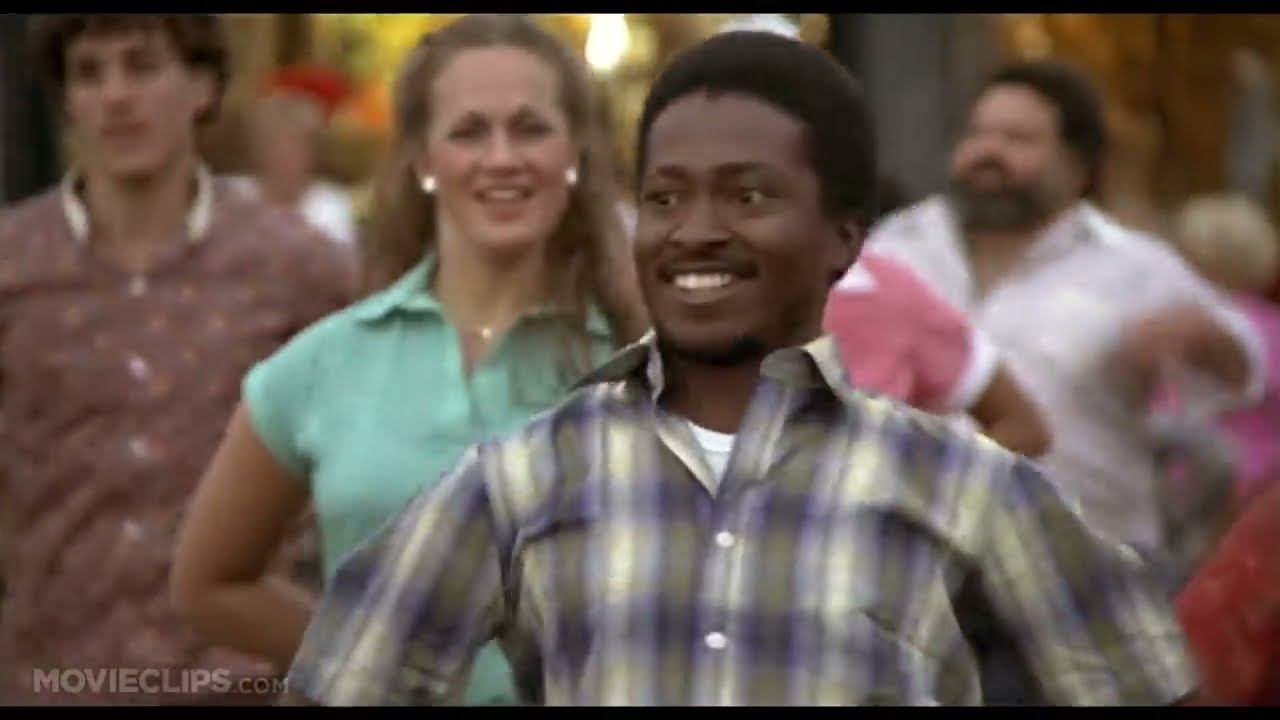
A few minutes later, Ray Charles is at the keyboard, the Blues Brothers Band is playing behind him, people outside are dancing in the street, and an ordinary Chicago block has somehow turned into a full-scale rhythm-and-blues celebration.
It should feel completely ridiculous.
Instead, it feels perfectly natural.
That may be the greatest thing about the scene.
Nothing in The Blues Brothers ever seems to question why music can suddenly take over reality.
It simply happens.
And once Ray Charles starts playing, you do not question it either.
Jake and Elwood Need Instruments
By this point in The Blues Brothers, Jake Blues, played by John Belushi, and Elwood Blues, played by Dan Aykroyd, are working to reunite their old band.
Their goal is serious, at least to them.
They need to raise money to save the Catholic orphanage where they grew up.
That mission sends them across Chicago searching for former bandmates, equipment, gigs, and basically anything else they need to get the Blues Brothers Band working again.
The movie itself is a strange mixture of road comedy, action movie, musical, and celebration of rhythm and blues.
TCM describes the story simply: Jake and Elwood reunite their band while on their famous “mission from God” to save the orphanage. The cast surrounding Belushi and Aykroyd includes extraordinary musical figures such as James Brown, Aretha Franklin, Cab Calloway, John Lee Hooker, and Ray Charles.
When the brothers arrive at Ray’s Music Exchange, they are supposed to be shopping.
But nothing in this movie stays ordinary for very long.
Meet Ray
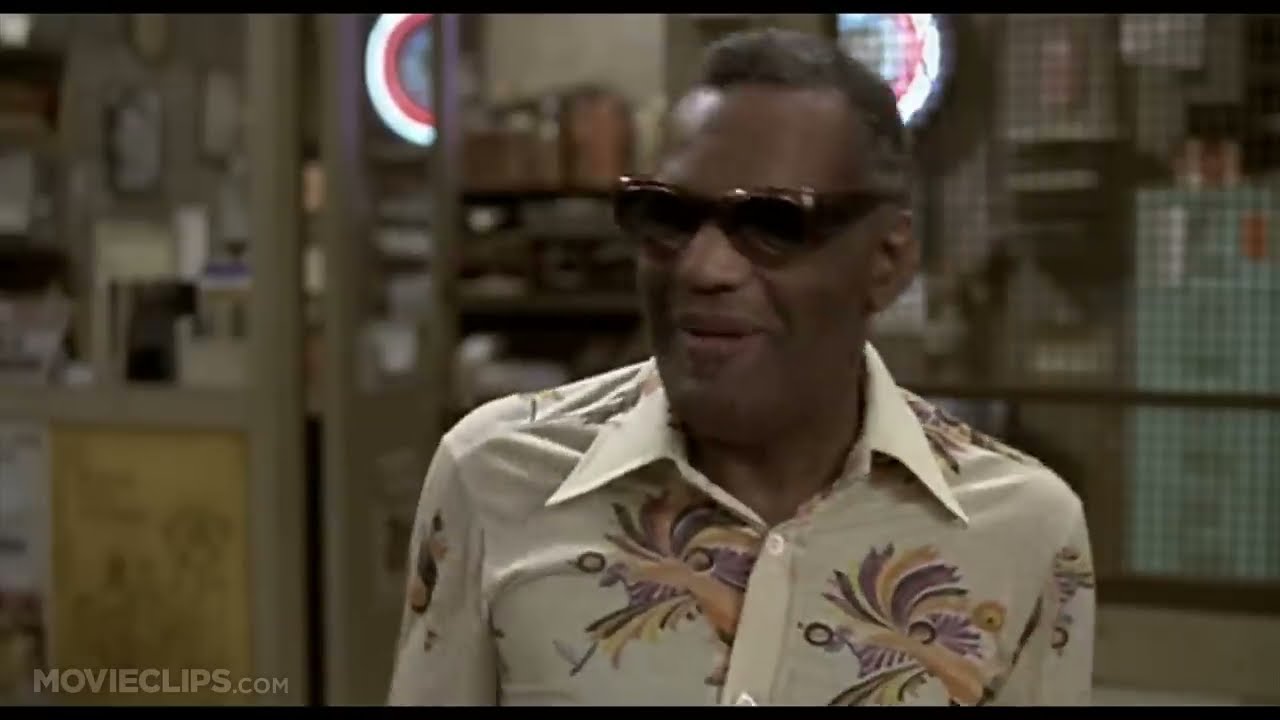
Behind the counter is Ray, played by Ray Charles.
That casting alone tells you something about the movie’s ambitions.
Director John Landis and Dan Aykroyd did not simply want actors pretending to represent rhythm-and-blues history.
They brought major figures from that history directly into the film.
The Library of Congress later described The Blues Brothers as a tribute to Chicago, soul, and R&B music, specifically noting appearances by Ray Charles, Aretha Franklin, and Cab Calloway. Director John Landis said the film grew out of Aykroyd and Belushi’s genuine passion for rhythm and blues and their love for the artists and Chicago itself.
Ray’s introduction begins like comedy rather than a concert.
The band wants to inspect the instruments.
Ray is protective of his merchandise.
Then comes a question about the electric piano.
Is there something wrong with it?
Ray knows exactly how to answer.
Not with an argument.
Not with a sales pitch.
With music.
He sits down.
And the entire scene changes.
One Piano Chord Changes Everything
There is a special energy that arrives the second Ray Charles begins playing.
Until that moment, we are inside a music store.
Then the keyboard hits.
The rhythm arrives.
The band joins in.
Suddenly the store does not feel like a store anymore.
It feels like a stage.
Ray Charles performs “Shake a Tail Feather” with the Blues Brothers Band, and what begins as a demonstration of the instrument quickly becomes a full musical number. The song appears in the film specifically during the Ray’s Music Exchange sequence.
That transformation is central to the charm of The Blues Brothers.
Music is not background decoration in this movie.
Music changes the physical world.
When Aretha Franklin sings “Think,” a restaurant becomes a stage.
When James Brown performs, a church erupts.
When Cab Calloway performs, an audience is transported into another era of show business.
And when Ray Charles starts playing, the neighborhood itself begins to dance.
Nobody stops to explain it.
Nobody needs to.
Then the Street Starts Moving
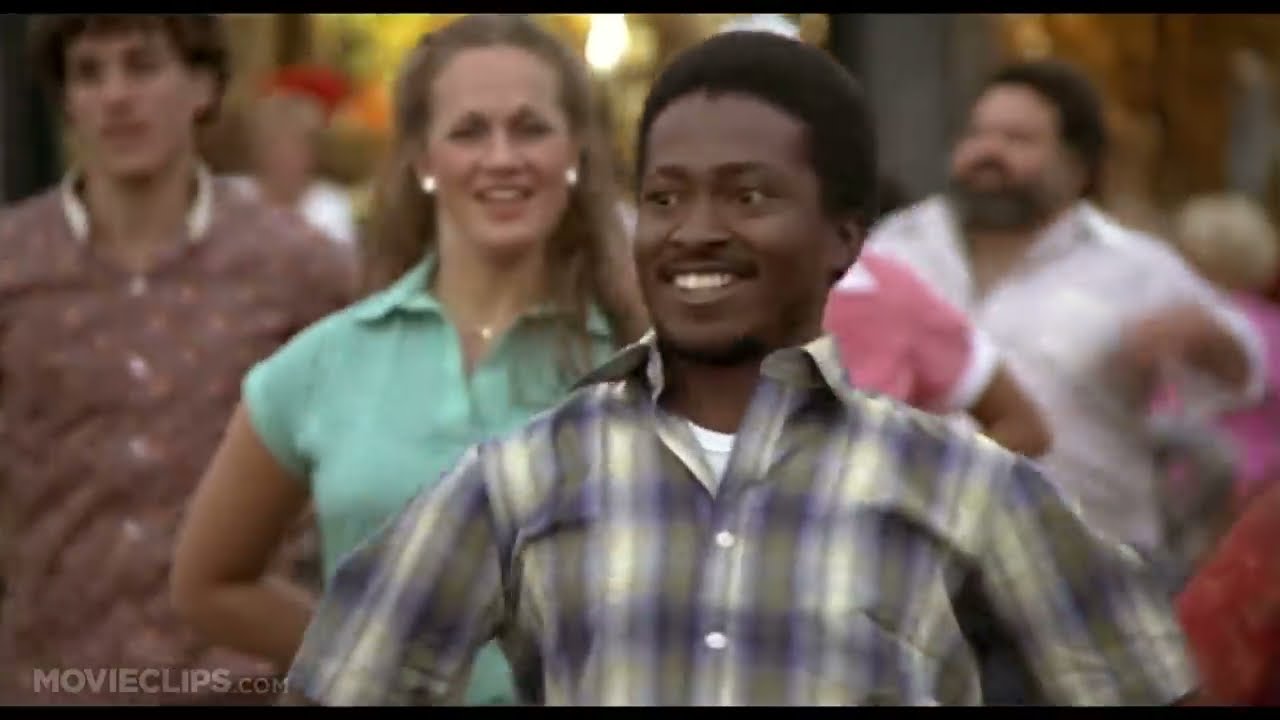
The camera moves beyond the walls of Ray’s Music Exchange.
Outside, everyday life is continuing.
There are sidewalks.
Buildings.
Traffic.
People going about their day.
Then they hear the music.
And apparently everyone in Chicago knows the choreography.
People begin dancing.
Groups move together.
The sidewalk becomes a performance space.
The choreography spreads down the street until what began with one man at a keyboard has transformed the neighborhood into a celebration.
It is one of those movie moments where realism is intentionally abandoned in favor of pure joy.
And that choice matters.
A lesser movie might have tried to make the scene believable.
The Blues Brothers understands that the better option is to make it irresistible.
Dan Aykroyd later told the Library of Congress that the film needed a dance number at exactly this point in the story. He remembered “Shake a Tail Feather” as the perfect song for the moment and praised Ray Charles for committing completely to the performance.
That commitment is visible in every second of the scene.
Ray is not treating this like a celebrity cameo.
He performs.
Ray Charles Owns the Scene
John Belushi was one of the most explosive performers of his generation.
Dan Aykroyd could command a scene with deadpan intensity.
Yet when Ray Charles sits at that piano, Jake and Elwood are perfectly happy to let him become the center of the movie.
That is exactly the right choice.
Ray has a relaxed authority that cannot be manufactured.
He does not have to convince the audience that he belongs behind the keyboard.
The audience already knows.
The humor and joy come from watching everyone else get pulled into his orbit.
Belushi and Aykroyd dance.
The band plays.
The street moves.
But Ray remains the source of the energy.
There is also something wonderfully funny about the reason the performance begins.
Remember, this was supposedly a demonstration of whether a keyboard worked properly.
Most store owners might play a few notes.
Ray Charles essentially gives them a concert.
By the end, there can be absolutely no argument about whether the instrument works.
John Belushi’s Dancing Makes It Even Better
Of course, if Ray Charles provides the musical authority, John Belushi provides some of the physical comedy.
Belushi’s Jake Blues always looks like a fascinating contradiction.
He wears the black suit.
Black tie.
Black hat.
Dark sunglasses.
His expression frequently suggests a man conducting extremely important business.
Then the music starts.
And suddenly he moves.
That contrast was a huge part of the Blues Brothers appeal.
Jake and Elwood rarely smile broadly or announce how much fun they are having.
They maintain their cool, almost mysterious appearance.
Yet their bodies reveal everything.
They love this music.
They cannot stand still when it starts.
Belushi was especially good at combining physical comedy with legitimate musical performance.
He could move with wild energy without making the Blues Brothers feel like a parody of musicians.
That distinction matters.
Jake and Elwood are funny characters.
But the music itself is never treated as a joke.
The performances are real.
The musicians are real.
The enthusiasm is real.
The comedy surrounds the music instead of mocking it.
Dan Aykroyd Keeps Elwood Cool
Aykroyd’s Elwood provides a different kind of energy.
Where Jake can explode physically, Elwood often looks almost impossibly controlled.
The sunglasses stay on.
The face remains serious.
The thin black tie is perfectly in place.
Yet once the rhythm takes over, he is just as committed.
That contrast between Jake and Elwood gives the musical scenes personality.
They look almost identical at first glance.
Black suits.
Black hats.
Black sunglasses.
But they move differently.
React differently.
Carry different kinds of energy.
Together they become one unit.
That visual identity had already made the Blues Brothers memorable as characters originating on Saturday Night Live, but the movie gave Aykroyd and Belushi a much larger world in which to celebrate the music they loved.
This Is More Than a Celebrity Cameo
Modern movies often advertise celebrity cameos like surprises.
A famous person appears for thirty seconds.
The audience recognizes them.
Everyone cheers.
Then the story moves on.
The Blues Brothers does something more interesting with its musical legends.
It gives them room.
Ray Charles does not simply appear behind a counter and wave at the audience.
He performs an entire number.
Aretha Franklin does not merely play a restaurant owner.
She sings.
James Brown gets a musical sequence.
Cab Calloway gets his moment.
John Lee Hooker performs on a Chicago street.
The movie understands that if you have access to performers of that caliber, you should not rush them.
Let them do what made them legendary.
The result is that the movie functions almost like a collection of musical showcases connected by Jake and Elwood’s increasingly chaotic mission.
That approach is one reason The Blues Brothers became more than just an extended SNL spin-off.
Its musical identity became part of its historical significance.
A Song With Roots Before the Movie
“Shake a Tail Feather” was not originally a Ray Charles song.
It was written by Otha Hayes, Verlie Rice, and Andre Williams and first recorded by the Chicago group the Five Du-Tones in 1963. Over the years, other artists recorded versions before Ray Charles performed it for The Blues Brothers.
That history makes its appearance in the movie especially fitting.
The Blues Brothers constantly reaches backward into American rhythm-and-blues traditions and brings them forward for another audience.
The movie was released in 1980, but much of its musical soul came from earlier decades.
Younger viewers who may not have been listening to classic R&B suddenly encountered performers and songs through Jake and Elwood’s adventure.
The film was comedy.
But it was also an introduction.
A celebration.
And, in its own chaotic way, an act of musical preservation.
Chicago Is Almost Another Character
The street dance also works because The Blues Brothers is so closely tied to Chicago.
The movie does not feel like a musical that could have happened anywhere.
Chicago is part of its identity.
The trains.
The streets.
The neighborhoods.
The buildings.
The restaurants.
The roads.
Even the enormous car chases feel connected to the city.
The Ray’s Music Exchange sequence was filmed using a Chicago location associated with 300 E. 47th Street, while some production work was also done on soundstages.
When the dancers spill into the street, that Chicago environment gives the number texture.
It does not look like a polished Broadway stage.
It looks like the city itself has heard Ray Charles and decided to participate.
That is a much more memorable image.
The Scene Never Loses Its Sense of Fun
One reason this clip remains so easy to rewatch is that there is almost no cynicism in it.
The joke is not that people look foolish dancing.
The film loves the dancers.
It loves the musicians.
It loves the song.
It loves Ray Charles.
And Jake and Elwood clearly love every second of it.
That sincerity is important.
You can make comedy from something you admire.
In fact, some of the best comedy comes from exactly that combination.
Belushi and Aykroyd could be ridiculous while still treating blues and soul music with deep respect.
The movie may exaggerate everything around the performances, but when the music starts, the musicians are allowed to be great.
Why the Scene Still Works
More than four decades after the movie’s release, the sequence remains incredibly simple to understand.
You do not need to know the entire plot.
You do not need to understand every Blues Brothers reference.
You do not even need to know why Jake and Elwood are buying instruments.
A man sits at a keyboard.
The band starts playing.
The rhythm catches.
The street begins dancing.
That is enough.
The clip has movement from the first musical beat.
It has instantly recognizable characters.
It has Ray Charles.
It has John Belushi dancing.
And it keeps expanding visually until an ordinary shopping trip feels like a citywide party.
That is almost perfect short-form entertainment decades before anyone used the phrase “viral clip.”
From SNL Characters to American Film History
When Jake and Elwood first appeared as the Blues Brothers, it would have been difficult to predict just how long the characters would last.
Yet the 1980 film ultimately became significant enough to join the National Film Registry in 2020. The Registry preserves films judged culturally, historically, or aesthetically significant.
And when people explain why The Blues Brothers matters, scenes like this are a major part of the answer.
It is not simply because the movie is funny.
It is because it put performers like Ray Charles, Aretha Franklin, Cab Calloway, James Brown, and John Lee Hooker into a mainstream Hollywood comedy and let their music command the screen.
Jake and Elwood may be the characters driving the story.
But they know when to get out of the way.
When Ray Charles starts playing, the mission can wait.
Just Try Not to Move
That may ultimately be the best way to describe “Shake a Tail Feather.”
It is a scene designed to make sitting still difficult.
The rhythm starts.
Ray takes control.
The band joins him.
Jake and Elwood begin moving.
Then the people outside start dancing.
One group becomes another.
The entire street comes alive.
And suddenly you are no longer watching two men trying to buy instruments.
You are watching a celebration of the reason they wanted those instruments in the first place.
Music.
That is what makes the sequence more than a funny interruption in the story.
For a few minutes, the mission, the money, the police, the cars, and all the other chaos disappear.
There is only the band.
There is only the rhythm.
There is only Ray Charles at the keyboard.
And there is an entire Chicago street shaking along with him.
More than forty years later, the scene still has exactly the same invitation:
Turn it up.
Forget everything else for a few minutes.
And see if you can keep your feet from moving.
👇 Be honest: can you watch Ray Charles, John Belushi, Dan Aykroyd, and that entire street perform “Shake a Tail Feather” without moving along with them?
And which musical moment from The Blues Brothers do you love most — Ray Charles singing “Shake a Tail Feather,” Aretha Franklin performing “Think,” or Jake and Elwood taking the stage with “Everybody Needs Somebody to Love”?
#TheBluesBrothers #RayCharles #JohnBelushi #DanAykroyd #ShakeATailFeather #ClassicMovies #ClassicComedy #MusicLegends #BluesBrothers #80sMovies #SoulMusic #RhythmAndBlues #MovieNostalgia #ComedyLegends #Chicago