After car chases, explosions, police roadblocks, angry country-bar patrons, neo-Nazis and what seems like half the law-enforcement population of Chicago chasing them across the city, The Blues Brothers arrives at a surprisingly appropriate destination.
Prison.
But for Jake and Elwood Blues, even prison can’t stop the music.
The final sequence of The Blues Brothers turns what could have been a conventional ending into one last musical celebration. Jake, Elwood and the band perform “Jailhouse Rock” for a room full of prisoners, bringing the movie to a close with exactly the mixture of music, comedy and chaos that defined everything that came before it.
It’s difficult to imagine a more appropriate ending.
The Mission Is Finally Complete
The entire adventure begins with a problem.
The Catholic orphanage where Jake and Elwood grew up needs money to survive.
Jake has only recently been released from prison when he and Elwood learn about the situation. Their solution is characteristically ambitious: reunite their old rhythm-and-blues band, perform concerts and raise the money legitimately.
That plan eventually sends them across Chicago.
Along the way they attract an extraordinary collection of enemies.
Police officers pursue them.
A country-and-western band wants revenge.
Neo-Nazis want revenge.
And Jake’s mysterious former fiancée repeatedly attempts to destroy him.
Yet somehow the brothers keep moving.
The movie’s plot description summarizes their mission as reuniting the old band to save the Catholic home where they were raised while outrunning the police across Chicago.
For Jake, none of this is optional.
They’re famously on a mission.
And by the end, they actually succeed.
After the enormous Palace Hotel Ballroom concert and the spectacular chase that follows, Jake and Elwood reach the Cook County government building and deliver the money needed for the orphanage’s tax bill.
Mission accomplished.
There is only one small problem.
The authorities have finally caught them.
From One Prison to Another
There’s a beautiful symmetry to the structure of The Blues Brothers.
The movie begins with Jake leaving prison.
It ends with Jake back in prison.
Everything in between is one gigantic musical detour.
But Jake doesn’t return alone.
This time Elwood and the band are there too.
And instead of allowing prison to provide a gloomy conclusion, director John Landis turns the setting into another stage.
The musicians take their positions.
Jake steps up to the microphone.
And the unmistakable opening of “Jailhouse Rock” begins.
IMDb’s documentation of the film’s ending confirms that the Blues Brothers and their band perform the song in prison, with the number continuing into the closing credits.
That choice works on several levels.
The title obviously fits the location.
But more importantly, it reinforces one of the central ideas of the movie:
Jake and Elwood can turn almost anywhere into a performance venue.
Music Is Their Superpower
Throughout The Blues Brothers, music changes environments.
A church becomes an explosion of gospel energy.
A soul-food restaurant becomes a stage.
A music store spills into a street-wide dance number.
A country bar becomes an unlikely home for rhythm-and-blues musicians desperately pretending they belong there.
A grand ballroom becomes the setting for a spectacular comeback.
And finally, a prison cafeteria becomes a rock-and-roll concert.
The locations change.
The principle doesn’t.
When the band starts playing, normal reality temporarily disappears.
That’s why “Jailhouse Rock” isn’t merely an end-credit song.
It feels like a summary of the entire movie.
Jake and Elwood have lost their freedom again.
But they haven’t lost their identity.
Put Jake Blues in prison and he’s still Jake Blues.
Give him a microphone and he’s ready to perform.
John Belushi’s Energy
The sequence also gives John Belushi one final opportunity to demonstrate why Jake Blues became such an unforgettable character.
Belushi’s Jake is an unusual combination.
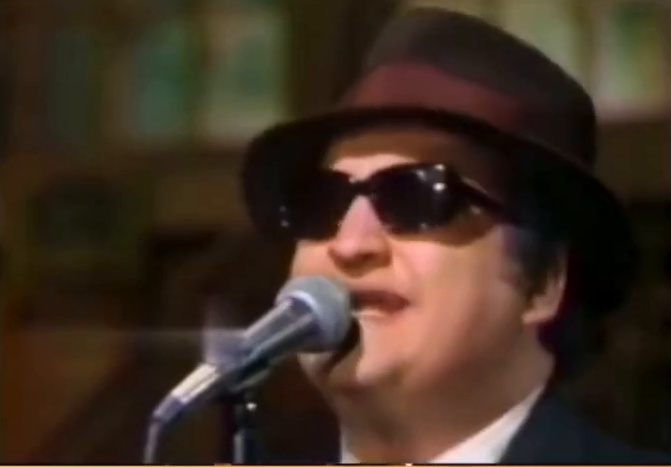
He looks permanently unimpressed with the world.
Dark suit.
Dark hat.
Dark sunglasses.
Almost expressionless cool.
Then the music begins.
Suddenly that controlled exterior releases enormous energy.
That contrast is central to the Blues Brothers image.
Jake and Elwood rarely behave like conventional musical-film protagonists. They don’t spend the movie explaining their feelings.
Their personalities emerge through movement, deadpan dialogue and music.
Dan Aykroyd’s Elwood provides the perfect counterpart.
Together they created silhouettes recognizable almost instantly: black suits, hats and sunglasses.
But the image alone wouldn’t have lasted.
The music gave it life.
More Than a Comedy Duo
One of the reasons The Blues Brothers remains unusual is that its musical performances aren’t simply comedy sketches pretending to be songs.
The movie is deeply invested in American rhythm and blues, soul, gospel and rock and roll.
Its musical world includes legendary performers and musicians, and the soundtrack moves through a remarkable range of styles. IMDb’s soundtrack documentation lists numbers including “The Old Landmark,” “Think,” “Shake a Tail Feather,” “Minnie the Moocher,” “Everybody Needs Somebody,” “Sweet Home Chicago,” and finally “Jailhouse Rock.”
The result is a movie that can function simultaneously as comedy, action spectacle and musical celebration.
The final performance preserves all three identities.
It’s funny because they’re playing in prison.
It’s musical because the performance is treated seriously.
And even after the chase has ended, there’s still an atmosphere of impending chaos.
The prisoners don’t remain quietly seated forever.
The Perfect Final Joke
There is something wonderfully absurd about everything Jake and Elwood have accomplished.
They’ve survived impossible car crashes.
They’ve escaped explosions.
They’ve outrun enormous numbers of police officers.
They’ve saved the orphanage.
And after all of that…
They’re right back behind bars.
A conventional hero might consider that a tragic ending.
Jake and Elwood apparently consider it an opportunity to book another gig.
That’s the joke.
The authorities can stop the Bluesmobile.
They can handcuff Jake and Elwood.
They can lock the doors.
But they can’t stop the Blues Brothers from being the Blues Brothers.
So the band plays.
The prisoners listen.
The music builds.
And eventually the entire place erupts.
https://youtu.be/Cb_te9trg9E?si=PqywklXxpLLMsQov
Why the Ending Still Works
More than four decades after the film’s 1980 release, the scene remains a fitting farewell because it doesn’t attempt to suddenly turn The Blues Brothers into something it isn’t.
There’s no long sentimental goodbye.
No serious speech explaining what Jake and Elwood learned.
No quiet sunset.
There’s a microphone.
There’s a band.
And there’s rock and roll.
The movie began with Jake walking out of prison alone.
It ends with him back inside — but now surrounded by Elwood, his band and an audience.
In a strange way, that’s almost a happy ending.
The orphanage has been saved.
The mission is complete.
The band is together.
And the music is still playing.
For Jake and Elwood Blues, perhaps that’s all that ever really mattered.
They may have ended up in jail — but they still got one last show.