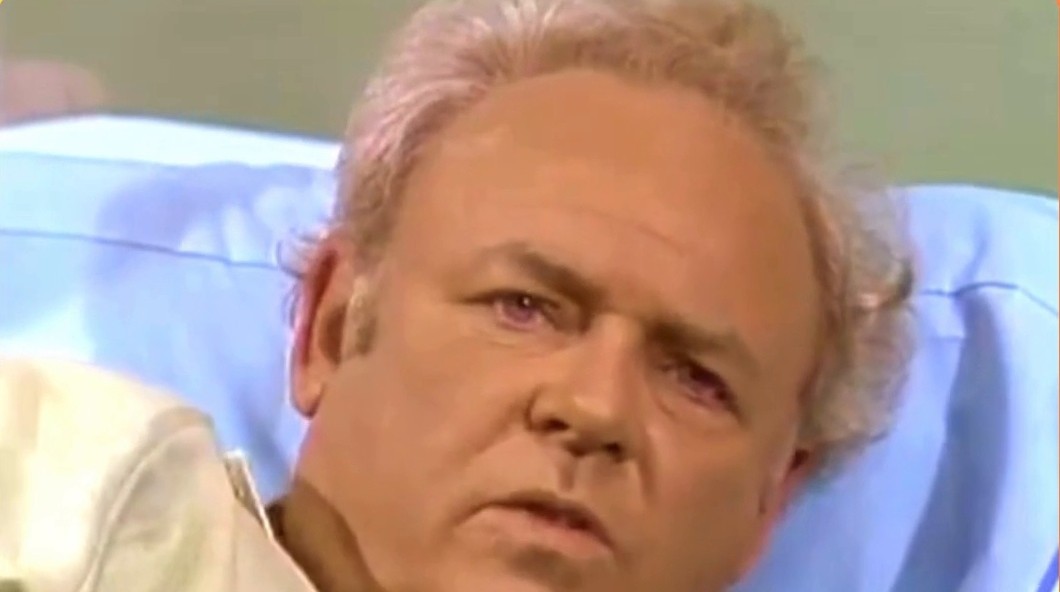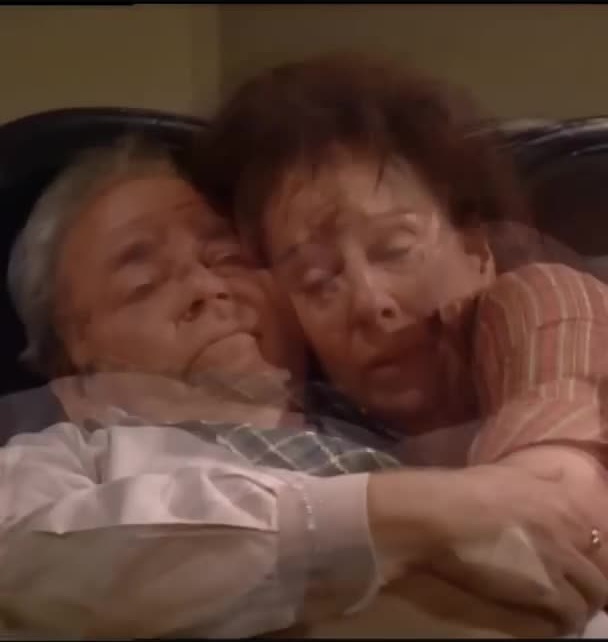
Archie Bunker was rarely short of confidence.
For years on All in the Family, he seemed to have an opinion about practically everything. Whether he was arguing with Michael, complaining about the changing world or sitting in his famous chair explaining exactly how he thought things ought to be, Archie usually presented himself as a man who had everything figured out.
But losing his job was different.
Suddenly, the outspoken head of the Bunker household found himself facing something that jokes, arguments and stubbornness couldn’t easily fix.
That is what gives this wonderfully funny bedroom scene between Archie and Edith so much meaning.
The scene comes from Season 7, Episode 4, “The Unemployment Story: Part 1,” originally broadcast on October 6, 1976. Archie loses his longtime loading-dock job just as the family is preparing to celebrate Michael having an article published.
For Archie, unemployment isn’t simply about losing a paycheck.
Work is deeply connected to how he sees himself.
He is proud of being the provider. He believes in working hard, earning a living and taking care of his family.
Then, without warning, that security disappears.
Throughout the episode, viewers watch Archie struggle with the reality of being unemployed. Even dealing with the unemployment office becomes frustrating for him, adding humiliation to an already difficult situation.
By the time he finally gets into bed with Edith, he has had enough.
Archie wants the day to end.
He wants quiet.
Most importantly, he doesn’t particularly want to talk about what he is feeling.
That alone tells us a great deal about Archie Bunker.
He could talk endlessly when he was angry.
But vulnerability?
That was considerably harder.
So Archie lies beside Edith and attempts to establish some distance between them.
After what he describes as a long and nervous day, he essentially suggests that they simply go to sleep.
And then comes something unexpectedly tender.
Archie reminds Edith that, whatever happens, he loves her.
For a character who often expresses affection through grumbling, teasing and complaining, it is a surprisingly vulnerable admission.
Edith responds exactly as Edith would.
She takes the word “truly” and turns it into a song.
She begins singing “I Love You Truly.”
And suddenly the emotional bedroom scene becomes classic All in the Family comedy. The episode is specifically documented as featuring Edith singing the song while trying to make Archie feel better after his job loss.
Archie’s face says almost everything.
He was looking for comfort.
He was probably not expecting a private concert.
The longer Edith sings, the more uncomfortable Archie becomes until he finally interrupts her.
His complaint is pure Archie: he jokes that the neighbors might hear Edith singing and think he’s torturing her.
It is a wonderful punchline.
But there is more happening beneath the laughter.
Edith isn’t trying to annoy Archie.
She genuinely wants to comfort him.
That was one of the defining qualities of Jean Stapleton’s portrayal of Edith Bunker. Edith could be naïve, endlessly talkative and unintentionally hilarious, but her kindness was rarely in doubt.
When Archie is hurting, she wants to help.
She simply does it in the most Edith Bunker way imaginable.
And Archie, despite all his complaints, understands that.
That dynamic is what makes the scene work so beautifully.
The comedy doesn’t erase the sadness.
The sadness doesn’t erase the comedy.
Both exist at exactly the same time.
In fact, Norman Lear later selected this Archie-and-Edith bedroom sequence when looking back at some of All in the Family’s memorable moments. In the show’s retrospective, Lear used the scene while discussing how closely laughter and tears can exist beside each other.
That philosophy can be seen throughout the scene.
Archie has lost his job.
For a working-class man who has spent much of his adult life defining himself through work and providing for his family, that is a serious blow.
Yet the writers don’t turn the situation into pure tragedy.
Instead, Edith starts singing.
Archie complains.
The audience laughs.
And somehow the humor makes Archie’s vulnerability feel even more human.
Then the scene goes one step further.
After stopping Edith’s singing, Archie finally admits something is wrong.
He tells her that he doesn’t quite feel like himself.
The implication becomes increasingly obvious: the stress and emotional shock of losing his job have affected Archie in an intensely personal way as well. The following episode continues that storyline, with episode descriptions noting the effect unemployment has had on him.
Once again, Archie doesn’t know how to discuss vulnerability directly.
So he struggles.
He hesitates.
He searches for words.
This is a man who normally speaks before thinking suddenly finding himself unable to say what he really feels.
And beside him is Edith.
She doesn’t judge him.
She doesn’t laugh at him.
She simply stays there.
That may be the sweetest part of the entire scene.
Throughout All in the Family, Archie and Edith could seem like complete opposites.
Archie was loud, argumentative and impatient.
Edith was gentle, optimistic and remarkably tolerant.
He frequently told her to “stifle.”
She frequently continued talking anyway.
Yet beneath all of their comedic differences was a marriage built on genuine affection.
Scenes like this allowed viewers to see it.
Archie didn’t suddenly transform into a romantic leading man.
That would not have felt authentic.
Instead, he remained Archie.
He complained about Edith’s singing.
He made jokes.
He became embarrassed.
But somewhere between all those reactions, he told his wife he loved her.
That was enough.
It also demonstrates why Carroll O’Connor and Jean Stapleton worked so well together.
O’Connor could communicate Archie’s embarrassment and insecurity with tiny changes in expression.
Stapleton could make Edith’s innocence funny without making the character feel foolish or cruel.
Together, they could move an audience from laughter to genuine tenderness within seconds.
The scene doesn’t need dramatic music.
It doesn’t need an enormous speech.
It doesn’t even leave the bedroom.
It is simply two people who have been married for years lying beside each other after one of them has had a terrible day.
One is scared.
The other wants to help.
And because they’re Archie and Edith Bunker, the attempt becomes hilarious.
That simplicity is probably one reason the scene continues to work decades later.
Jobs disappear.
People worry about money.
Pride gets wounded.
Husbands and wives sometimes struggle to tell each other what they are really feeling.
Those experiences aren’t limited to the 1970s.
They are human experiences.
And All in the Family was often at its strongest when it took something deeply human and allowed viewers to laugh at it without pretending the underlying problem wasn’t serious.
Archie may have lost his job that day.
For a moment, he may even have felt as though he had lost part of himself.
But when he went to bed that night, Edith was still beside him.
Singing.
Talking.
Trying to make him feel better.
Probably driving him crazy in the process.
And somehow, that was exactly what Archie needed.