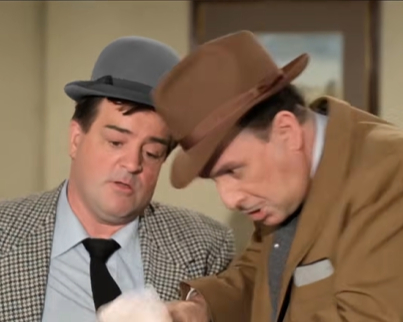
Some comedy sketches become classics because of elaborate sets, spectacular costumes, or complicated stories. Others become unforgettable because two performers can turn the simplest situation into complete chaos. “Thirteen Cents!” from the legendary comedy duo Abbott & Costello is a perfect example.
Built around the duo’s trademark combination of misunderstanding, rapid-fire dialogue, frustration, and perfectly timed reactions, the sketch takes an ordinary situation and transforms it into a hilarious comedy routine. What begins with something as simple as a small amount of money quickly spirals into a wonderfully ridiculous exchange that showcases why Abbott & Costello remain icons of classic American comedy.
The title itself — “Thirteen Cents!” — immediately suggests that something very small is about to become a very big problem.
And that is exactly what happens.
Abbott & Costello were masters at finding humor in everyday situations. Their comedy often depended on the contrast between Bud Abbott’s seemingly confident, straight-man personality and Lou Costello’s confused, emotional, and increasingly frustrated character. The dynamic was simple, but incredibly effective.
In “Thirteen Cents!”, that familiar chemistry is front and center.
Lou Costello’s character often approaches a situation with innocent confusion. He wants to understand what is happening, but every explanation seems to create another question. Bud Abbott, meanwhile, attempts to maintain control and explain things logically. The problem is that the more Abbott tries to clarify the situation, the more complicated it becomes.
That contrast creates the heart of the routine.
The humor does not come simply from the amount of money involved. Thirteen cents is an almost absurdly small amount, and that is precisely why it works so well as a comedic device. The tiny figure becomes the center of a growing argument, allowing the performers to stretch a simple misunderstanding into a full-blown comic battle.
Costello’s reactions are especially important.
His expressive face, physical movements, pauses, and vocal delivery turn every moment into something bigger. A simple line can become hilarious because of the way he reacts to it. He could communicate confusion, disbelief, irritation, and desperation within seconds, often without needing an elaborate punchline.
Abbott plays the perfect counterbalance.
His delivery is typically calmer and more controlled. While Costello becomes increasingly frustrated, Abbott often appears as though he is trying to solve a perfectly ordinary problem. This creates a classic comedy pattern: one performer becomes more emotional while the other remains comparatively composed.
The audience knows that the situation is spiraling out of control, even when the characters seem to be discussing something completely ordinary.
That is one of the great strengths of Abbott & Costello’s style.
Their comedy frequently transforms language itself into a source of chaos. Words are repeated, meanings become confused, and seemingly simple statements are interpreted in completely different ways. The audience is invited to follow the conversation while watching the two characters move further and further away from understanding each other.
“Thirteen Cents!” captures that style beautifully.
Another reason the routine remains entertaining is its rhythm. Abbott & Costello understood timing on an almost musical level. A pause can be just as funny as a punchline. A repeated phrase can become funnier each time it returns. A reaction shot can give the audience just enough time to anticipate what might happen next.
Then comes another misunderstanding.
And the cycle begins again.
This type of comedy may look simple when viewed from the outside, but maintaining that rhythm requires tremendous performance skill. Every pause, interruption, gesture, and reaction has to land at the right moment.
Lou Costello was particularly gifted at physical comedy. His movements often made the character appear completely overwhelmed by the situation. He could turn confusion into something visual, allowing the audience to laugh even before the next line was delivered.
Bud Abbott, on the other hand, understood the importance of restraint. His straight-man role gave Costello’s antics a foundation. Without Abbott’s calm responses, Costello’s increasingly chaotic behavior would not have the same impact.
Together, they created a comic balance that became one of the most recognizable partnerships in entertainment history.
What makes a routine like “Thirteen Cents!” especially enjoyable today is how little it needs to work.
There is no dependence on modern technology, elaborate special effects, or complicated visual effects. The comedy is carried almost entirely by the performers themselves.
Two people.
A conversation.
A tiny amount of money.
And an enormous amount of confusion.
That simplicity is part of its charm.
Classic comedy like this also provides a fascinating look at the performance style of an earlier era of television and entertainment. Performers had to rely heavily on personality, timing, physical expression, and audience interaction. The result was a style of comedy that could feel immediate and personal.
Abbott & Costello were particularly successful at creating routines that could be understood quickly. Even if viewers did not know every detail of the setup, the emotional situation was easy to recognize.
Someone is trying to explain something.
Someone else does not understand.
The explanation makes things worse.
And before long, everybody is caught in the confusion.
That formula remains effective because misunderstandings are universal. People have all experienced conversations where a simple question somehow turns into a complicated argument. Abbott & Costello simply pushed that everyday experience to an outrageous extreme.
“Thirteen Cents!” is also a reminder that great comedy does not always require a complicated premise. Sometimes the smallest detail can become the funniest part of the entire story.
The phrase “thirteen cents” sounds almost insignificant.
But in the hands of Abbott & Costello, it becomes a comedic obsession.
Their ability to build an entire routine around such a small detail demonstrates their understanding of escalation. The audience starts with a simple premise and watches as the performers gradually increase the confusion. Each new exchange adds another layer until the original problem seems almost impossible to solve.
And that is where the real fun begins.
For longtime Abbott & Costello fans, routines like this are a reminder of why the duo has remained so influential. Their work helped establish a style of comedy based on verbal confusion, character contrast, repetition, and physical reactions — techniques that would continue to influence comedians for generations.
For viewers discovering them for the first time, “Thirteen Cents!” offers a quick introduction to the duo’s unique chemistry.
You can see the difference between Abbott and Costello immediately.
You can hear the rhythm of their dialogue.
You can watch Costello’s frustration build.
And you can appreciate how Abbott keeps the conversation moving while everything around him seems to fall apart.
Decades later, that chemistry still works.
That is the remarkable thing about classic comedy. When the timing is right and the performers understand each other perfectly, the joke does not need to belong to a particular generation. The situation may be old, the setting may look vintage, and the production style may be different from modern television, but the laughter can still feel surprisingly immediate.
“Thirteen Cents!” is a wonderful example of that timeless quality.
It is a small problem turned into a huge comedy routine, powered by two performers who knew exactly how to turn confusion into laughter.
If you enjoy classic television, vintage comedy, or legendary comedy duos, this Abbott & Costello clip is well worth watching. Pay attention to the timing, the reactions, the repeated misunderstandings, and especially the way the two performers build the joke step by step.
Because with Abbott & Costello, even thirteen cents can become an unforgettable comedy disaster.
And somehow, that is exactly what makes it so funny.