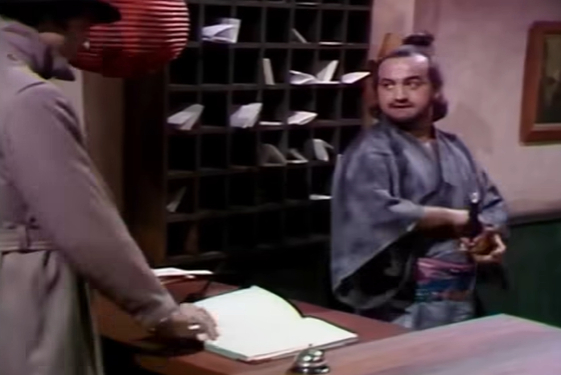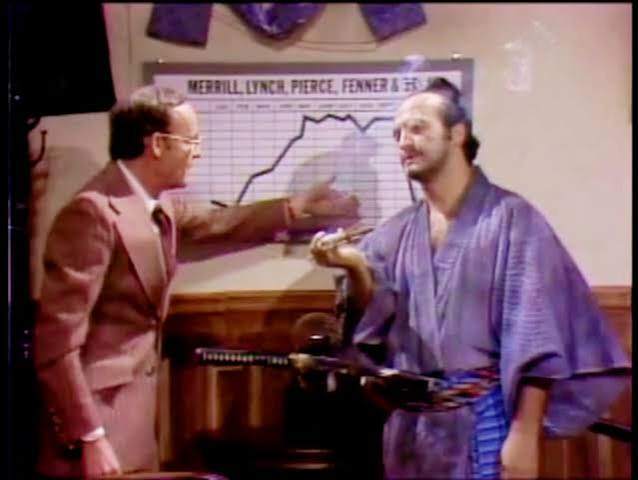
A collection of The Three Stooges’ funny moments from 1947–1949 captures exactly why this period remains so entertaining. The footage moves rapidly between verbal jokes, visual gags, misunderstandings, fights, disguises, dangerous jobs, and the perfectly timed physical comedy that made Moe Howard, Larry Fine, and Shemp Howard such an unforgettable combination.
What makes these moments special is not simply the hitting and falling. The Stooges created a rhythm. A harmless conversation would begin normally, someone would misunderstand a word, another Stooge would make the situation worse, and Moe would eventually reach the limit of his patience.
Then chaos took over.
Even small exchanges could become memorable.
At one point, the dialogue produces the familiar kind of twisted logic the Stooges loved. Someone declares, “Rome wasn’t built in a day,” only for the conversation to immediately wander into another joke. Elsewhere, simple questions about clothing, colors, payments, or everyday objects become opportunities for confusion.
The jokes often move so quickly that the audience barely has time to recover before the next gag arrives.
This was particularly effective with Shemp.
After returning to the Stooges, Shemp brought a different comic personality to the trio. Curly’s comedy had often relied on explosive childlike reactions and distinctive vocal sounds. Shemp was nervous, talkative, suspicious, and wonderfully expressive. His face could communicate panic before anything had even happened.
Put Shemp in a dark room, near a threatening stranger, or in the middle of one of Moe’s schemes, and the audience already knew trouble was coming.
The compilation repeatedly demonstrates how effectively Moe, Larry, and Shemp could build comedy from misunderstanding.
One wonderful example comes when the trio hears that “the King commands your presence.”
Their response?
They do not have any presents because the stores are closed.
One word changes the entire meaning of the sentence.
That kind of joke is simple, but simplicity was one of the Stooges’ strengths. They did not need an elaborate setup. The comedy came from characters who interpreted language in the most ridiculous possible way while remaining completely confident that they understood what was happening.
The same principle applied to physical comedy.
The Stooges could turn clothing into a weapon, furniture into an obstacle course, machinery into a disaster, and almost any room into a battlefield.
Throughout the collection, music and audience reactions frequently accompany extended visual sequences. Dialogue sometimes disappears almost entirely because it is no longer necessary. The performers’ movements tell the joke.
A Stooge looks in one direction.
Danger approaches from another.
Someone bends down at exactly the wrong moment.
A hand swings.
The intended victim moves.
Someone innocent gets hit.
Then everyone reacts.
It is almost choreography.
That precision explains why their slapstick still works. Although the scenes appear wildly uncontrolled, the timing had to be extremely controlled. A fraction of a second could determine whether a gag looked convincing.
Another essential ingredient was repetition.
Modern comedy sometimes avoids repeating a joke too many times. The Three Stooges often did the opposite.
They understood that repetition could make something funnier if every repetition changed slightly.
A character might repeatedly give the same direction. Someone could misunderstand it each time. A physical routine might happen once, then again with another character, and finally a third time with a completely unexpected victim.
One sequence in the compilation captures this beautifully with directions involving the first door on the right.
The instructions should be simple.
Naturally, they aren’t.
Soon everyone is pointing, people are moving in different directions, and the basic task of telling someone where to go becomes another Stooge catastrophe.
The trio’s comedy also worked particularly well whenever they pretended to be more competent than they really were.
Give them authority and they immediately become dangerous.
Give them responsibility and disaster becomes inevitable.
The collection moves through situations involving money, clothing, offices, castles, royal figures, machinery and other environments where somebody presumably expects professional behavior.
The Stooges almost never provide it.
That contrast is crucial.
They frequently enter a scene acting as though they know exactly what they are doing.
The audience knows better.
The anticipation becomes part of the comedy because viewers are not asking whether something will go wrong.
They are waiting to discover how badly it will go wrong.
The verbal exchanges are equally important.
At one point, the trio begins counting money:
“100, 200, 300, 400, 500…”
Then suddenly:
“5000.”
https://www.youtube.com/watch?v=P9hZXPyJ3nE
It is classic Stooge mathematics.
Elsewhere, someone’s name becomes an opportunity for wordplay. Ordinary objects receive ridiculous explanations. A pipe, a statue, a hat, a drink or a piece of clothing can instantly launch another routine.
Even historical references are not safe.
When something connected to Columbus is mentioned, the conversation immediately becomes confused with the idea that Columbus arrived by boat.
Logic never survives for long around the Stooges.
Another recurring source of humor is false bravery.
The Stooges love declaring themselves ready for danger—usually while attempting to make somebody else face it first.
One line from the compilation captures that attitude perfectly:
“I’ll protect those girls to the last drop of your blood.”
It sounds heroic for approximately half a second.
Then the final word reveals the truth.
That joke represents the Stooge personality perfectly. They want the glory of heroes without necessarily volunteering for the dangerous part.
Fear itself becomes a major comic tool whenever they enter strange or dark environments.
The trio’s reactions often make an uncertain situation far more frightening than it really is. One Stooge sees something. Another misidentifies it. A third panics because of the explanation. Before anyone checks what is actually happening, all three are terrified.
Their own imaginations become their greatest enemies.
But perhaps the most impressive element of these 1947–1949 moments is the sheer variety of ways they create chaos.
There are verbal misunderstandings.
There are musical interludes.
There are elaborate chases.
There are fights.
There are mistaken identities.
There are workplace disasters.
There are royal adventures.
There are dark-room scares.
There are money schemes.
There are strange hats and clothing jokes.
There are objects that refuse to behave properly.
https://youtu.be/HrLJPkz0ZlU?si=mOyYc84HYt9KmMO8
And, naturally, there are countless moments when Moe realizes that Larry or Shemp has done something unbelievably stupid.
The audience knows what usually follows.
That familiarity became part of the Stooges’ appeal.
Viewers knew Moe’s patience would eventually disappear. They knew Larry might accidentally become the victim of a fight he did not start. They knew Shemp could turn the smallest danger into enormous panic.
Yet knowing the personalities did not ruin the joke.
It enhanced it.
The audience was watching three established comic characters collide with new situations.
That is why a simple exchange such as “Thank you” — “What are you thanking me for? I wasn’t thanking you for anything” can start another comic chain reaction. In ordinary life, the misunderstanding would be corrected.
In a Three Stooges short, correction is merely the beginning.
Even surreal dialogue becomes funny through commitment. Later in the collection, a bizarre exchange repeatedly shifts between Sing Sing and Boston, with the characters insisting on contradictory locations. The logic becomes increasingly meaningless, but everyone behaves as though winning the argument is critically important.
Then there are the mechanical disasters.
Near the later portion of the compilation, even pipes become part of the madness, including the wonderfully ridiculous claim that the pipes are “full of termites.”
It is exactly the kind of sentence that belongs in the Stooge universe.
Plumbing problems are not allowed to remain plumbing problems. They have to become something stranger.
The Three Stooges understood that comedy often becomes memorable when reality bends just enough to make the impossible seem temporarily reasonable.
But beneath the eye pokes, slaps, crashes and nonsense was extraordinary chemistry.
Moe needed Larry and Shemp.
Larry and Shemp needed Moe.
Moe’s aggression was funnier because the others constantly tested his patience. Shemp’s nervousness became funnier when Moe refused to tolerate it. Larry frequently served as the bridge between their extremes, yet he could become just as foolish when the situation demanded it.
Together, they created something far more effective than three comedians simply performing separate jokes.
They created a comic machine.
One character’s mistake powered the next character’s reaction.
That reaction caused another accident.
The accident triggered retaliation.
Retaliation created a bigger problem.
And eventually the original situation barely mattered.
That formula is visible again and again throughout The Three Stooges All Funny Moments 1947–1949.
These scenes also demonstrate why their comedy remains instantly recognizable decades later. The settings may belong to another era, but the fundamental humor is remarkably accessible. You do not need to understand every reference to laugh at someone confidently giving terrible directions. You do not need historical context to understand a man pretending to be brave while volunteering someone else’s blood.
And you certainly do not need an explanation when three supposedly competent adults turn a simple task into complete destruction.
That was the magic of The Three Stooges during this era.
They could walk into almost any situation—a castle, an office, a workshop, a dangerous hideout or an ordinary room—and immediately make it their own.
The plot provided the destination.
Moe, Larry and Shemp provided the disaster.
And from 1947 through 1949, that disaster produced some wonderfully enduring comedy gold.