Some Western scenes explode immediately.
Others make the audience wait.
The sequence in Joe Kidd where Clint Eastwood’s character finds himself among Luis Chama’s rebels belongs to the second kind.
The scene is built around uncertainty.
Nobody fully trusts anybody.
Everyone is armed.
And Joe Kidd, as usual, says far less than the people around him.
That restraint is exactly what makes the sequence work.
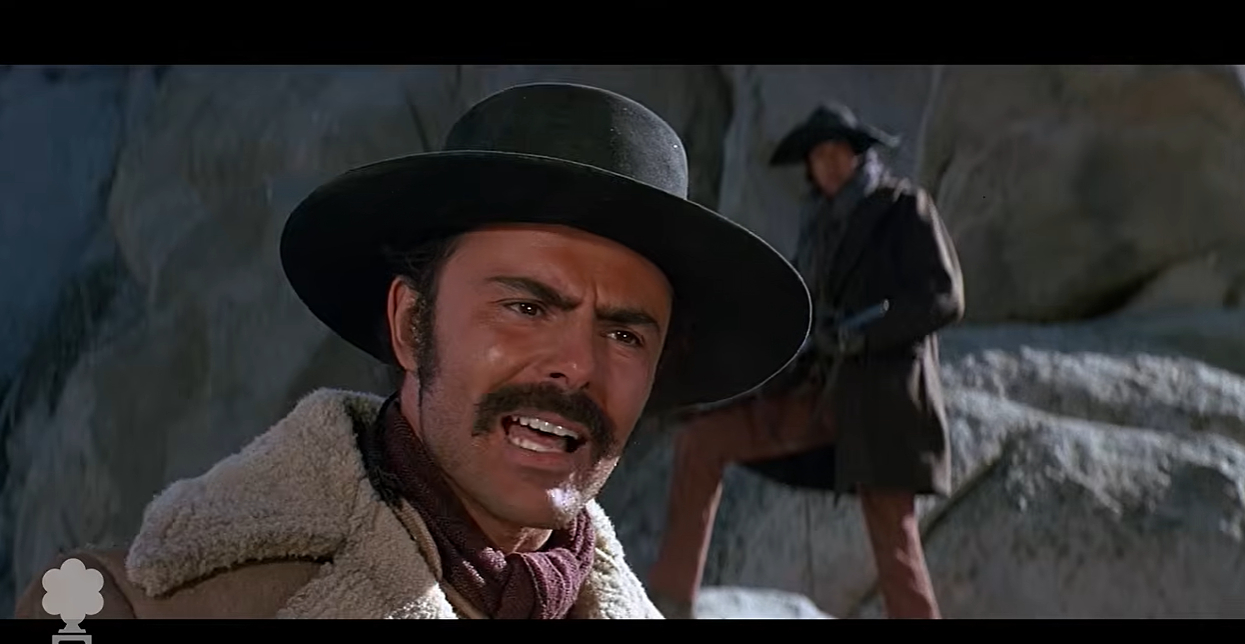
From the opening moments in the rocky mountain terrain, the atmosphere feels dangerous.
Men are positioned at different heights among the rocks.
Rifles are visible.
Horses stand nearby.
Every character appears to understand that one wrong movement could turn a conversation into a gunfight.
And standing in the middle of it is Eastwood.
Calm.
Watchful.
Almost impossible to read.
Joe Kidd Never Looks Like a Man Who Is Completely Trapped
One of Clint Eastwood’s greatest strengths as a Western actor was his ability to make danger feel almost routine.
Joe Kidd may be surrounded.
Other men may have rifles pointed in his direction.
The terrain may offer few easy escape routes.
Yet he rarely looks panicked.
That calmness is important.
It tells the audience that Kidd is not simply waiting for someone else to decide what happens next.
He is watching.
Calculating.
Looking for the moment when the balance of power changes.
That creates tension without requiring constant dialogue.
Luis Chama’s Rebels Control the Ground
The location gives the rebels an obvious advantage.
They know the terrain.
They are positioned around the rocks.
They can observe anyone approaching long before that person gets close.
That makes the area feel less like a meeting place and more like a natural fortress.
For Joe Kidd, that means every conversation takes place under pressure.
There is nowhere to stand without being watched.
Every visible rifle matters.
Every man on a ridge becomes another possible threat.
The setting therefore does much of the storytelling before anyone even speaks.
Eastwood’s Face Carries the Scene
The video repeatedly moves into close-ups of Joe Kidd.
Those close-ups are essential.
Eastwood does not need a speech explaining what his character is thinking.
A slight change in his eyes is enough.
A pause before answering becomes meaningful.
A look toward another armed man tells the audience that Kidd has noticed something important.
This kind of acting works especially well in Westerns because the genre is often about waiting.
Who will move first?
Who is lying?
Who actually has control?
Eastwood makes those questions visible without explaining them.
The Rebels Are Not Presented as a Simple Crowd
Another strength of the scene is that the men around Chama feel like individuals rather than anonymous background figures.
Some appear more aggressive.
Some appear cautious.
Some watch Joe closely.
Others seem to wait for Chama’s reaction before deciding how they should respond.
That uncertainty gives the group realism.
Even people fighting on the same side do not necessarily think the same way.
That becomes important when Joe enters their world.
He is an outsider.
And outsiders are dangerous when trust is already fragile.
Joe Kidd’s Position Is Complicated
The title of the clip suggests a simple idea: Joe Kidd joins Luis Chama’s rebels.
But the scene itself feels much more complicated than a straightforward alliance.
Joe Kidd is not the type of character who suddenly becomes loyal because someone asks him to.
He observes before committing.
He understands that both sides of a conflict may be dangerous.
That makes his involvement interesting.
He may stand with the rebels at one moment.
That does not mean he has surrendered his independence.
Eastwood’s character remains his own man.
That independence is central to his screen identity.
The Western Hero as an Outsider
Many classic Western protagonists belong to something.
A town.
A law office.
A ranch.
A military unit.
Joe Kidd feels different.
He operates around groups without completely becoming part of them.
That allows him to move between sides.
It also makes him difficult to predict.
A man who belongs to no one cannot easily be controlled.
That quality is visible throughout the video.
Even when surrounded by armed men, Kidd never looks like he has given away his ability to make his own decision.
The Revolver Changes the Conversation
One of the strongest portions of the scene comes when the tension becomes openly connected to weapons.
Eastwood raises his revolver.
The visual changes immediately.
A conversation that had been dangerous in theory is suddenly dangerous in practice.
This is classic Western filmmaking.
The gun does not need to fire instantly.
Its presence is enough.
Once the weapon enters the center of the frame, every character must reconsider the situation.
That pause is where suspense lives.
A Gunfighter’s Real Skill Is Knowing When to Move
Western mythology often focuses on speed.
The fastest draw.
The fastest shot.
But scenes like this show another kind of skill.
Judgment.
Joe Kidd survives because he understands timing.
Drawing too early can start a fight he does not need.
Drawing too late can get him killed.
The real tension comes from finding the exact moment between those two mistakes.
Eastwood plays that uncertainty beautifully.
His hand may move quickly when the time arrives.
But the decision happens first.
The Mountain Landscape Makes Everyone Look Vulnerable
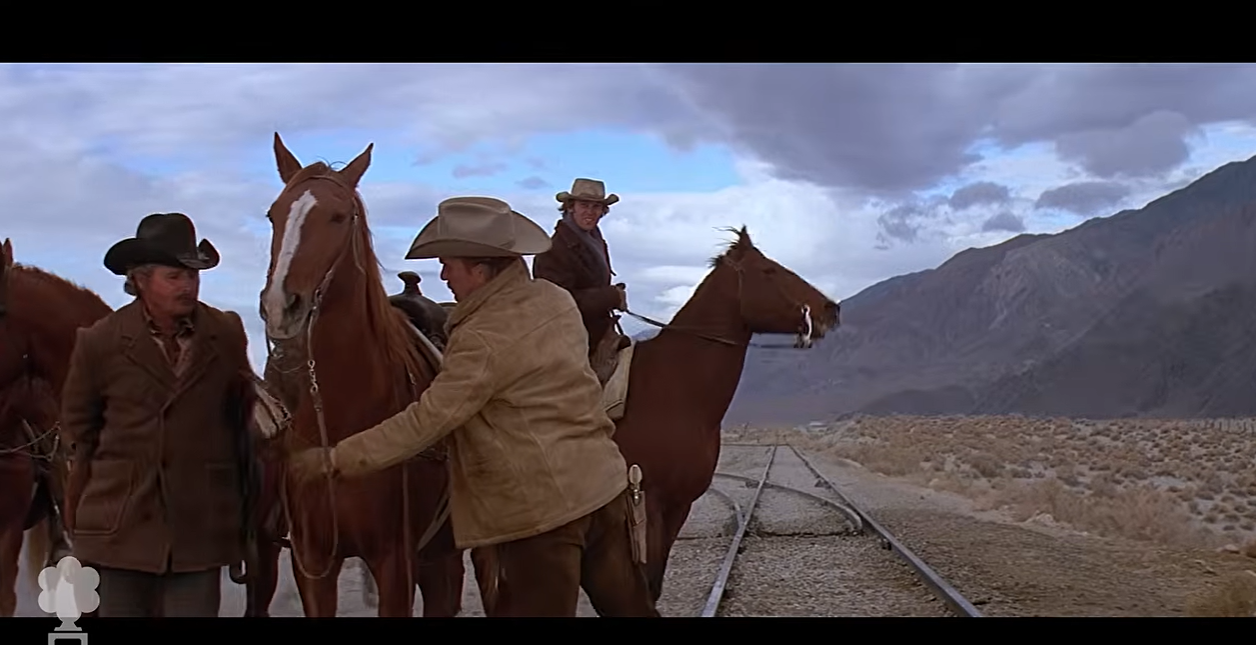
The wide shots are especially effective.
Large rock formations dominate the frame.
Snow-covered mountains appear in the distance.
People look small against the landscape.
That visual scale reminds the viewer that these characters are operating in a harsh environment where help is far away.
A gunshot in town may bring witnesses.
A gunshot in the mountains may disappear into empty space.
That isolation raises the stakes.
The landscape is beautiful.
But it also makes violence easier to hide.
Horses Give the Scene Movement
Once the sequence begins shifting away from the rocky meeting area, horses become more important.
The group rides across open country.
The pace of the scene changes.
Instead of people standing and studying one another, the characters begin moving through the landscape together.
That creates a temporary sense of alliance.
But the audience still understands that the trust is incomplete.
Traveling together does not automatically mean believing in one another.
In a Western, the person riding beside you can still become an enemy.
The Story Becomes More Dangerous When the Group Moves
A fixed location offers some predictability.
Once the characters start traveling, new threats can appear.
Riders can be seen from a distance.
Ambushes become possible.
Open terrain creates exposure.
The video takes advantage of that change.
The wide riding shots make the world feel larger.
Then the later gunfight brings the danger back into tight focus.
That contrast keeps the sequence visually interesting.
Joe Kidd Becomes the Hunter
One of the strongest later sections shows Kidd preparing a rifle.
The tone changes again.
Now he is no longer simply reacting to armed men around him.
He is positioning himself.
Preparing.
Looking across the terrain.
The Western hero who seemed surrounded earlier begins to look like the most dangerous man in the scene.
That reversal is satisfying.
Eastwood’s characters often work this way.
They allow other men to believe they have control.
Then the situation changes.
The Rifle Sequence Builds Suspense Differently
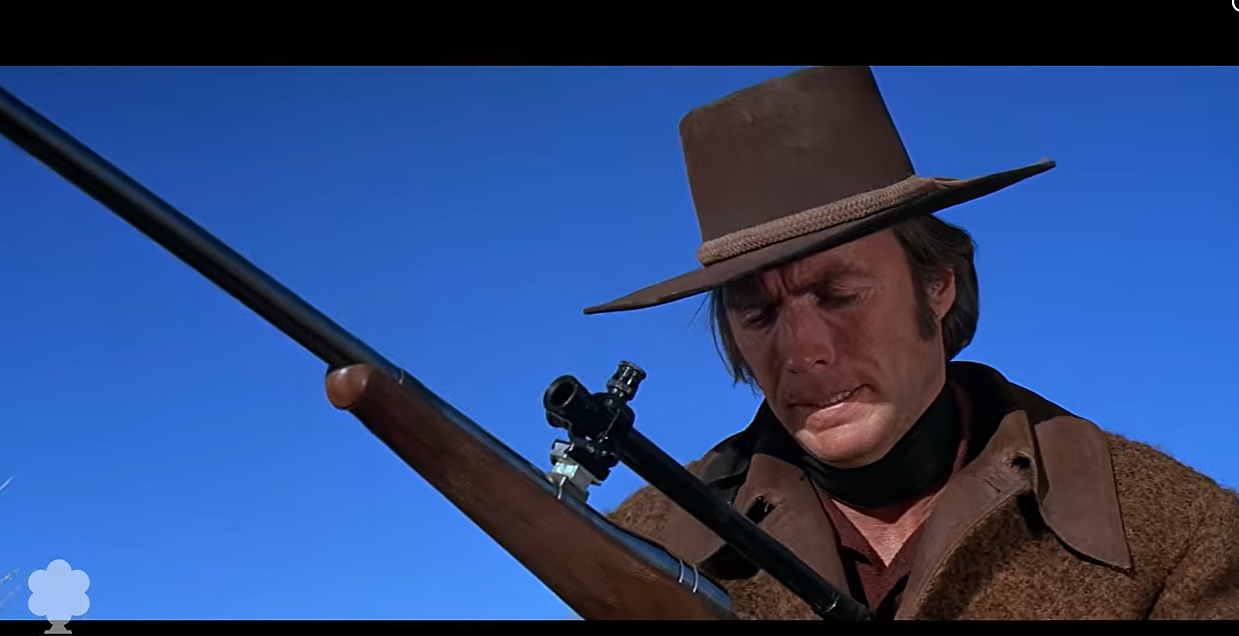
A revolver confrontation is usually close.
Personal.
Fast.
A rifle fight feels different.
Distance becomes important.
Visibility matters.
Cover matters.
A shooter may see an enemy who does not yet know he is being watched.
That creates another form of tension.
The footage of Kidd handling the rifle slows the action just enough for the viewer to anticipate what is coming.
You know the weapon will be used.
The uncertainty is where and when.
The Close-Up of the Rifle Is Pure Western Cinema
The camera gives attention to the gun itself.
Hands work the weapon.
Kidd adjusts his position.
The rifle rises.
Then the frame returns to his face.
That visual sequence tells a complete story without dialogue.
Preparation.
Aim.
Decision.
Action.
It is simple, but effective.
The audience immediately understands what is happening.
That clarity is one reason Western gunfight clips work so well in short-form video today.
Then the Violence Arrives Quickly
After the slow preparation, the later section becomes much more aggressive.
Shots are fired.
Characters drop behind rocks.
Men scramble for cover.
The calm landscape turns into a battlefield.
That sudden transition gives the sequence its payoff.
The audience has spent several minutes watching suspicion develop.
Now there is no need for suspicion.
The danger is real.
Eastwood Looks Most Dangerous When He Is Focused
During the gunfight, Joe Kidd does not become frantic.
He becomes more focused.
That is an important distinction.
Some characters react to gunfire with panic.
Kidd reacts with purpose.
He finds cover.
Raises the rifle.
Searches for the target.
Fires.
That professionalism makes him believable as a survivor.
He does not look heroic because he is fearless.
He looks dangerous because he knows what to do with fear.
The Western Gunfight Is Really About Position
The scene also demonstrates something classic Westerns understood well.
Gunfights are not only about shooting.
They are about where people stand.
Who has higher ground?
Who has cover?
Who can see whom?
Who is exposed?
The rocky environment creates natural shooting positions.
Every ridge can become an advantage.
Every bush can hide someone.
That makes the landscape part of the action.
Joe Kidd’s Independence Remains the Most Important Thing
Even when he temporarily aligns himself with Chama’s group, Kidd never seems absorbed into it.
That matters.
His identity is built around personal judgment.
He listens.
He watches.
He chooses.
He does not simply follow orders because someone claims authority.
This makes him a classic Eastwood Western character.
The law may have one opinion.
The rebels may have another.
Joe Kidd decides for himself.
Why Clint Eastwood Was So Effective in Roles Like This
Eastwood had a rare ability to look completely comfortable inside silence.
That is harder than it sounds.
Many actors try to fill empty space.
Eastwood lets it exist.
The camera can stay on his face for several seconds and the audience remains interested.
Why?
Because silence becomes information.
He is thinking.
Measuring.
Waiting.
The viewer begins doing the same thing.
That creates connection.
The Scene Balances Dialogue and Action
The first part of the video is heavily driven by conversation and suspicion.
The later portion shifts toward movement and gunfire.
That structure is effective because the action has context.
The audience understands who is watching whom.
We know why trust is uncertain.
We have seen the characters together before violence starts.
When shots finally come, they mean more.
This is stronger than random action.
The Visual Style Is Pure Classic Western
Bright blue sky.
Brown rock.
Dark hats.
Long rifles.
Horses crossing open country.
Snowy mountains in the distance.
The scene contains almost every visual ingredient associated with classic American Western cinema.
But the images never feel decorative.
They create mood.
The open spaces suggest freedom.
The armed men remind us how dangerous that freedom can be.
Why This Sequence Is Strong for Modern Reels
The clip contains several things that stop viewers quickly.
Clint Eastwood’s face is instantly recognizable.
The rifles immediately signal danger.
The rocky landscape clearly communicates “Western.”
The standoff is easy to understand.
No complicated explanation is needed.
A viewer sees Eastwood facing armed men and immediately asks:
What happens next?
That is exactly what a short-form clip needs.
The Best Part Is the Change in Power
At the beginning, Joe Kidd looks like the man at a disadvantage.
He is surrounded.
The rebels know the terrain.
They have numbers.
Later, Kidd is behind the rifle.
The perspective changes.
He is no longer just the outsider being watched.
He is the gunfighter doing the watching.
That shift is the real dramatic payoff of the sequence.
And it captures the central appeal of Clint Eastwood’s Western persona.
You can surround him.
Threaten him.
Question him.
Force him into someone else’s conflict.
But eventually, the moment arrives when everyone around him realizes the same thing:
Joe Kidd may not control the situation at first — but he is usually the man you least want holding the gun when the situation finally explodes.