Some movie scenes need time to explain themselves.
This one needs only a few notes from Ray Charles.
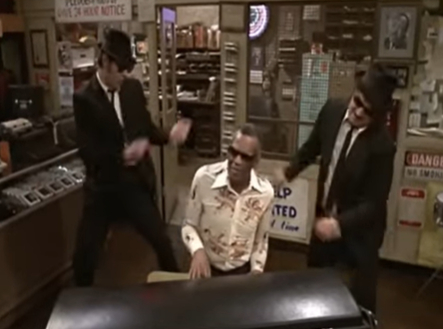
Inside a crowded Chicago music store, Jake and Elwood Blues stand beside an electric piano. They are supposed to be shopping for instruments as they rebuild their band. The moment appears ordinary, almost practical.
Then Ray Charles places his hands on the keys.
The rhythm begins.
Within seconds, the walls of the store seem unable to contain the music. John Belushi starts moving. Dan Aykroyd joins him. The musicians come alive. Outside, people who appeared to be going about an ordinary day suddenly form lines, move together, and turn the street into a giant dance floor.
What began as a demonstration becomes “Shake a Tail Feather,” one of the most joyful and instantly recognizable sequences in The Blues Brothers.
Released in 1980, the movie combined comedy, car chases, musical history, and two of the most famous characters John Belushi and Dan Aykroyd ever created. Yet even in a film filled with legendary performers and spectacular destruction, the Ray Charles sequence remains special.
It is funny without treating the music like a joke.
It is carefully choreographed without feeling stiff.
It is enormous without losing the personality of the three men at its center.
And more than four decades later, it still possesses the rare ability to make viewers stop, smile, and turn up the volume.
An Ordinary Piano Demonstration Becomes Something Much Bigger
The brilliance of the sequence begins with its simplicity.
Jake and Elwood are attempting to reassemble their old band. That mission requires musicians, transportation, determination, and, of course, instruments.
Their search brings them to Ray’s Music Exchange, where the store’s owner is played by Ray Charles.
Jake expresses concern about the electric piano. Ray does not answer with a lengthy sales pitch. He demonstrates it.
That decision is the doorway into the musical number.
His fingers find the keys, the band joins in, and the scene changes instantly. Ray is no longer simply a store owner helping two customers. He becomes the center of a full-scale performance.
This transformation is one of the movie’s greatest strengths.
The song does not feel inserted merely because the filmmakers wanted to feature a famous musician. It grows naturally from the scene. A question about an instrument becomes a reason to play it. Playing it becomes a reason to sing. Singing becomes an invitation for everyone nearby to dance.
The escalation is ridiculous, but the movie never pauses to acknowledge how ridiculous it is.
Nobody asks why an entire neighborhood knows the choreography.
Nobody stops to explain where all the musicians came from.
The music begins, and the world responds.
That confidence allows the audience to accept everything.
Ray Charles Does Not Enter the Scene Like a Guest
Many celebrity appearances in movies feel separate from the story. A famous person arrives, the audience recognizes them, and the film waits for applause before continuing.
Ray Charles is treated differently.
He does not appear as an unnamed star whose only purpose is to surprise viewers. He plays a character with a role in Jake and Elwood’s mission. He owns the store. He understands the instruments. He controls the room before the song even begins.
The moment he starts playing, his authority becomes complete.
Charles does not need exaggerated movements or elaborate costumes to command attention. His performance feels effortless. His voice carries warmth, power, humor, and absolute confidence.
Meanwhile, everything around him grows increasingly energetic.
The musicians play harder. Jake and Elwood begin dancing. The camera moves outside. More people join. The number becomes larger, but Ray remains its center of gravity.
That balance is difficult to achieve.
A performer can disappear when a sequence becomes crowded. Ray Charles does the opposite. The larger the scene becomes, the more powerful his presence feels.
He is not being supported by the spectacle.
The spectacle exists because he started playing.
John Belushi Turns Rhythm Into Physical Comedy
Ray Charles supplies the musical authority, but John Belushi provides a different kind of electricity.
As Jake Blues, Belushi never dances like a polished Broadway performer. His movements are heavier, stranger, and more unpredictable. He bends his knees, kicks his feet, swings his arms, and throws his entire body into the beat.
That is exactly why watching him is so entertaining.
Belushi’s greatest physical performances often seem caught between perfect control and complete chaos. The audience can tell that the timing has been rehearsed, yet he creates the impression that anything might happen next.
He may lean too far.
He may kick too high.
He may suddenly launch himself across the room.
He may appear to be fighting the rhythm before surrendering to it completely.
The black suit makes his movement even funnier. Jake and Elwood dress like two men arriving for a serious meeting, not two dancers preparing to take over a music store.
The hats remain in place.
The sunglasses hide their eyes.
Their expressions remain remarkably controlled while their bodies do increasingly ridiculous things.
Belushi understood that contrast.
Jake Blues looks emotionally restrained from the neck up and completely uncontrollable everywhere else.
It is a combination few performers could make believable.
Dan Aykroyd Is the Perfect Counterbalance
Belushi’s energy becomes more effective because Dan Aykroyd is beside him.
As Elwood Blues, Aykroyd is thinner, sharper, and more controlled. His movements often appear cleaner and more deliberate. Where Jake seems ready to crash through a wall, Elwood looks as if he has already calculated exactly how the wall will fall.
Together, they create a visual rhythm before either man takes a dance step.
Jake is explosive.
Elwood is precise.
Jake pushes the energy outward.
Elwood holds the shape of the performance together.
Their contrasting styles allow viewers to choose where to look. One moment, Belushi commands attention with a powerful kick or an exaggerated turn. The next, Aykroyd’s cool, economical movement becomes the joke.
Neither character breaks.
They do not smile at the audience to signal that the scene is funny. They perform with the seriousness of two men who believe dancing in a music store is an essential part of their mission.
That commitment is crucial.
Jake and Elwood are ridiculous characters, but they never believe they are ridiculous.
The audience laughs because the Blues Brothers treat every impossible situation as perfectly reasonable.
Then the Music Escapes Into the Street
The scene could have remained inside Ray’s Music Exchange and still worked.
Instead, the filmmakers allow the song to escape.
The camera cuts outside, where dancers begin moving in front of the store. What starts with a relatively small group quickly expands. Men, women, and children fill the street. Brightly colored clothing contrasts with Jake and Elwood’s black suits.
The neighborhood becomes part of the performance.
This expansion gives the sequence a sense of discovery. Every cut reveals that the music has reached someone else. It moves from the piano to the band, from the band to the Blues Brothers, and from the store to the street.
The choreography is large, but it does not feel detached from the location.
The dancers use the road, sidewalks, storefronts, and elevated structures around them. The environment becomes a stage without stopping its identity as a real neighborhood.
That is one reason the sequence feels so alive.
It does not appear to take place inside a sealed studio where every surface has been polished. The textures of the city remain visible. Storefronts, signs, pavement, vehicles, and buildings give the number a grounded atmosphere.
The fantasy grows out of an ordinary place.
For a few minutes, the entire neighborhood seems connected by a single beat.
“Shake a Tail Feather” Was the Perfect Choice
The song works because it functions as both music and instruction.
“Shake a Tail Feather” does not ask listeners to sit quietly and admire it. The rhythm demands movement. The lyrics encourage participation, and the repeated phrases allow even a first-time listener to understand the energy immediately.
That makes it ideal for a scene built around escalation.
Ray Charles does not merely perform for Jake and Elwood. He appears to challenge them.
They respond by dancing.
The people outside respond by dancing.
The audience watching the movie is invited to respond as well.
The song also gives the filmmakers room to shift between different kinds of movement. The sequence can feature Ray at the piano, musicians inside the store, Jake and Elwood performing together, small groups of dancers, and enormous wide shots of the street.
Each image feels connected by the same pulse.
Even viewers unfamiliar with the song can understand what the scene wants them to feel.
Joy.
Energy.
Community.
The irresistible need to move.
The Comedy Never Weakens the Music
This balance is essential to understanding The Blues Brothers.
Belushi and Aykroyd were comedians. Jake and Elwood began as characters connected to Saturday Night Live. Their appearance is funny, their mission is absurd, and the movie regularly pushes situations beyond reason.
But the music is never presented as worthless.
The jokes do not depend on Ray Charles performing badly. They work because he is extraordinary.
The same principle applies throughout the movie. James Brown, Aretha Franklin, Cab Calloway, John Lee Hooker, and other remarkable performers are given moments that recognize their power.
The comedy creates an entrance for the music.
It does not reduce the music to a punchline.
That distinction helped the film reach audiences who might not otherwise have sought out rhythm and blues. Viewers came because they knew Belushi and Aykroyd. They left remembering the songs and the artists who performed them.
In the Ray Charles sequence, the relationship is especially clear.
Jake and Elwood may attract the audience’s attention, but Ray controls what happens next.
The Blues Brothers enter his store.
They enter his musical world.
And once he begins playing, they happily follow his lead.
The Scene Is Carefully Constructed to Feel Spontaneous
The sequence appears effortless, but its sense of spontaneity is the result of careful filmmaking.
The editing constantly changes scale.
A close shot of Ray Charles creates intimacy. A wider shot shows Jake and Elwood moving together. A cut to the musicians increases the musical energy. Then an exterior view suddenly reveals dozens of people dancing outside.
The filmmakers repeat this pattern while increasing the size of the spectacle.
Close.
Wide.
Inside.
Outside.
Musician.
Dancer.
Individual.
Crowd.
The visual variety keeps the scene moving even though the story has temporarily stopped. Jake and Elwood are not driving toward their next destination or escaping another disaster. For these few minutes, the performance is the story.
The number also gives each major figure time to dominate the frame.
Ray receives expressive close-ups.
Belushi gets full-body shots that showcase his physical comedy.
Aykroyd receives moments where his controlled style contrasts with Jake.
The musicians are not hidden.
The dancers are not treated as anonymous background decoration.
Everyone contributes to the sensation that one piece of music has united an entire community.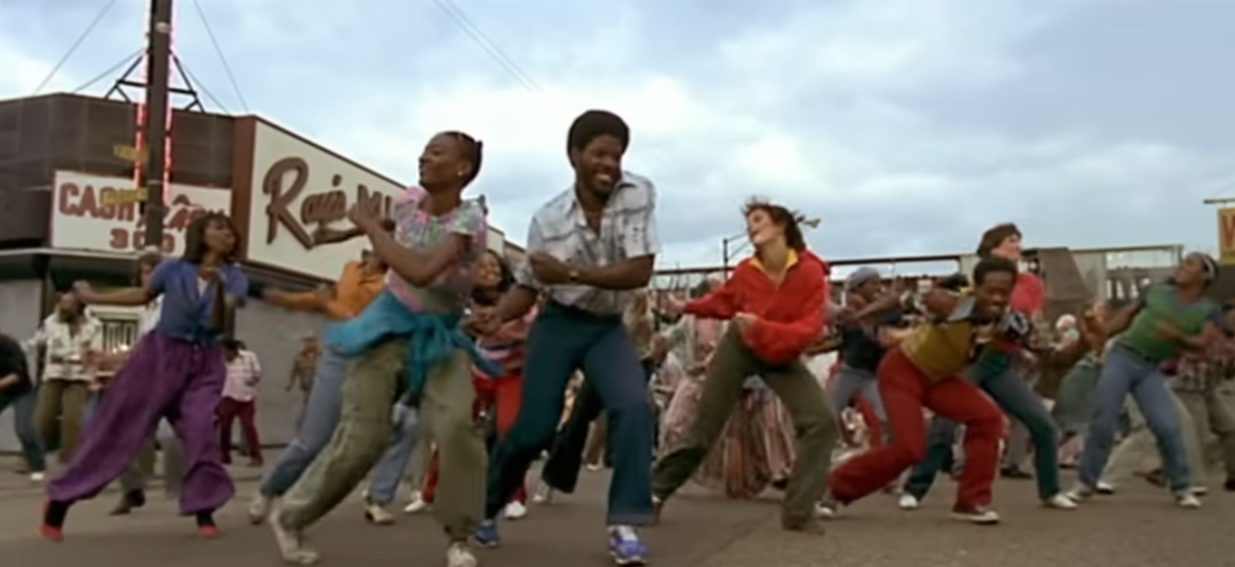
Why the Scene Still Stops the Scroll
Modern audiences often discover classic movies through short clips rather than complete television broadcasts or theatrical rereleases.
That change could have caused an older scene like this to disappear.
Instead, “Shake a Tail Feather” remains perfectly suited to the way people watch video today.
The hook is immediate.
Ray Charles begins playing, and viewers know something is about to happen.
The faces are recognizable.
The black suits and sunglasses identify the Blues Brothers instantly.
The movement grows rapidly.
A small indoor performance becomes a giant outdoor dance number in less time than many modern videos spend explaining their premise.
The scene also works without extensive context. A viewer does not need to understand every detail of Jake and Elwood’s mission. The basic story is visible:
Two men enter a music store.
A legendary musician tests a piano.
Everybody starts dancing.
That clarity is extremely valuable on Facebook, where a video may begin playing while the viewer is still scrolling.
The scene provides movement, familiar characters, changing camera angles, bright colors, and a recognizable song. Most importantly, it provides genuine joy.
Nothing about the performance feels cynical.
The characters are not afraid of looking foolish.
The dancers do not hold back.
The movie gives the music room to build until remaining still seems impossible.
The Moment Carries More Emotion Today
Watching John Belushi in the sequence now also produces an emotion audiences in 1980 could not have anticipated.
Belushi died in 1982 at only 33 years old.
That knowledge changes the way many fans see his performances. In “Shake a Tail Feather,” he looks almost indestructible. He is young, energetic, funny, and surrounded by extraordinary talent.
His career appears to be moving forward at full speed.
Knowing how soon it ended makes every kick, turn, and perfectly timed reaction feel more valuable.
But the sequence does not ask audiences to be sad.
It preserves Belushi at his most alive.
He is not standing politely beside Ray Charles for a celebrity photograph. He is dancing, performing, and contributing to a scene that people continue sharing decades later.
Aykroyd’s presence adds another layer. Jake and Elwood feel inseparable within the movie’s world. Their synchronized suits and contrasting movements create the image audiences still associate with the Blues Brothers.
For a few minutes, all three men seem to exist inside a moment that will never age.
Ray at the piano.
Jake moving with barely controlled force.
Elwood maintaining his impossible cool.
The street dancing behind them.
More Than a Famous Cameo
Calling the sequence a Ray Charles cameo does not fully describe it.
A cameo is often brief and decorative. This performance changes the atmosphere of the film.
Ray Charles enters the movie and immediately creates his own world. The story, characters, musicians, dancers, and city all begin moving according to his rhythm.
Belushi and Aykroyd do not compete with him.
They amplify him.
That generosity is part of what makes The Blues Brothers unique. Its stars were willing to step aside and let the music become larger than their characters.
The result is not simply a funny scene or a memorable song.
It is a celebration of performance itself.
A piano is tested.
A rhythm begins.
Two men in black suits start dancing.
The doors can no longer contain the energy, so it spreads into the street.
More people join until an ordinary neighborhood becomes a stage.
Then, almost as suddenly as it began, the song reaches its finale. Ray, Jake, and Elwood stand together, leaving the audience with an image that feels both spontaneous and iconic.
More than four decades later, the scene still accomplishes exactly what Ray Charles intended when he touched those keys.
It proves there was absolutely nothing wrong with that piano.
And it makes everyone watching want to shake a tail feather.