
At first, it sounds like the perfect husband moment.
His wife has been awake all night with the baby.
She is exhausted.
She has barely slept.
So her husband looks at her and does something surprisingly thoughtful.
He tells her to go back to bed.
He will make breakfast.
For a few seconds, it almost feels sweet.
Then he walks into the kitchen.
And everything falls apart.
That is the simple but brilliant setup behind this classic Carol Burnett Show sketch.
The wife has already had a terrible night.
The baby has been crying for hours, and she is clearly running on almost no sleep.
Her husband, meanwhile, seems only vaguely aware of what happened.
When she explains that the baby kept her up, he reacts as if he had only heard some noise in the background.
That alone tells the audience exactly where this is going.
He wants breakfast.
Bacon.
Eggs.
Toast.
Coffee.
At first, he casually starts listing everything he would like her to make.
Then, almost as if the idea has just occurred to him, he notices how tired she looks.
Suddenly, he becomes considerate.
Why should she cook?
Why not go back to bed?
He will make breakfast himself.
It sounds generous.
It sounds helpful.
It sounds like she may finally get a few minutes of rest.
She leaves.
And almost immediately, he needs her again.
First, there is the coffee.
Where is it?
The wife comes back.
She answers the question.
He tells her to relax.
He is handling everything.
Then he needs something else.
Could she open the can of pears?
Just one small favor.
No big deal.
She helps.
Surely now she can go back to bed.
Not quite.
He needs a bowl.
Then he needs the frying pan.
The problem is not that he cannot find one complicated piece of kitchen equipment.
The problem is that he seems incapable of doing almost anything without calling her back.
That becomes the running joke.
Every time he tells her to rest, he immediately finds another reason to interrupt her.
The contradiction is what makes it so funny.
He genuinely seems to believe he is helping.

That is the key.
He is not deliberately making her life harder.
He is trying to be useful.
He is just so helpless in the kitchen that his version of “making breakfast” requires his wife to supervise nearly every step.
At one point, she has to point out the frying pan.
It is right there.
He looks at it.
That is the frying pan.
Simple.
Obvious.
But in his hands, even something as basic as locating a pan becomes part of the disaster.
The wife is not just tired anymore.
She is trapped.
She cannot fully go back to bed because every few seconds, another question comes from the kitchen.
Where is this?
How do I open that?
What do I use for this?
What do I do next?
The audience can see what the husband apparently cannot.
His attempt to give her a break is creating more work for her.
That is what makes the scene so relatable.
The joke is exaggerated, but the situation feels familiar.
Someone says, “Don’t worry, I’ve got it.”
Then five minutes later, they are asking where everything is.
They need help finding the ingredients.
They need help using the tools.
They need someone to explain every step.
By the end, the person who was supposed to be resting has done almost as much work as if they had handled the whole thing themselves.
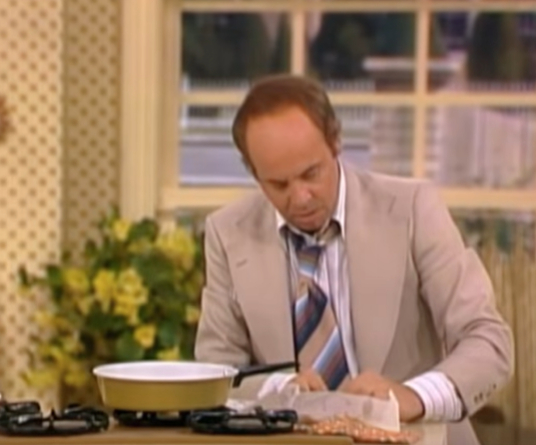
The kitchen gets more chaotic as the scene continues.
There are ingredients everywhere.
There is water.
There are pans.
There are attempts to cook.
And every movement seems to create another problem.
The husband still acts as if breakfast is only a minute or two away.
He keeps insisting he can handle it.
But the evidence in front of him says otherwise.
That contrast creates another layer of comedy.
He has confidence.
He does not have competence.
The wife has competence.
She has no energy.
So the person who knows how to do everything is exhausted, while the person with all the energy has no idea what he is doing.
That is the perfect comedy balance.
Tim Conway’s style makes the scene even better because he never needs to play the husband as wildly foolish.
He stays calm.
He moves through the kitchen with the confidence of someone who thinks the plan is still working.
That deadpan approach makes every failure funnier.
If he panicked, the joke would be obvious.
Instead, he treats each problem like a minor inconvenience.
Need coffee?
Call the wife.
Need the can opened?
Call the wife.
Need the pan?
Call the wife.
Need the next ingredient?
Call the wife.
And after every interruption, he still seems convinced she is getting a break.
The wife’s reactions become just as important as his mistakes.
She is tired before the scene even begins.
Each new interruption takes a little more patience away.
She does not need to deliver a huge speech about how ridiculous the situation is.
Her exhaustion tells the story.
The husband is trying to make breakfast.
She is trying to survive breakfast.
Eventually, the entire plan collapses.
The food is not coming together.
The kitchen is a mess.
FULL VIDEO:
The idea of a simple homemade breakfast has become far more complicated than expected.
And finally, the husband reaches the only conclusion left.
Maybe it would be easier to get something at the office.
That is the perfect ending.
After all the promises.
After all the interruptions.
After calling his exhausted wife back into the kitchen again and again.
He gives up.
The breakfast he was going to make never really becomes breakfast at all.
And then he casually says he will be home for lunch.
That final thought makes the whole situation even funnier.
If breakfast went this badly, what is going to happen at lunch?
That is what makes this sketch work so well.
There is no complicated plot.
There is no giant twist.
The entire comedy comes from one simple promise:
“Go back to bed. I’ll take care of breakfast.”
Then Tim Conway spends the rest of the scene proving that he cannot take care of breakfast without the help of the very person he is supposedly helping.
His intentions are good.
His execution is terrible.
And his exhausted wife never really gets the break she was promised.
Sometimes comedy does not need anything more complicated than that.
One tired wife.
One confident husband.
One kitchen.
And the dangerous phrase:
“Don’t worry. I’ve got it.”