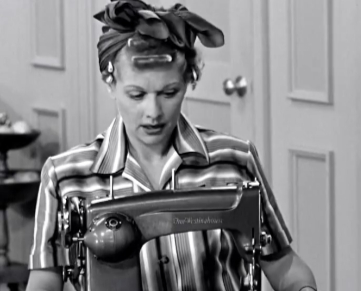
What happens when Lucy Ricardo decides she can save money by making her own dress? With Lucille Ball behind a sewing machine, even the simplest household project becomes a recipe for unforgettable laughter!
Some of the funniest moments in television history begin with perfectly reasonable ideas.
Saving money, learning a new skill, or making something at home should be ordinary activities.
But when Lucy Ricardo becomes involved, an innocent plan can quickly turn into a spectacular comedy disaster.
That is exactly what happens in the classic I Love Lucy episode “Lucy Wants New Furniture,” which originally aired on June 1, 1953.
Starring the legendary Lucille Ball alongside Vivian Vance, Desi Arnaz, and William Frawley, the episode demonstrates how an ordinary domestic disagreement can lead to one of Lucy’s most entertaining attempts at household economy.
And at the center of the chaos is a sewing machine.
Lucy’s Expensive Furniture Surprise
The trouble begins when Lucy decides that her living room desperately needs new furniture.
She has grown tired of the old sofa and coffee table and believes that replacing them will make the apartment much more attractive.
Unfortunately, Ricky does not share her enthusiasm.
He sees no reason to spend money on furniture when the existing pieces are still perfectly usable.
Lucy, however, has already made her decision.
Without first obtaining Ricky’s agreement, she purchases a new sofa and coffee table.
Her plan is to reveal the purchase at just the right moment and persuade Ricky that the furniture is a wonderful improvement.
But things do not go as smoothly as she hopes.
When Ricky discovers what has happened, he is far from delighted.
Instead of celebrating the new furniture, he insists that Lucy must pay for it herself.
Suddenly, Lucy’s decorating adventure becomes a financial problem.
A New Plan to Save Money
Lucy is determined to keep her beautiful new furniture.
But Ricky’s decision means she will need to reduce her personal spending.
This presents an immediate challenge.
Lucy has social plans and wants to look her best for an upcoming evening out.
Ordinarily, she would purchase a new dress and visit a beauty salon.
Now, those expenses seem impossible to justify.
Fortunately, Lucy has what she believes is a brilliant solution.
Why pay someone else to make a dress when she can sew one herself?
And why spend money at a salon when she can take care of her hair at home?
To Lucy, the plan seems both practical and economical.
To viewers familiar with her history of household adventures, it sounds like the beginning of another unforgettable disaster.
The Sewing Machine Becomes the Star
The sewing scene is especially entertaining because it places Lucy in a situation that requires patience, precision, and technical skill.
Those qualities are not always her strongest assets.
Sitting at the machine, Lucy attempts to handle the fabric and guide the material through the sewing process.
Her concentration is obvious.
She wants the project to succeed.
After all, the dress represents more than a simple fashion experiment.
It is part of her attempt to prove that she can manage her expenses without giving up the things she enjoys.
Ethel is nearby, watching her friend’s latest adventure unfold.
The contrast between Lucy’s determination and Ethel’s observations creates a familiar comedic rhythm.
Lucy approaches the task with enthusiasm.
Ethel provides a more skeptical perspective.
And the audience waits to discover how badly the project might go wrong.
Why Lucille Ball’s Physical Comedy Was So Brilliant
Lucille Ball possessed an extraordinary gift for transforming everyday activities into visual comedy.
Her talent did not depend entirely on clever dialogue.
She could communicate frustration, excitement, confusion, and embarrassment through the smallest gestures.
A suspicious glance could make an audience laugh.
An exaggerated expression could turn a minor mistake into a memorable punchline.
And a simple household object could become the center of an elaborate comic performance.
The sewing machine sequence demonstrates this ability beautifully.
Ball treats the task seriously, allowing the audience to understand how important it is to Lucy.
Yet her expressions and movements reveal the potential for disaster.
This combination of genuine determination and comic exaggeration was one of her greatest strengths.
Lucy never approaches her schemes as though they are jokes.
She believes in them completely.
That sincerity makes the resulting failures even funnier.
Ethel Mertz: The Perfect Partner in Chaos
Vivian Vance played an essential role in making Lucy’s adventures memorable.
As Ethel Mertz, she frequently served as Lucy’s closest friend, reluctant assistant, and occasional voice of reason.
Ethel understood Lucy better than almost anyone.
She knew that her friend had a remarkable talent for turning simple plans into complicated problems.
Yet she continued to participate in those adventures.
Their friendship became one of the defining features of I Love Lucy.
In the sewing scene, Ethel’s presence adds another dimension to the comedy.
She can observe Lucy’s efforts from a more practical perspective.
Her reactions provide a contrast to Lucy’s confidence.
The two actresses understood how to work together without competing for attention.
Sometimes Ball would deliver an exaggerated expression while Vance responded with a dry remark.
At other moments, Ethel’s disbelief became the funniest part of the exchange.
Their chemistry made even ordinary conversations entertaining.
When Saving Money Becomes More Expensive
One of the episode’s central jokes is the irony of Lucy’s attempt to economize.
She begins by making an expensive purchase.
When Ricky insists that she pay for it, she responds by trying to reduce other expenses.
In theory, this is sensible.
In practice, Lucy’s limited experience with sewing and hairstyling creates new problems.
The episode explores a familiar situation: an attempt to save money that becomes far more complicated than expected.
Many people have experienced something similar.
A home improvement project seems easy until the work begins.
A do-it-yourself repair appears inexpensive until additional supplies are needed.
Or a simple craft project becomes unexpectedly difficult.
Lucy exaggerates those experiences into comedy.
Her enthusiasm is admirable, but her confidence frequently exceeds her abilities.
That gap between intention and reality is what makes the storyline so entertaining.
The Homemade Dress and the Unexpected Result
As Lucy continues her sewing adventure, her attempt to create an elegant outfit becomes increasingly questionable.
The finished dress does not turn out quite as she imagined.
Instead of the sophisticated appearance she hoped to achieve, the homemade creation becomes another example of her wonderfully unpredictable talent.
The situation grows even more ridiculous when combined with her decision to style her own hair.
Lucy is attempting to save money on both clothing and beauty treatments.
But the results are hardly what she expected.
The contrast between her glamorous ambitions and the final appearance creates an unforgettable comic payoff.
What makes the sequence especially funny is that Lucy genuinely wants to look beautiful.
She has invested effort and enthusiasm in the project.
Unfortunately, determination alone cannot guarantee a successful result.
Ricky Ricardo and the Marriage Comedy Formula
Although the sewing sequence focuses on Lucy and Ethel, Ricky Ricardo remains central to the episode’s story.
Played by Desi Arnaz, Ricky often represents the practical side of the Ricardo household.
He works hard to support the family and becomes frustrated when Lucy makes expensive decisions without consulting him.
Lucy, meanwhile, believes that her ideas are perfectly reasonable.
Their disagreements create the foundation for many memorable episodes.
In “Lucy Wants New Furniture,” Ricky’s insistence that Lucy pay for her purchase sets the entire storyline in motion.
His decision forces her to become resourceful.
But that resourcefulness produces unexpected complications.
The comedy works because both characters have understandable motivations.
Ricky wants to manage the household budget.
Lucy wants to enjoy her new furniture and maintain her glamorous appearance.
Neither expects the situation to become so ridiculous.
Why This 1953 Episode Still Feels Relatable
More than seventy years after its original broadcast, the episode remains entertaining because its central themes are familiar.
People still disagree about household spending.
They still attempt to save money by completing projects themselves.
And they still discover that certain tasks are much more difficult than they initially appear.
The technology and fashion may have changed, but the underlying experiences remain recognizable.
Lucy Ricardo’s sewing adventure captures the frustration of trying to master a new skill under pressure.
She wants to succeed quickly.
She does not want to admit defeat.
And she certainly does not want Ricky to believe that his concerns were justified.
These motivations make her character both funny and relatable.
Viewers can laugh at her mistakes while understanding exactly why she makes them.
The Lasting Legacy of I Love Lucy
I Love Lucy helped establish many of the storytelling techniques that continue to influence television comedy.
The series combined recognizable domestic situations with exaggerated misunderstandings and carefully choreographed physical performances.
Lucille Ball’s extraordinary timing made her one of the most influential comedians in entertainment history.
Vivian Vance provided the ideal partner for her adventures.
Desi Arnaz and William Frawley contributed the contrasting personalities that completed the ensemble.
Together, they created a show that remains popular across generations.
Episodes such as “Lucy Wants New Furniture” demonstrate the series’ ability to find humor in ordinary life.
A disagreement about furniture becomes a lesson in household budgeting.
A plan to save money becomes a sewing adventure.
And an attempt to look glamorous becomes a memorable comedy disaster.
Final Thoughts: Lucy Proves That Sewing Is Not Always Simple
The sewing machine scene from “Lucy Wants New Furniture” is a wonderful reminder of Lucille Ball’s remarkable comedic talent.
What begins as a practical attempt to save money develops into a series of entertaining mistakes.
Lucy approaches the challenge with determination.
Ethel watches the situation unfold with familiar skepticism.
And the audience enjoys every moment of the growing confusion.
The episode celebrates the kind of comedy that never truly goes out of style.
Sometimes the funniest stories are not about extraordinary adventures.
They are about ordinary people attempting ordinary tasks with extraordinary confidence.
Would you trust Lucy Ricardo to make your next dress, or would you leave the sewing to a professional?
Share your favorite Lucy and Ethel moment in the comments!
#ILoveLucy #LucilleBall #VivianVance #LucyAndEthel #ClassicComedy #VintageTelevision #ComedyLegends