What happens when two stable workers try to fill a bucket that has no bottom? In Laurel and Hardy’s Wrong Again (1929), the answer is a wonderfully ridiculous chain of accidents, misunderstandings, and unforgettable silent comedy.
Nearly a century after its release, Wrong Again remains a delightful example of the comic genius of Stan Laurel and Oliver Hardy.
Directed by Leo McCarey and released on February 23, 1929, the short film follows the legendary duo as they work at a horse stable and become involved in a spectacular misunderstanding about a valuable horse named Blue Boy.
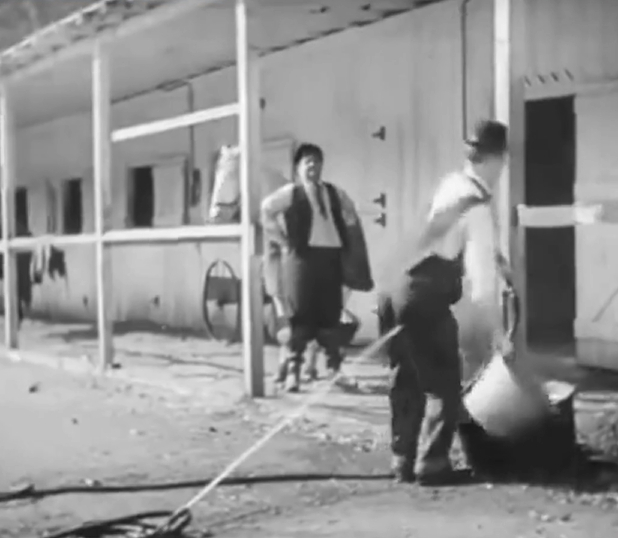
But before that adventure even begins, the audience is treated to a hilarious sequence involving a water hose, a defective bucket, and two men who cannot seem to accomplish the simplest task.
It is a perfect demonstration of what made Laurel and Hardy one of the greatest comedy partnerships in cinema history.
A Quiet Day at the Stables Goes Wrong
At the beginning of Wrong Again, Stan and Ollie are employed as stable hands.
Their responsibilities appear straightforward.
They must care for the horses, maintain the stable, and complete ordinary tasks around the property.
Unfortunately, ordinary work rarely remains ordinary when these two are involved.
The opening sequence introduces the characters through their familiar combination of clumsiness, confusion, and misplaced confidence.
Oliver Hardy attempts to manage the situation with an air of authority.
Stan Laurel follows along, apparently determined to help.
But even the simplest activities soon become unexpectedly difficult.
Their troubles begin when they attempt to fill a bucket with water.
The Bucket With No Bottom
The central joke of the stable sequence is brilliantly simple.
Stan picks up a bucket and places it beneath a water hose.
He turns on the water, expecting the bucket to fill.
Instead, the water pours straight through.
The bucket has no bottom.
Stan becomes soaked and confused by the unexpected result.
Oliver watches the situation and assumes that he can do better.
After all, he considers himself the more capable member of the partnership.
He takes control of the bucket and attempts to demonstrate the proper method.
But the problem has nothing to do with Stan’s technique.
The bucket itself is defective.
Naturally, Oliver experiences the same disastrous result.
The comedy comes from his failure to recognize the obvious problem before attempting the task himself.
Oliver Hardy’s Confidence Makes Everything Funnier
One of Oliver Hardy’s greatest comic strengths was his ability to portray a man determined to maintain his dignity.
He frequently believed that he understood situations better than Stan.
When something went wrong, he often blamed his partner.
But his attempts to correct the problem regularly produced an even greater disaster.
The bucket sequence is a perfect example.
Oliver initially treats Stan’s failure as evidence of incompetence.
He believes that taking charge will solve the problem.
Instead, he becomes just as wet and frustrated.
His reaction transforms the moment from a simple visual joke into a character-driven comedy routine.
The audience laughs not only because the bucket is broken but because Oliver’s confidence has once again been misplaced.
Stan Laurel’s Innocent Confusion
Stan Laurel’s performance provides the perfect contrast.
His character is frequently bewildered by the world around him.
He approaches ordinary tasks with sincerity, even when his actions make little sense.
When the water pours through the bucket, Stan reacts with genuine confusion.
He does not immediately understand what has happened.
His expressions invite the audience to share his surprise.
This innocent quality made Laurel an extraordinary physical comedian.
He could turn a small mistake into a memorable performance without needing exaggerated dialogue.
A puzzled glance, an awkward movement, or a moment of hesitation could communicate the entire joke.
His partnership with Hardy worked because their personalities were so different.
Stan was confused.
Oliver was confident.
And both were usually wrong.
The Flying Bucket and the Unfortunate Driver
After the repeated failures with the bucket, Oliver’s patience disappears.
In frustration, he throws the troublesome object away.
Unfortunately, his aim creates another problem.
The bucket strikes a man traveling in a horse-drawn vehicle.
The resulting accident adds another layer to the comedy.
What began as a simple attempt to collect water has now affected an innocent passerby.
This escalation is typical of Laurel and Hardy’s films.
A minor problem leads to an impulsive reaction.
That reaction creates an even larger complication.
And the characters find themselves dealing with consequences they never anticipated.
The sequence is funny because each new disaster grows naturally from the previous mistake.
The Mystery of Blue Boy
The stable comedy is only the beginning of the film’s story.
Soon, Stan and Ollie overhear two men discussing a valuable object called Blue Boy.
They learn that a reward of $5,000 has been offered for its return.
The amount immediately captures their attention.
They believe that Blue Boy is the horse they have been caring for at the stable.
After all, the animal has exactly that name.
But the men they overhear are discussing something entirely different.
The missing Blue Boy is a famous painting.
This misunderstanding becomes the central premise of the film.
Stan and Ollie decide to return the horse and claim the reward.
They have no idea that the wealthy owner is expecting a work of art rather than a living animal.
A Horse Named Blue Boy and a Famous Painting
The film’s central misunderstanding is inspired by the famous painting The Blue Boy by Thomas Gainsborough.
The painting depicts a young boy wearing a striking blue costume.
Within the film’s story, the artwork has been stolen, and its owner wants it returned.
Stan and Ollie, however, know nothing about the painting.
They simply hear the name Blue Boy and the promise of a large reward.
Their interpretation seems reasonable to them.
They work at a stable.
They care for a horse named Blue Boy.
And someone is offering money for Blue Boy’s return.
What could possibly go wrong?
The answer, of course, is almost everything.
The Horse Arrives at the Mansion
Determined to collect the reward, Stan and Ollie take the horse to the wealthy owner’s home.
The owner is initially unaware of the misunderstanding.
When he gives instructions about where Blue Boy should be placed, he assumes that the men are carrying a painting.
Stan and Ollie assume that he is talking about the horse.
The situation becomes increasingly absurd when the owner instructs them to place Blue Boy on the piano.
To an ordinary person, this would seem impossible.
But Oliver explains the unusual request by suggesting that wealthy people have strange habits.
The duo attempts to follow the instructions.
This leads to an extraordinary sequence involving a full-grown horse inside an elegant mansion.
The contrast between the refined setting and the enormous animal creates wonderful visual comedy.
Why Wrong Again Is a Silent Comedy Treasure
One of the most impressive qualities of Wrong Again is its ability to communicate a complicated misunderstanding without relying on spoken dialogue.
The film was produced during the transition from silent cinema to sound.
Its comedy depends primarily on physical action, facial expressions, and visual storytelling.
The audience understands the difference between the horse and the painting.
Stan and Ollie do not.
This gives viewers a privileged perspective.
They can anticipate the disaster long before the characters recognize their mistake.
The resulting tension makes every new development funnier.
The film demonstrates that successful comedy often depends on what the audience knows compared with what the characters believe.
Leo McCarey’s Direction and Comic Timing
Director Leo McCarey played an important role in the development of Laurel and Hardy’s screen partnership.
His approach emphasized character relationships and the gradual escalation of simple comic situations.
Rather than presenting a collection of unrelated jokes, Wrong Again allows one misunderstanding to create another.
The defective bucket sequence establishes the duo’s personalities.
The reward announcement introduces a larger misunderstanding.
The journey to the mansion develops the situation.
And the horse’s arrival creates an increasingly spectacular comic payoff.
Each stage builds on the previous one.
This structure gives the film a satisfying rhythm while allowing the performers to demonstrate their distinctive talents.
The Lasting Appeal of Laurel and Hardy
Laurel and Hardy remain beloved because their comedy is rooted in recognizable human behavior.
Everyone has made a simple mistake.
Everyone has experienced the frustration of trying to solve a problem that refuses to disappear.
And many people have encountered someone who confidently offers advice without fully understanding the situation.
Stan and Ollie exaggerate these familiar experiences into unforgettable entertainment.
Their personalities complement each other perfectly.
Stan’s innocence makes his mistakes endearing.
Oliver’s pride makes his failures especially funny.
Together, they create a partnership in which even the smallest task can become an adventure.
Why the Stable Scene Still Makes Audiences Laugh
The bucket sequence from Wrong Again is a wonderful example of timeless visual comedy.
The joke is immediately understandable.
A bucket should hold water.
This one does not.
The characters fail to recognize the problem.
Their attempts to fix it only make things worse.
The audience does not need to understand complicated dialogue or historical references.
The humor is universal.
The scene also demonstrates the importance of timing.
The performers allow the audience to recognize the problem before the characters do.
That delay creates anticipation.
When Oliver repeats Stan’s mistake, the audience receives exactly the comic payoff it has been waiting for.
Final Thoughts: One Broken Bucket and Endless Laughter
Wrong Again is a delightful reminder of Laurel and Hardy’s extraordinary ability to transform ordinary situations into classic comedy.
The opening stable sequence begins with a simple task and quickly becomes a series of ridiculous accidents.
A bottomless bucket, a water hose, and an unfortunate passerby provide the ingredients for unforgettable slapstick.
The story then develops into a larger misunderstanding involving a valuable horse and a famous painting.
Throughout the film, Stan Laurel and Oliver Hardy demonstrate the timing, chemistry, and expressive performances that made them comedy legends.
Nearly a century later, their humor continues to entertain audiences around the world.
Would you have noticed the missing bottom of the bucket before getting soaked?
#LaurelAndHardy #WrongAgain1929 #StanLaurel #OliverHardy #SilentComedy #ClassicComedy #VintageHollywood