
Every country has traditions that make perfect sense to the people who grew up with them and absolutely no sense to everyone else.
America may have more than its fair share.
Feet instead of meters. Miles instead of kilometers. Pounds instead of kilograms. A foot containing twelve inches, while almost everything else seems to prefer groups of ten. A mile containing 5,280 feet for reasons most people could not explain if their lives depended on it.
Saturday Night Live took all of those strange little facts and built one of its funniest modern sketches around a surprisingly grand idea:
What if George Washington dreamed about them before the United States even existed?
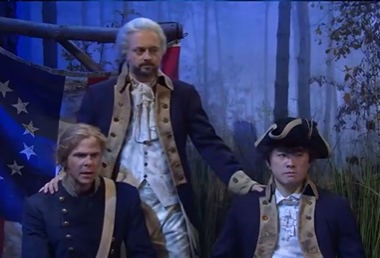
That is the wonderfully ridiculous premise of “Washington’s Dream,” starring comedian Nate Bargatze as the future first president.
The sketch takes place during the Revolutionary War. Washington stands beside his soldiers in the darkness, looking toward an uncertain future. The men around him are tired and worried. They need inspiration.
Washington gives them exactly that.
Just not the inspiration anyone expects.
Instead of talking about liberty, representative government, independence, or defeating the British, Washington begins describing his dream of a future America where people will measure things in the most confusing ways imaginable.
And he speaks about it with the solemn seriousness of a man describing destiny itself.
That contrast is what makes the sketch so funny.
The Setup Looks Like a Historical Drama
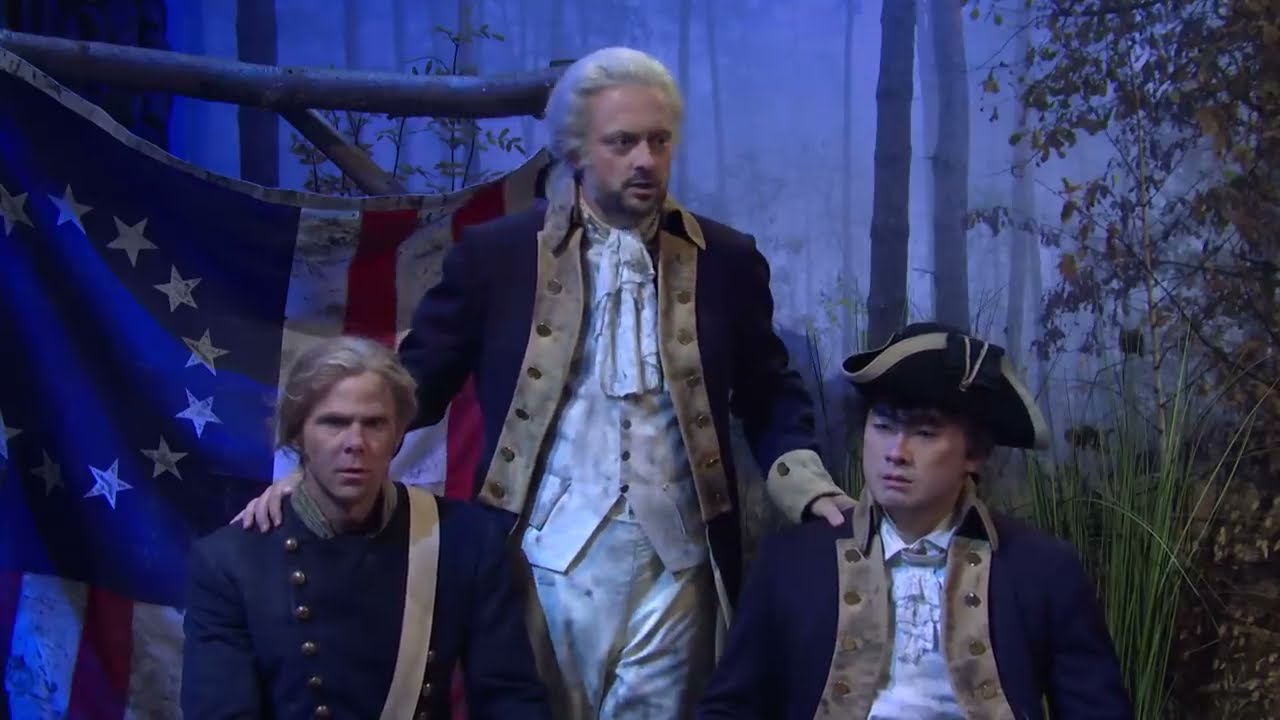
At first, “Washington’s Dream” barely looks like a comedy sketch.
The lighting is dark and dramatic.
The soldiers are gathered around their commander.
Their uniforms place them immediately in the Revolutionary era.
Nate Bargatze’s Washington speaks slowly and seriously.
Everything suggests that an important patriotic speech is coming.
Then Washington begins talking about weights and measurements.
The shift is perfect because the production never changes its tone.
Nobody suddenly announces that this is silly.
Washington treats every measurement system as if it were part of a sacred vision for the future.
His soldiers listen because he is their leader.
But gradually, their expressions reveal something important.
None of this makes any sense.
That becomes the entire engine of the sketch.
Nate Bargatze Is Perfect Because He Refuses to Push the Joke
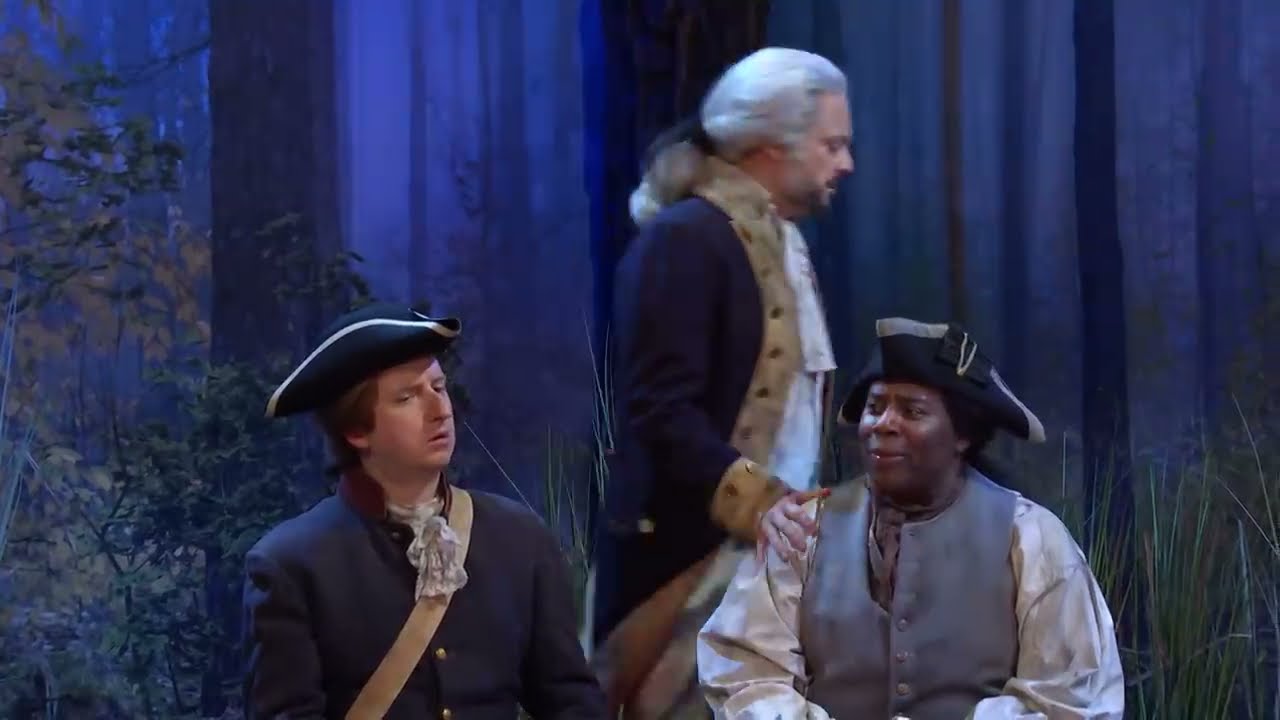
Another comedian might have performed Washington as a loud caricature.
Bargatze does almost the opposite.
His comedy has long been built around a calm, slightly confused delivery. He often sounds like a man trying to explain something he only partially understands but has already accepted as reality.
That style fits “Washington’s Dream” perfectly.
His Washington is confident.
Not energetic.
Not emotional.
Just certain.
America will use miles.
There will be 5,280 feet in each mile.
Why?
Washington does not seem especially interested in answering that question.
That is simply how America will work.
Bargatze’s performance becomes funnier because he never acts like he knows he is saying something ridiculous.
To Washington, these ideas are beautiful.
To the soldiers, they are increasingly alarming.
The audience gets to sit between those two perspectives.
The American Measurement System Is Already a Joke
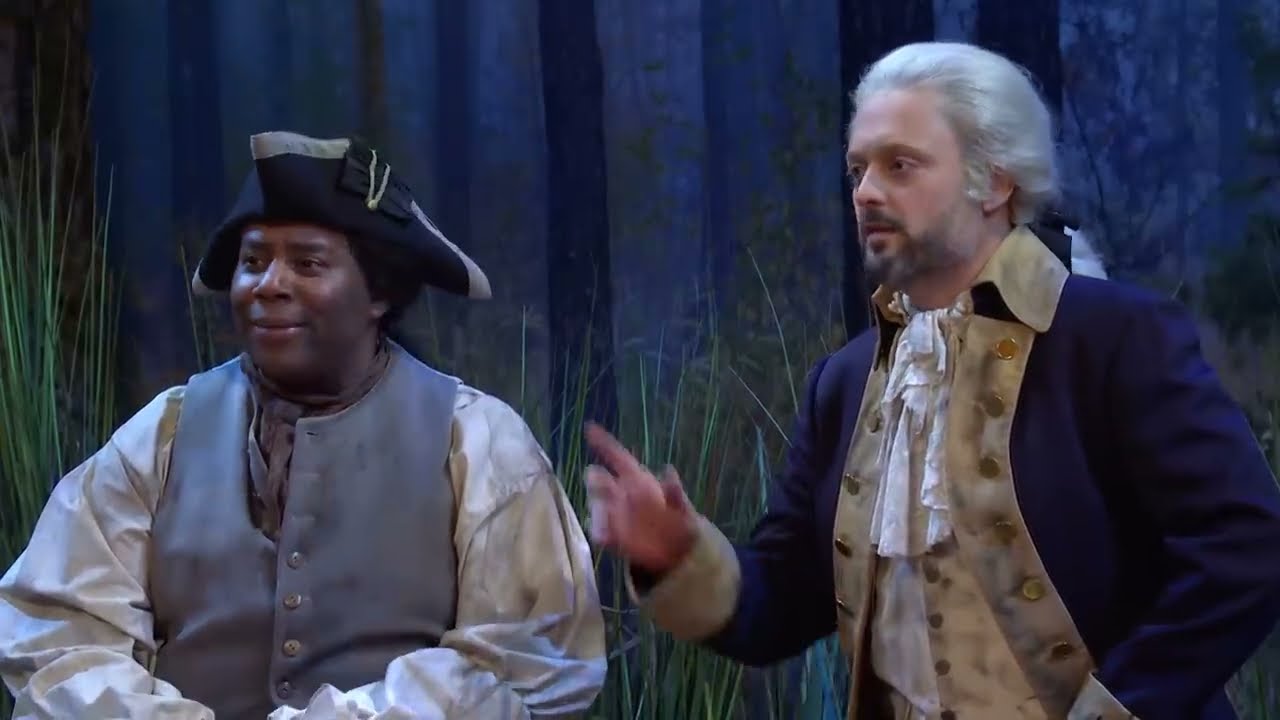
The writers had a huge advantage: the material was waiting for them.
American measurements really are confusing when you describe them out loud.
Twelve inches make a foot.
Three feet make a yard.
Then 1,760 yards make a mile.
Or, if you prefer, 5,280 feet.
These numbers sound completely arbitrary when presented without generations of familiarity.
Most Americans rarely stop to think about them because they learned them as children.
That is what the sketch cleverly exposes.
Something can feel completely normal simply because you have never known anything else.
Washington’s soldiers have not grown up with the system yet.
So they react the way an outsider might.
They ask perfectly reasonable questions.
Washington gives answers that somehow make the system even harder to understand.
The Soldiers Are Really the Audience
Mikey Day, Bowen Yang, James Austin Johnson and Kenan Thompson have an important job in the sketch.
They mostly ask questions.
That might sound easy.
It is not.
Their questions provide the logic against which Washington’s nonsense becomes funny.
A soldier hears that a mile will contain thousands of feet and naturally wants to know how that number was chosen.
Another wants to understand whether the same logic will apply somewhere else.
Every question seems reasonable.
And every answer reveals that America’s future system will become even less consistent.
The soldiers are doing exactly what the audience is doing at home.
They are trying to find the rule.
Surely there must be a pattern.
Surely Washington can explain it.
Surely all of these measurements connect somehow.
They do.
Just not in a way that anyone can easily defend.
Then the Sketch Introduces the Metric System
The appearance of meters makes everything even better.
Washington imagines a future in which much of the world adopts a system based around clean units of ten.
That sounds simple.
Logical, even.
The soldiers naturally assume America will do the same.
Washington has other plans.
America will largely continue using its own measurements.
But not always.
And that exception is crucial.
Because the United States does use metric measurements in certain situations.
A two-liter bottle of soda is perfectly normal.
So is a 100-meter race.
Medication may be measured in milligrams.
Engine sizes can be described in liters.
Yet road distances are still measured in miles, people describe their height in feet and inches, and many Americans think about body weight in pounds.
The result is not a completely separate system.
It is a strange mixture.
That is much funnier.
If America simply refused to use metric measurements entirely, the joke would be too clean.
Reality is messier.
The Football Joke Takes the Idea Even Further
One of the smartest turns comes when Washington describes sports.
Football fields will be measured in yards.
That sounds consistent enough.
But players will still try to gain inches.
And the sport called football will mostly involve carrying or throwing the ball with the hands.
The more Washington explains America’s future, the more language itself seems to become unreliable.
That is where the sketch grows beyond a joke about rulers and scales.
It becomes a joke about the strange systems people inherit.
Names survive even after they stop describing things accurately.
Rules are added on top of older rules.
Traditions accumulate.
Eventually everyone accepts the result simply because changing it would be too difficult.
Washington speaks as though all of this chaos is part of a grand national destiny.
That seriousness makes every detail funnier.
Fahrenheit Is Where Logic Completely Surrenders
Then comes temperature.
This may be the strongest example in the entire sketch because Fahrenheit is almost impossible to explain elegantly to someone who has never used it.
Water freezes at 32 degrees.
It boils at 212.
Those are not numbers anyone would naturally invent while designing a simple system from scratch.
The soldiers are understandably confused.
Why 32?
Why 212?
Why not zero and 100?
Washington is unmoved.
Those will be the numbers.
Nobody knows why.
That attitude captures the comic philosophy of the entire sketch.
Many things in life are not the result of one person sitting down and designing the perfect system.
They are inherited.
They evolve.
They survive because they are already there.
And eventually people stop asking questions.
Until someone turns them into an SNL sketch.
“Nobody Knows” Becomes the Perfect Answer
One of the funniest recurring ideas is Washington’s inability—or refusal—to explain why these systems work the way they do.
The soldiers want reasons.
Washington offers certainty instead.
This is a powerful comedy structure because the audience recognizes the feeling.
Ask an American why there are twelve inches in a foot.
You may get an answer.
Ask why there are exactly 5,280 feet in a mile.
The room may become quieter.
Ask why milk is commonly sold by the gallon but soda frequently comes in two-liter bottles.
Now things become difficult.
Many customs survive long after ordinary people have forgotten how they began.
“Nobody knows” becomes less of a punch line and more of an unexpectedly accurate description of everyday life.
Kenan Thompson Adds Another Layer
Kenan Thompson’s soldier is especially important because he repeatedly tries to bring Washington’s attention toward a far more serious question: what will freedom mean for enslaved people?
Washington keeps returning to measurements and other details of his national dream.
The contrast adds a darker edge to the comedy.
The sketch does not attempt to turn American history into a simple inspirational story. It reminds viewers that the language of freedom during the founding period existed alongside slavery, a contradiction that shaped the country’s early history. The sketch’s creators later discussed Kenan Thompson’s role as a deliberate historical counterpoint to the absurd measurements conversation.
Importantly, Thompson does not deliver a long speech.
He asks a question.
Washington avoids it.
That is enough.
The joke lands because the audience understands what is being left unresolved.
The Sketch Never Loses Its Straight Face
One of the biggest reasons “Washington’s Dream” works is discipline.
The performers never allow the sketch to become too broad.
Nobody begins screaming.
Washington does not suddenly become a cartoon.
The soldiers do not collapse from frustration.
Everyone remains inside the historical-drama style.
That restraint protects the central joke.
Imagine the exact same dialogue performed with exaggerated voices and constant mugging toward the camera.
It would become exhausting quickly.
Instead, Bargatze speaks like a leader revealing the future.
The soldiers react like men trying to understand their commander.
The ridiculousness comes from the words.
Nothing else needs to force the laughter.
It Feels Like Classic SNL Despite Being Very Modern
Some SNL sketches depend heavily on the week in which they aired.
They parody a political speech from three days earlier.
They reference a celebrity scandal everyone is discussing.
Those sketches can be hilarious in the moment and confusing ten years later.
“Washington’s Dream” is different.
The basic joke is unlikely to expire.
As long as Americans continue buying gasoline by the gallon, measuring roads in miles, running races in meters, and drinking soda by the liter, the sketch will have material.
That timelessness gives it the feeling of older classic sketches.
You do not need to remember what happened in the news on October 28, 2023.
You only need to have encountered American measurements.
It Became Bigger Than Anyone Expected
The sketch quickly became one of the standout pieces from Bargatze’s first hosting episode and remained widely discussed afterward. Entertainment Weekly highlighted it in its recap of the episode, and Bargatze later said the sketch helped take his public profile to “a whole other level.”
Its popularity was strong enough that when Bargatze returned to host SNL in October 2024, the show produced “Washington’s Dream 2,” bringing back the same basic group of characters and expanding the joke into more strange American customs.
A sequel is always risky.
The fact that audiences immediately understood why Washington was back shows how quickly the original sketch had become recognizable.
The Joke Is Really About Familiarity
Underneath all the historical costumes and measurement jokes is a simple observation.
Humans can get used to almost anything.
If you grow up hearing that a foot has twelve inches, twelve feels normal.
If someone proposed that system today, you might ask whether they were serious.
Tradition has enormous power.
It makes strange things feel ordinary.
“Washington’s Dream” reverses that process.
It takes rules Americans usually accept without thinking and presents them as brand-new ideas.
Suddenly, the familiar becomes ridiculous again.
That is one of comedy’s most useful tricks.
You do not always need to invent something absurd.
Sometimes you simply need to look carefully at something everyone already does.
The Simplicity Is What Makes It Great
The entire premise can be explained in one sentence:
George Washington describes America’s confusing future measurement system to soldiers who have never heard of it.
That is all SNL needs.
There is no complicated plot.
No elaborate twist.
No huge celebrity cameo.
Just one extremely strong idea, one performer perfectly suited to deliver it, and four supporting actors asking exactly the questions the audience wants answered.
By the end, Washington has revealed a future nation where distances, temperatures, sports, weights, liquids, and units follow a collection of rules that seem almost intentionally designed to frustrate anyone searching for consistency.
His soldiers are confused.
Washington remains proud.
And Americans watching at home realize that they have spent their entire lives treating all of it as perfectly normal.
That may be why “Washington’s Dream” became such an immediate favorite.
It does not really make fun of George Washington.
It makes fun of us.
Our measurements.
Our traditions.
Our ability to live inside systems we cannot explain.
And our confidence that somehow, despite everything, it all makes sense.
Why are there 5,280 feet in a mile?
Why does water freeze at 32 degrees?
Why do Americans run 100 meters but drive 100 miles?
Why does soda come in liters while gasoline comes in gallons?
There are historical explanations for these things, of course.
But after watching Nate Bargatze stare into the distance with complete confidence, one answer feels much funnier.
Nobody knows.