
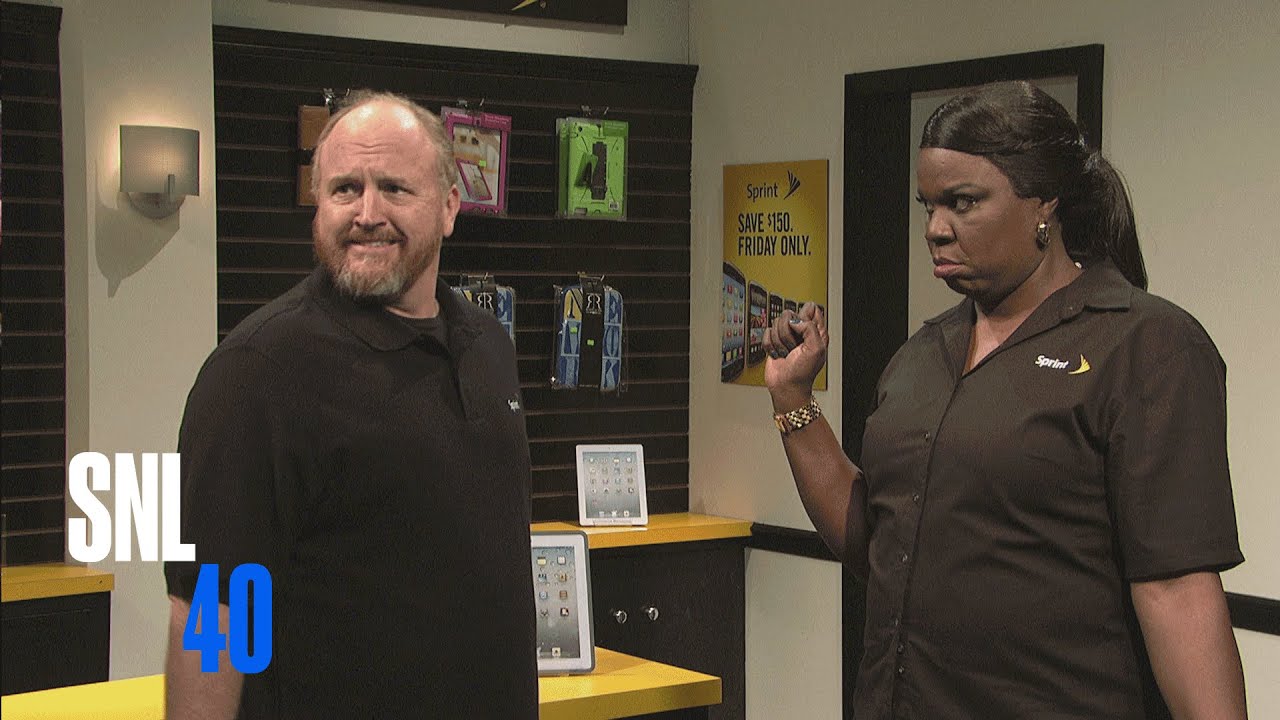
Some Saturday Night Live sketches begin with a complicated premise that takes a minute to understand.
“This Is How I Talk” needs about ten seconds.
A nervous new employee makes fun of his boss.
She hears him.
He panics.
Instead of apologizing, he makes the worst possible decision.
He claims that the offensive impression she just heard is actually his natural speaking voice.
From that moment forward, there is no escape.
The sketch, starring Louis C.K. and Leslie Jones, takes one lie and stretches it until the lie becomes an entire identity. Every attempt to survive the situation creates another problem. Every explanation forces Louis C.K.’s character deeper into a performance he desperately wants to stop.
The result is one of those beautifully uncomfortable SNL sketches where the audience can see disaster coming long before the character does.
And that is exactly what makes it funny.
A New Job Already Feels Dangerous

Louis C.K. plays Donald, a man starting work at a Sprint phone store.
Before anything unusual happens, we already learn something important about him.
He needs this job.
He has been unemployed.
He does not want to ruin another opportunity.
That information immediately raises the stakes.
Donald is not a confident employee who can simply quit if something goes wrong.
He is nervous.
He wants to make a good impression.
His coworkers, played by Jay Pharoah and Vanessa Bayer, welcome him and explain how the store operates.
Then they give him one piece of advice.
Do not upset Brenda.
Brenda, played by Leslie Jones, is the manager.
She enters loudly, aggressively, and with exactly the kind of energy Donald was warned about.
She tells everyone to work.
Then she leaves.
That should be the end of the moment.
Donald should nod, remember the warning, and go back to his job.
Instead, he decides to imitate her.
It may be the fastest career mistake in SNL history.
Donald Makes the Worst Possible Choice
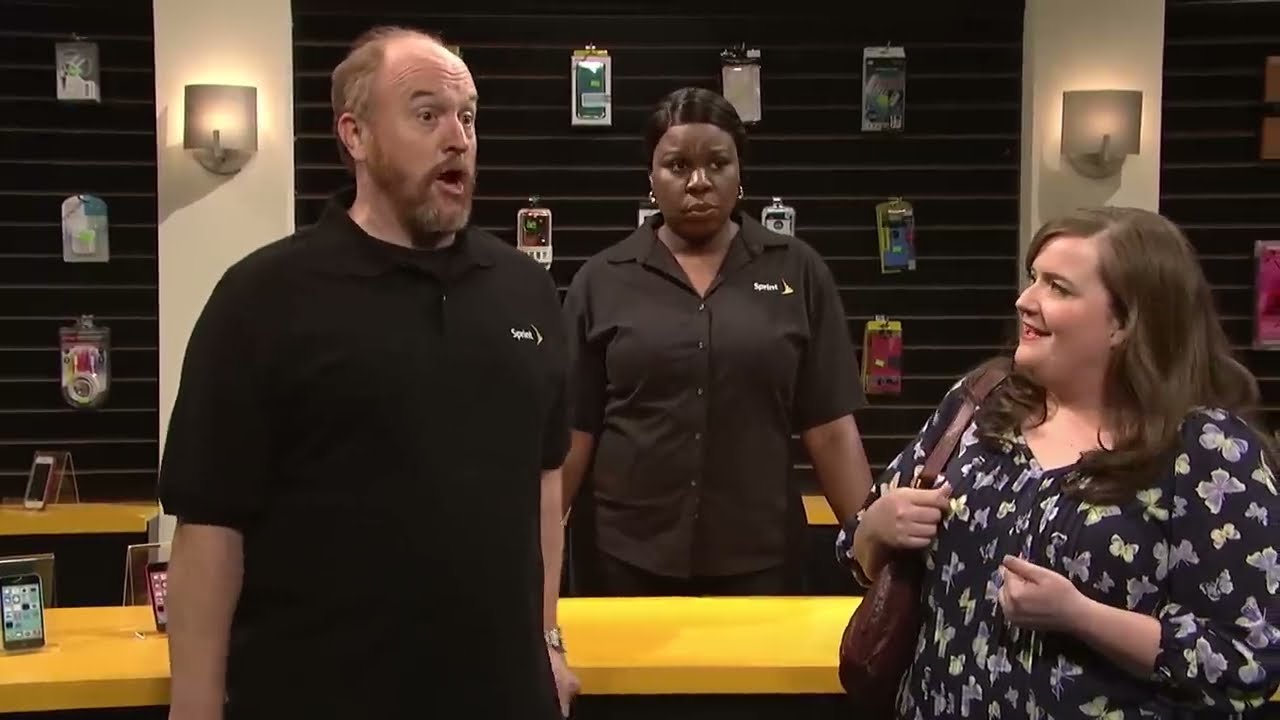
Donald begins repeating Brenda’s words in an exaggerated imitation.
He thinks she is gone.
She is not.
Suddenly Brenda is standing behind him.
Everyone freezes.
Donald realizes he has been caught making fun of the person who controls whether he keeps his new job.
There are several reasonable ways to respond.
He could apologize.
He could admit he was nervous.
He could say he made a stupid joke.
Donald chooses none of them.
Instead, he claims that he was not imitating Brenda at all.
That is simply how he talks.
It is an extraordinary lie because it solves the immediate problem while creating a much larger one.
Brenda cannot accuse Donald of mocking her if this is genuinely his voice.
But now Donald has to prove it.
For the rest of the sketch.
Possibly for the rest of his employment.
Maybe forever.
That is where the comedy trap closes.
Louis C.K.’s Awkwardness Becomes the Engine
The sketch is perfectly suited to Louis C.K.’s comic style because Donald is trapped by his own social discomfort.
He is not a brilliant liar.
He is not manipulating Brenda because he has a clever plan.
He is improvising badly.
Every second.
You can see the panic on his face as Brenda asks questions.
Donald has to think quickly enough to keep the lie alive but not quickly enough to make it convincing.
That gap creates the humor.
He speaks in the exaggerated voice.
He tries to behave naturally.
Nothing about him looks natural.
The audience knows he wants to stop.
His coworkers know something is wrong.
Brenda becomes increasingly interested in him.
And Donald has no idea how to return to his real voice without admitting what happened.
The more uncomfortable he becomes, the funnier the sketch gets.
Leslie Jones Gives Donald No Room to Escape
Brenda is the perfect character to put opposite Donald.
She is direct.
She is confident.
She does not quietly wonder whether something seems suspicious.
She asks.
That forces Donald to keep producing explanations.
If Brenda simply ignored him, the joke would end.
Instead, she starts accepting his claim.
That is worse.
Now she wants to connect with him.
Donald wanted Brenda to stop being angry.
He succeeds.
Unfortunately, he succeeds so completely that she starts treating him like someone who genuinely shares her style of speaking.
The escape route disappears.
Every friendly interaction becomes another test.
Can Donald maintain the voice?
Can he invent a believable background?
Can he answer a normal question without exposing himself?
The answer keeps being barely.
The Coworkers Make Everything More Painful
Jay Pharoah and Vanessa Bayer play an important role because they know what happened.
They saw Donald before Brenda entered.
They heard his normal voice.
They heard him begin the impression.
So now they have to stand there while he pretends this ridiculous voice has always belonged to him.
Their reactions add another level of embarrassment.
Donald cannot even convince himself that the performance is believable.
His coworkers certainly are not convinced.
But Brenda is his boss.
Nobody wants to be the person who suddenly explains that the new employee was mocking her.
So everyone becomes trapped inside Donald’s lie.
That is a great comedy structure.
One person makes a mistake.
Then everyone else has to participate in maintaining the consequences.
The Sketch Is Really About the Danger of Doubling Down
Donald’s biggest problem is not the original impression.
It is the refusal to admit what he did.
That is why the sketch becomes relatable even beyond its specific subject.
Most people have experienced a moment when they said something stupid and immediately had two choices.
Tell the truth.
Or make things worse.
Donald makes things worse.
Then he makes them worse again.
Every lie requires another lie.
The original problem might have lasted thirty seconds.
An apology could have ended everything.
Instead, Donald builds an entire fake personality because he is too frightened to face one uncomfortable conversation.
That pattern is universal.
Maybe your mistake was not impersonating your manager.
But almost everyone understands the feeling of realizing halfway through an explanation that honesty would have been much easier.
Then the Sketch Introduces Another Twist
Just when Donald’s situation appears impossible, Brenda reveals something unexpected.
The aggressive voice everyone hears from her may not be the full story.
Suddenly, Brenda demonstrates that she can speak in a completely different way.
Now the entire premise shifts again.
Donald has spent the whole sketch pretending.
It turns out Brenda may understand pretending better than he thought.
For a brief moment, Donald believes he has found freedom.
If Brenda has been performing a voice, perhaps Donald can finally stop performing his.
He relaxes.
He returns to something closer to his real manner of speaking.
It feels like the nightmare is ending.
Of course, this is Saturday Night Live.
The nightmare is not ending.
The Final Reversal Is What Makes the Sketch Work
The last turn reveals that Brenda has understood far more than Donald realized.
His relief disappears immediately.
The lie collapses.
The entire elaborate performance has accomplished nothing.
This is the perfect ending because Donald’s punishment does not come from some random new event.
It comes directly from his original decision.
He tried to escape responsibility by pretending.
The pretending becomes the evidence against him.
That is good sketch construction.
The ending grows naturally from the premise.
Donald does not lose because he is unlucky.
He loses because he could not stop lying.
The Sketch Is Also About Performance
There is another clever layer underneath the workplace story.
Almost everybody is performing something.
Donald performs a voice because he is afraid of being fired.
Brenda presents herself one way at work while suggesting there may be another side to how she speaks.
The employees adjust their behavior depending on who is in the room.
The entire store becomes a place where language, identity, and authority are being negotiated.
That makes the sketch more interesting than a simple impression joke.
How people speak can change depending on workplace, family, neighborhood, social group, or professional environment.
People sometimes code-switch without even thinking about it.
They adjust vocabulary, tone, volume, and rhythm depending on the situation.
“This Is How I Talk” pushes that very real phenomenon into absurd territory.
Donald does not simply change slightly.
He invents an entirely different version of himself in seconds.
Then he becomes trapped inside it.
The Racial Element Makes the Comedy More Uncomfortable
The sketch deliberately plays with race and assumptions about speech.
That is part of why it creates such strong secondhand embarrassment.
Donald is a white employee caught imitating a Black female manager in a stereotyped way.
The audience immediately understands why getting caught is so dangerous.
This is not simply one coworker copying another coworker’s funny voice.
The imitation carries cultural baggage.
That makes Donald’s attempt to escape even more desperate.
The sketch places the audience in an unusual position.
We know Donald has done something wrong.
We also know he is terrified.
We watch him make increasingly ridiculous choices because he cannot bring himself to say the simplest sentence:
“I’m sorry.”
The humor comes from watching someone discover that avoiding embarrassment can become much more embarrassing than admitting the truth.
Leslie Jones Uses Confidence as Comedy
Jones is especially effective because she never needs to make Brenda uncertain.
Donald is uncertain enough for everyone.
Brenda occupies the space.
She speaks directly.
She expects employees to respond.
When she becomes suspicious, Donald begins falling apart.
This contrast creates a strong comic rhythm.
Brenda advances.
Donald retreats.
Brenda asks.
Donald invents.
Brenda believes.
Donald panics because she believes.
That last part is especially funny.
Normally, a liar wants to be believed.
Donald eventually reaches the point where being believed is almost as dangerous as being exposed.
If Brenda accepts his fake voice completely, he may have to use it every day.
Imagine maintaining that performance for an entire shift.
Then a week.
Then months.
Donald has saved his job and destroyed his life at the same time.
The Sprint Store Is the Perfectly Ordinary Setting
The sketch could take place almost anywhere, but the phone store setting helps.
Nothing about the location is dramatic.
There is no courtroom.
No police station.
No presidential office.
Just retail.
That makes Donald’s panic funnier.
He is not trying to avoid prison.
He is trying to survive his first day at work.
The stakes are small enough to be ridiculous and large enough to matter to him personally.
Retail workplaces also create constant forced interaction.
Donald cannot simply hide in an office.
He has customers.
Coworkers.
A manager walking around.
The fake personality has to function in public.
That makes the lie impossible to contain.
Good Comedy Often Comes From Watching Someone Get Trapped
Many classic comedy routines use the same basic mechanism.
A character makes one small mistake.
Instead of fixing it, he tries to hide it.
The hiding creates a second mistake.
Then a third.
Eventually, the original problem barely matters.
“This Is How I Talk” follows that tradition perfectly.
The impression lasts only seconds.
The consequences consume the entire sketch.
Donald spends far more energy defending the lie than an apology would ever have required.
That is why the premise feels so satisfying.
The audience sees the exit door from the beginning.
Donald simply refuses to use it.
Why the Sketch Still Works
The episode aired in May 2015, but the core situation does not depend on news from that year.
People still have bosses.
People still say stupid things when they think someone cannot hear them.
People still panic when they are caught.
And people still turn manageable problems into disasters because admitting the truth feels too uncomfortable.
The specific cultural context adds another layer, but the comic structure is timeless.
Donald needs a job.
Donald mocks his boss.
His boss hears him.
Donald lies.
Everything gets worse.
That is all a strong sketch really needs.
One Bad Impression, One Terrible Lie, and No Way Out
By the end, Donald has learned one of comedy’s oldest lessons.
The cover-up is usually worse than the mistake.
He could have admitted what happened.
He could have apologized.
Maybe Brenda would have been angry.
Maybe she would have fired him anyway.
But at least the humiliation would have ended quickly.
Instead, Donald creates a fictional voice, a fictional personality, and an increasingly impossible explanation for who he is.
For a few moments, he even seems to believe he might survive.
Then Brenda proves she has been paying attention.
The trap snaps shut.
And the man who began the day desperately trying not to lose another job discovers that his greatest threat was never Brenda.
It was his own mouth.
That is why “This Is How I Talk” works so well.
It takes a painfully human instinct—say anything to escape an embarrassing moment—and follows it to the worst possible conclusion.
Donald makes one joke.
Brenda hears it.
He has one chance to tell the truth.
He does not.
From there, all that remains is to watch the disaster grow.
And sometimes, that is exactly what great sketch comedy does best.