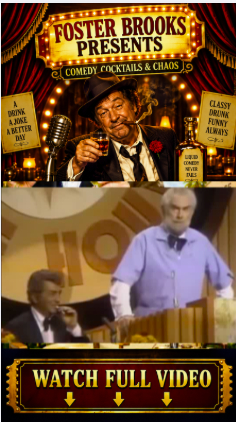
Foster Brooks Knew How to Make a Joke Stick
A memorable joke is rarely just about the words.
Delivery matters.
Timing matters.
The personality of the performer matters.
Foster Brooks understood all three.
He could take a relatively simple comedic idea and make it feel unique because audiences immediately recognized the character delivering it. Before the punchline even arrived, his voice and mannerisms had already created anticipation.
The audience knew something ridiculous was coming.
That expectation became part of the joke.
His Famous Drunk Persona Did the Heavy Lifting
Brooks’ exaggerated drunken character was one of the most recognizable comedy personas of his era.
The character’s slow speech and strange confidence created an unusual contrast. He often appeared uncertain while simultaneously behaving as though he were completely in control.
That contradiction gave Brooks enormous comedic freedom.
A simple statement could become hilarious because of the character’s perspective.
A normal situation could become absurd because of the way he interpreted it.
And a joke that might have sounded ordinary from another comedian could become unforgettable in Brooks’ hands.
The Delivery Was Often Funnier Than the Punchline
Foster Brooks understood that the road to a joke could be just as important as the destination.
He might pause before a sentence.
He might stretch a word.
He might change his expression halfway through an idea.
He might wait while the audience anticipated what he was going to say.
Those details transformed the material.
The audience was not simply waiting for the punchline.
They were enjoying Brooks’ journey toward it.
That is why his jokes could remain memorable even when separated from the original context.
People remembered how he said them.
His Pauses Created Anticipation
Silence can be one of the most powerful tools in comedy.
Foster Brooks knew exactly how to use it.
Rather than rushing from one joke to the next, he allowed moments to breathe. Sometimes the pause itself created laughter because the audience understood what the character was about to do.
The longer the silence lasted, the more anticipation developed.
Then came the line.
That rhythm could turn a small joke into a major comedic moment.
The Audience Often Saw the Joke Coming
There is an interesting paradox in Foster Brooks’ comedy.
The audience could sometimes predict that something ridiculous was about to happen.
And that made it funnier.
Once people recognized the character’s patterns, they began anticipating his next move. But Brooks was skilled at delaying the expected moment or approaching it from a slightly different angle.
The audience knew the laugh was coming.
They just did not know exactly when.
That tension kept his performances exciting.
His Expressions Added Another Punchline
Foster Brooks’ face often told a story alongside his words.
A quick grin could suggest that his character had just had a brilliant—or completely terrible—idea.
A confused expression could make a misunderstanding even funnier.
A long stare could allow the audience to absorb the absurdity of what had just been said.
These reactions meant that the joke did not necessarily end when the sentence ended.
Sometimes the expression afterward was the real finishing touch.
He Made Ordinary Material Feel Extraordinary
One reason Foster Brooks’ comedy remains fascinating is that his style did not require elaborate premises.
He could work with familiar situations.
The character itself provided the entertainment.
That was an enormous advantage.
Once the audience accepted the premise of the exaggerated drunk character, almost anything could become funny.
A conversation could go wrong.
A simple question could become complicated.
A straightforward explanation could turn into nonsense.
Brooks knew how to squeeze comedy out of those ordinary situations.
Hollywood Audiences Understood His Style
Foster Brooks became a familiar presence in American entertainment, appearing in television and comedy environments where audiences understood the language of celebrity and show business.
His humor worked particularly well in those settings because his character was so distinctive.
He did not need to spend a long time explaining who he was.
The voice did much of the work.
The audience recognized the persona.
Then they waited for the inevitable escalation.
The Joke Became Bigger Through Repetition
A memorable comedy line often gains power when audiences repeat it.
That is especially true when the line is associated with a distinctive performer.
Foster Brooks had that advantage.
His mannerisms and voice were so recognizable that people could imitate the style and immediately evoke the original performance.
The joke became more than a sentence.
It became part of a larger comedic identity.
That helped his humor remain recognizable long after the original television appearance was over.
His Confidence Made the Absurdity Work
One of Brooks’ most effective techniques was his character’s complete confidence.
Even when something was clearly going wrong, he could deliver his response as though he had solved the problem.
That confidence made the situation even more ridiculous.
The audience knew the character was not exactly reliable.
The character seemed convinced otherwise.
Every new statement therefore carried the possibility of making the situation worse.
That was the engine behind much of Brooks’ escalating comedy.
He Understood the Rhythm of Laughter
Great comedians do not simply deliver jokes.
They listen.
Foster Brooks knew how to let the audience react.
If a line generated a strong laugh, he could wait before continuing.
That pause allowed the laughter to become part of the performance.
Then he could move forward with another line or expression.
The audience became part of the timing.
This is one reason watching Brooks can feel different from reading his jokes on a page. The written words alone cannot reproduce the rhythm.
The performance was the real comedy.
Why the Laughter Could Continue Afterward
The best comedy moments often become memorable because they are easy to recall.
People remember the voice.
They remember the expression.
They remember the pause.
They remember how the audience reacted.
With Foster Brooks, all those elements could become attached to a single joke.
That is why the laughter did not necessarily stop when the show ended.
The moment could be retold.
The delivery could be imitated.
The character could be remembered.
The joke became part of the audience’s experience rather than simply another piece of dialogue.
Foster Brooks Created Comedy That Had a Personality
That may be the biggest reason his work continues to stand out.
His comedy did not feel anonymous.
You could hear a line and recognize the personality behind it.
You could see a particular expression and know exactly what kind of character was coming next.
Foster Brooks gave his jokes an identity.
And jokes with identity tend to last.
The Legacy of a Classic Comedy Moment
Foster Brooks belonged to a generation of entertainers who understood the value of performance.
The joke mattered.
But the voice delivering it mattered too.
The pause mattered.
The reaction mattered.
The audience mattered.
Together, those elements created something much more memorable than a simple punchline.
They created a moment.
The Foster Brooks Joke That Had Hollywood Laughing Long After the Show Ended
That is what makes Foster Brooks’ comedy so enduring.
His jokes were not simply funny because of what was said. They were funny because of the entire world he created around them.
The unmistakable voice.
The exaggerated character.
The slow delivery.
The confident nonsense.
The perfectly timed pauses.
The facial expressions.
And the audience laughter that seemed to encourage him to keep going.
The show might have ended, but the joke could remain in people’s memories because it was attached to something larger: the unforgettable personality of Foster Brooks.
That was his gift—turning a simple joke into a moment people could keep laughing about long after the curtain fell.