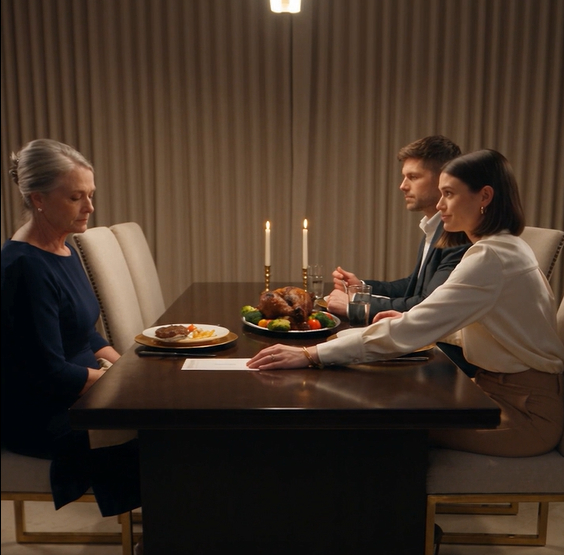
“Actually,” I said, “I think it’s time all of us faced reality.”
Brent frowned.
Rya folded her arms.
I pulled a slim white envelope from my purse and placed it on the table.
For the first time that evening, Rya stopped smiling.
“What’s that?”
“Something my lawyer prepared.”
Brent gave a short laugh.
“Your lawyer?”
“Yes.”
He looked at Rya.
They both thought I was bluffing.
I opened the envelope.
Inside was a copy of my updated estate plan.
Not the whole thing.
Just enough.
My son stared at the attorney’s letterhead.
“Mom, what is this?”
“You’ve spent weeks deciding what should happen to me,” I said. “So I decided what should happen to everything I own.”
Rya rolled her eyes.
“Dela, you rent an apartment.”
I looked at her.
“For now.”
That made her pause.
Brent leaned forward.
“What does that mean?”
I reached into my purse again.
This time, I removed a photograph.
It showed me standing beside my attorney at the state lottery office, holding an oversized ceremonial check.
The amount printed across it was impossible to miss.
$62,000,000.
Nobody spoke.
Rya’s fork slipped from her hand and hit the plate.
Brent stared at the picture.
Then at me.
Then back at the picture.
“Is this real?”
“Yes.”
His face changed completely.
Not slowly.
Instantly.
The irritation disappeared.
The impatience disappeared.
Even his posture changed.
“Mom…”
Rya grabbed the photograph.
“Sixty-two million dollars?”
“That was the advertised jackpot.”
“How long have you known?”
“Several weeks.”
Brent pushed away from the table.
“You knew all this time?”
“Yes.”
“And you didn’t tell me?”
I almost laughed.
“You left me on the side of a road with eight dollars.”
Rya’s expression hardened.
“That was a joke.”
“No.”
I shook my head.
“A joke is funny to the person it happens to.”
Her eyes narrowed.
“We didn’t know you were going to buy a lottery ticket.”
“Exactly.”
That sentence silenced her.
Because there it was.
If I had still been the same retired nurse living on a careful budget, they would have continued treating me exactly the same way.
The money hadn’t changed their behavior yet.
Only the knowledge of it had.
Brent walked around the table.
“Mom, listen. That night got out of hand.”
“It did.”
“I was angry.”
“You drove away.”
“I thought you’d call someone.”
“You knew I had no one nearby.”
He stopped.
I continued.
“Then I called you from the hospital.”
His face tightened.
“That wasn’t serious.”
“You didn’t know that.”
Rya stood.
“This is ridiculous. We were trying to help you.”
“By putting me in assisted living?”
“You’re alone.”
“I’m sixty-three.”
Neither of them answered.
I looked at Brent.
“Your grandmother lived alone until she was eighty-seven.”
“That’s different.”
“How?”
He couldn’t explain.
Then Rya’s expression suddenly softened.
It was almost impressive.
She stepped closer.
“Dela, this is huge.”
Her voice had become warm.
Gentle.
The exact voice she used when she wanted something.
“You shouldn’t be handling this alone.”
There it was.
I waited.
She continued.
“Brent understands investments. We could help you protect the money.”
I looked at my son.
He didn’t deny it.
Instead he nodded.
“We absolutely could.”
“Interesting.”
“What?”
“Five minutes ago, you were trying to put me in Sunset Manor.”
Brent rubbed his forehead.
“Mom, please stop framing everything in the worst possible way.”
I picked up my handbag.
“No.”
His voice sharpened.
“No what?”
“No, I won’t stop calling things what they are.”
I stood.
My grandchildren were watching from the other end of the table.
That was the only reason I kept my voice calm.
I walked over and kissed each of them.
“I love you.”
My granddaughter whispered, “Are you leaving?”
“Yes, sweetheart.”
“Will you come back?”
I looked at Brent.
“That depends.”
Rya followed me toward the door.
“Dela, don’t be childish.”
I turned.
“Childish?”
“You dropped a sixty-two-million-dollar bomb at dinner just to punish us.”
“No.”
I smiled.
“I told you because tonight was your last chance.”
Brent froze.
“Last chance for what?”
“To treat me like your mother before you knew I was rich.”
Silence.
“And you failed.”
I walked out.
My phone started ringing before I reached my car.
Brent.
Then Rya.
Then Brent again.
I switched it off.
The next morning, I had eleven missed calls.
By lunch, twenty-three.
Then came the texts.
Mom, we need to talk.
I’m sorry.
The kids miss you.
Please don’t make major financial decisions while you’re emotional.
That last one almost made me laugh.
Even while apologizing, Brent still needed to remind me that he thought I couldn’t trust my own judgment.
Rya’s messages were different.
Family should share good fortune.
Then:
Think about everything Brent has done for you.
I stared at that one for a long time.
Then I made a list.
Everything Brent had done for me.
There were good things.
Birthday dinners.
Christmas gifts.
A few doctor’s appointments years earlier.
He wasn’t an evil son.
That would have been easier.
He was simply a son who had gotten used to receiving more from me than he gave back.
And somewhere along the way, he decided my usefulness determined my value.
I didn’t want revenge.
I wanted clarity.
So I gave them one more test.
Two weeks later, I asked Brent to meet me at a small diner.
No Rya.
Just us.
He arrived twenty minutes early.
That alone told me something.
He hadn’t arrived early for lunch with me in years.
He hugged me too tightly.
“Mom, I’ve been worried sick.”
I sat down.
“You knew where I was.”
He ignored that.
For the next ten minutes, he apologized.
He said stress had affected him.
He said Rya had pressured him.
He said the roadside incident had been stupid.
He said the assisted-living idea had come from concern.
Then he finally said:
“I don’t want money to come between us.”
I almost admired the sentence.
“Then we can remove money from the conversation.”
He blinked.
“What?”
“I’ve made arrangements so you will never need to manage any of it.”
His face shifted.
Barely.
But I saw it.
“What arrangements?”
“A trust.”
He stared at me.
“What kind of trust?”
“One controlled by professionals.”
“Why would you pay strangers to manage family money?”
There it was.
Not my money.
Family money.
I leaned back.
“Because they don’t leave me on sidewalks.”
His jaw tightened.
“Mom.”
“And they don’t suggest removing me from my home.”
“I already apologized.”
“You did.”
“Then what else do you want?”
“The truth.”
“What truth?”
“Would you be sitting here if I hadn’t won?”
He looked offended.
“Of course.”
“When was the last time you invited me to lunch before you knew?”
He opened his mouth.
Closed it.
I nodded.
“That’s what I thought.”
Brent looked down at the table.
For the first time since the lottery, he stopped performing.
“I messed up.”
“Yes.”
“I got used to you always being there.”
“Yes.”
“I thought… I don’t know.”
He rubbed his eyes.
“I thought you needed us more than we needed you.”
That one hurt.
But at least it was honest.
I reached across the table and touched his hand.
“Brent, I do need family.”
He looked up.
“But I don’t need to buy one.”
His eyes filled.
That was the first moment I believed he was actually sorry.
Not enough to erase what happened.
But enough to make a beginning possible.
Rya was different.
When she learned I had placed most of the winnings in protected trusts, she became furious.
Not sad.
Not apologetic.
Furious.
She called me selfish.
Then manipulative.
Then controlling.
Finally, she said something that made everything simple.
“You could change your grandchildren’s lives overnight, and instead you’re hoarding money to prove a point.”
I answered calmly.
“I am changing their lives.”
She went silent.
I had already created education trusts for both children.
Neither Brent nor Rya could withdraw from them.
The money would cover tuition, books, housing, and approved educational expenses.
I also created a separate trust to help them with their first homes when they became adults.
Rya would never control a dollar.
Neither would Brent.
My lawyer had structured everything carefully.
When Rya realized that, she stopped calling me for almost two months.
Brent didn’t.
He came alone.
Sometimes with the children.
Sometimes without them.
At first, every visit felt awkward.
Then something slowly changed.
He started asking how I was instead of what I was doing with the money.
He took me to a cardiology follow-up.
He fixed a leaking faucet in my apartment even after I told him I could hire someone.
And once, when I offered to pay for dinner, he shook his head.
“My turn.”
It was such a small thing.
It almost made me cry.
As for the money, I did change my life.
Just not the way Rya expected.
I bought a comfortable three-bedroom house with a garden.
Nothing enormous.
Nothing with marble floors or twelve bathrooms.
I bought a reliable car.
I traveled.
I funded scholarships for nursing students who were raising children alone.
That mattered to me more than any mansion.
I also donated to a local emergency-housing organization for older women.
Because I never forgot what it felt like to stand on a dark street wondering how I was going to get home.
A year after the lottery, I returned to the convenience store where I bought the ticket.
The same clerk was working.
He recognized me.
“You’re the lottery lady.”
I laughed.
“I suppose I am.”
I handed him an envelope.
Inside was enough money to help him finish the community-college program he had once told me about.
He stared at it.
“I can’t take this.”
“Yes, you can.”
“Why?”
“Because you asked if I was okay that night.”
He looked confused.
“That’s all?”
“No.”
I smiled.
“That was everything.”
Sometimes kindness is enormous only because of when it arrives.
Brent and I never went completely back to the way we were.
I’m glad.
The old relationship had required me to give endlessly and call it love.
The new one had boundaries.
Rya never fully forgave me for those boundaries.
Eventually, she and Brent began having problems of their own.
I stayed out of them.
I had spent too much of my life fixing things that weren’t mine to fix.
Two years after the night she threw eight dollars at my feet, Rya came to my house alone.
She stood on the porch looking uncomfortable.
“I owe you an apology.”
I waited.
She swallowed.
“What I did that night was cruel.”
“Yes.”
“And the assisted-living thing…”
She looked down.
“That wasn’t really about you.”
“I know.”
She admitted that she and Brent had been overwhelmed financially.
They had debts I didn’t know about.
She had convinced herself that if I moved into assisted living eventually, I might sell my belongings, give up my apartment, and become easier for them to “manage.”
She hated saying the word.
I hated hearing it.
But I appreciated the truth.
“I thought because you always helped us, you would keep doing it forever.”
I nodded.
“So did I.”
She looked at me.
“Do you forgive me?”
I thought carefully.
“I’m working on it.”
That was the truth.
Forgiveness, I learned, did not mean restoring someone’s access to the version of you they mistreated.
Rya nodded.
Then she left.
That night, I went into my office and opened the small safe beside my desk.
Inside were important papers.
My updated will.
The trusts.
The original lottery photograph.
And one tiny plastic bag.
Inside it were three one-dollar bills.
The only money left from the eight dollars Rya had thrown beside my shoes.
I had spent five on the ticket.
I kept the remaining three.
Not because they were lucky.
Because they reminded me of the moment my life changed.
People love to say winning sixty-two million dollars changed me.
They’re wrong.
The money changed my circumstances.
That street changed me.
The moment my son drove away was when I finally understood I could no longer spend my life proving my worth by being useful.
The lottery ticket only gave me the freedom to act on what I had already learned.
Rya thought eight dollars was enough to send me home.
Instead, five of those dollars bought the ticket that made sure I would never again have to beg anyone for a place to stay.
And the remaining three?
I kept them as a reminder.
I had once believed being needed meant being loved.
Now I knew better.
Love doesn’t leave you on the sidewalk.
And family doesn’t become family only after finding out you’re worth sixty-two million dollars.