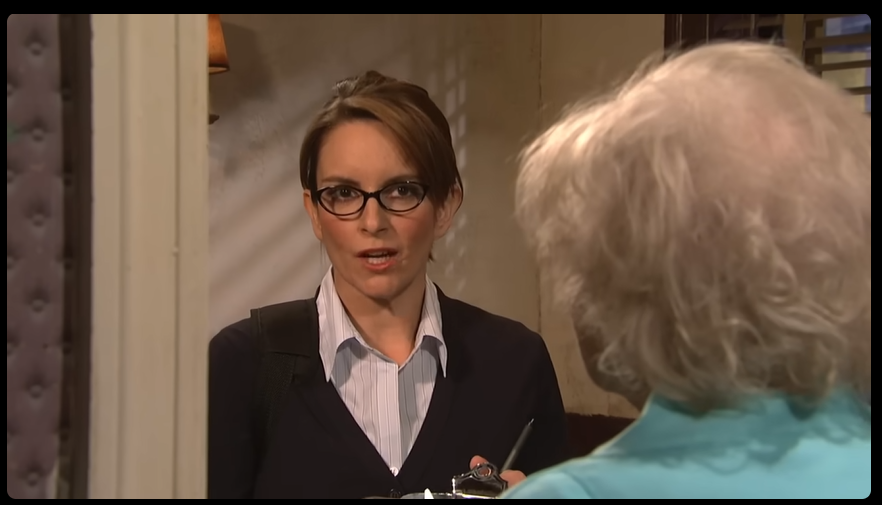
Tina Fey arrives at an apartment door with a clipboard and what should be one of the easiest assignments imaginable.
Ask a few census questions.
Write down the answers.
Leave.
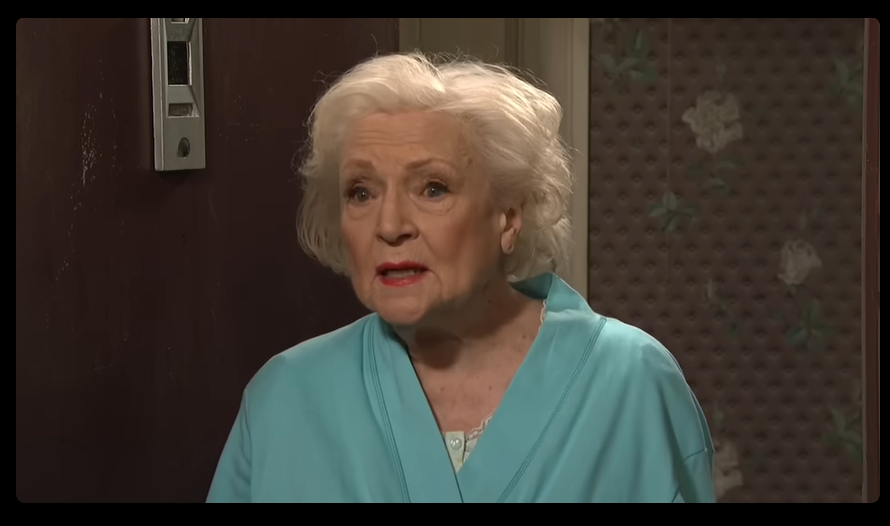
Then Betty White opens the door.
Within seconds, the routine interview starts slipping away from Fey’s increasingly bewildered census worker.
A simple question produces an impossible answer.
A name refuses to match its spelling.
And every time Fey thinks she has finally regained control, White calmly creates another problem.
That slow, perfectly controlled escalation is what makes “Census Taker vs. Old Lady” feel so funny years later — because Betty never behaves as though anything strange is happening.
The sketch originally aired during the May 8, 2010 episode of Saturday Night Live, hosted by Betty White with Jay-Z as musical guest. Tina Fey plays the census worker, while White plays apartment resident Lee Smith; Kenan Thompson appears in the final beat as Fluffy.
For White, the role is almost deceptively simple.
She is standing in a doorway.
There is no elaborate costume transformation.
No giant prop.

No complicated physical stunt.
The entire sketch depends on one person trying to complete a normal government form while another person makes normal language completely useless.
And Betty White understands exactly how little she needs to do.
She smiles.
She answers politely.
She sounds helpful.
Almost nothing she says actually helps.
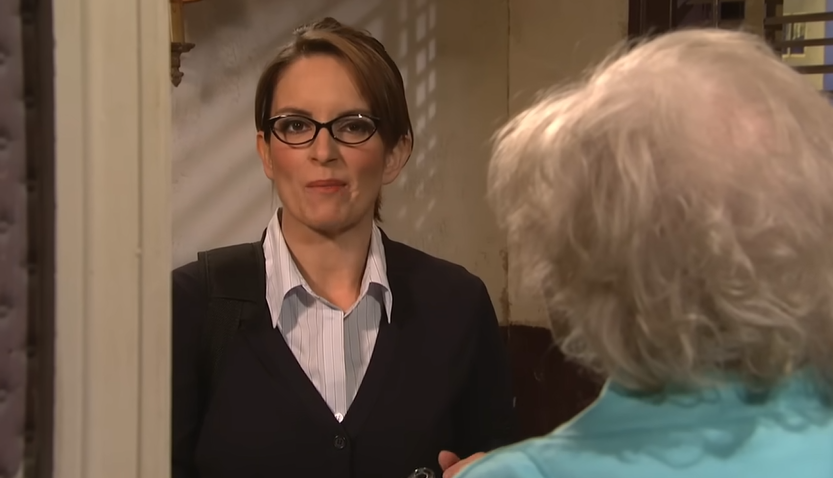
The joke begins before the census worker even gets inside.
Fey identifies herself.
White responds warmly — and immediately tries to end the conversation.
It establishes the rhythm.
Fey pushes forward.
White gives her just enough cooperation to keep the interview alive.
Then comes the most dangerous part of the sketch: the questions become simpler.
“How many people live at this residence?”
The answer should require almost no thought.
White says zero.
Fey points out the obvious problem.
White is standing there.
Then comes the correction: “Oh, including me? Three.”
It is a tiny exchange, but it explains almost everything that follows.
White’s character does not argue.
She does not panic.
She simply behaves as though her answer makes perfect sense.
That calmness forces Fey to carry the confusion for both of them.
And that is where the chemistry starts doing the heavy lifting.
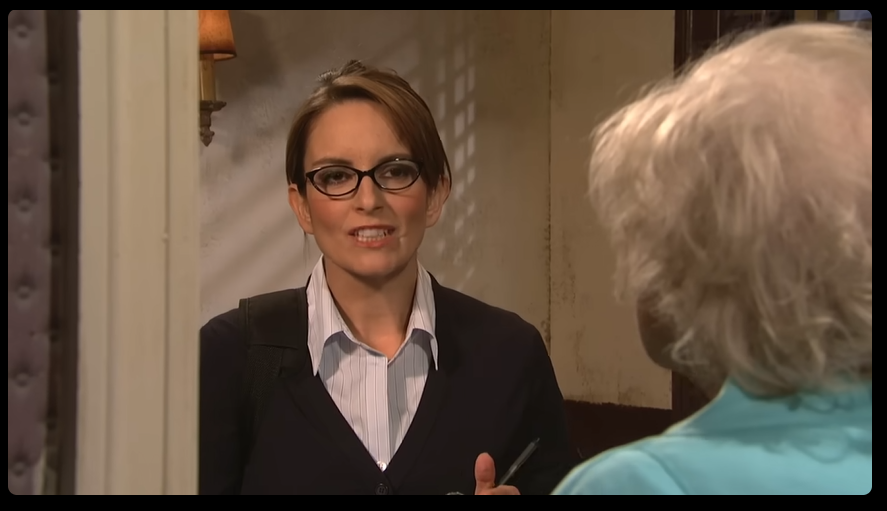
Then the sketch reaches the name.
Fey asks White’s character for her last name.
What comes back sounds nothing like an ordinary surname.
Fey does what any census worker would do.
She asks how to spell it.
White calmly spells S-M-I-T-H.
Now the sketch has moved beyond bad information.
Language itself has become unreliable.
Fey tries to confirm what she heard.
White doubles down.
The stranger the information becomes, the more relaxed Betty appears.
That contrast is the engine of the scene.
A weaker performance might chase the punchlines.
White does the opposite.
She lets Fey discover each contradiction.
She waits.
She watches.
Then she offers another explanation that somehow makes everything worse.
The humor comes from control.
Betty rarely looks like she is trying to win the scene.
That makes Lee Smith feel even more dangerous.
She is not intentionally torturing the census worker.
At least, she never admits that she is.
She simply exists inside a reality that Tina Fey cannot successfully document.
The routine keeps escalating through questions about who else might be living in the apartment.
Lee begins listing names.
The census worker has to determine whether she is talking about people or pets.
Even that distinction becomes impossible.
By this point, Fey’s character is no longer conducting an interview so much as trying to survive one.
Then the sketch saves another visual payoff for the ending.
A crash is heard.
Lee calls for Fluffy.
Kenan Thompson appears.
The uncertainty that had been running through the conversation suddenly becomes physical.
The interview is finished.
The census form may never recover.
And Betty White still looks remarkably satisfied with how everything went.
That ending works because the sketch has trained the audience not to trust any piece of information Lee provides.
Every previous answer has pushed reality slightly farther off balance.
So when Fluffy finally appears, it feels less like a random final joke and more like the logical conclusion to several minutes of completely illogical conversation.
What keeps the sketch alive is not just the strange answers.
It is the spacing between them.
Fey plays the scene straight enough that the questions continue to matter.
White refuses to acknowledge the absurdity strongly enough that every correction creates another dead end.
Neither performer needs to break character for the audience to understand how ridiculous the situation has become.
That restraint gives the sketch its slow-burn quality.
The official Saturday Night Live upload, posted in 2013 under the title “Census Taker vs. Old Lady – SNL,” has accumulated more than 15 million views, showing how strongly this particular Betty White appearance has continued circulating long after the original 2010 broadcast.
It also captures something Betty White did unusually well throughout her comedy career.
She could look completely harmless while delivering material that was anything but harmless.
The smile stayed gentle.
The voice stayed warm.
The punchline arrived anyway.
One clipboard.
One apartment door.
One increasingly exhausted census worker.
And one old lady who somehow turns every easy question into the wrong question.
FULL VIDEO
Census Taker vs. Old Lady – SNL
Watch: YouTube — Saturday Night Live Official Channel