Going to the dentist probably isn’t at the top of anyone’s list of favorite activities.
But when Lou Costello is the patient, an ordinary dentist appointment doesn’t remain ordinary for very long.
That simple premise became the foundation for one of the memorable episodes of The Abbott and Costello Show: “The Dentist’s Office.”
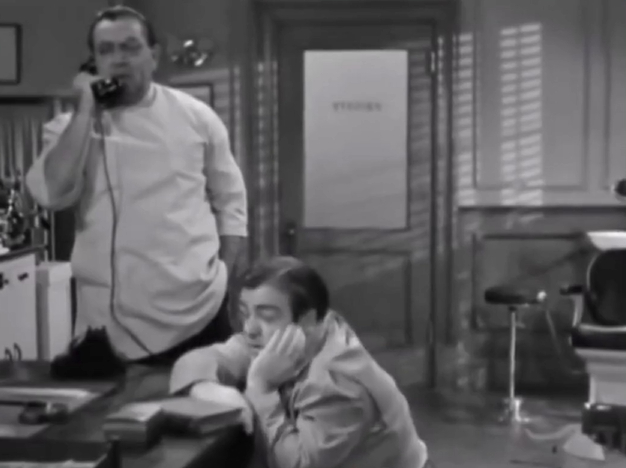
The episode belongs to the first season of the classic television series and originally aired in 1952. Its basic storyline is wonderfully straightforward: Lou has a terrible toothache, so Bud takes him to a dentist. Unfortunately for Lou, the dentist is extremely nearsighted, and what should have been a routine visit quickly becomes another Abbott and Costello disaster.
And that is exactly the kind of situation where this legendary comedy duo was at its best.
Abbott and Costello had an extraordinary ability to take something audiences immediately understood and push it into complete absurdity.
You didn’t need an elaborate storyline.
You didn’t need a huge set.
All they needed was Lou Costello in an uncomfortable situation and Bud Abbott nearby to make sure things became even more complicated.
A dentist’s office was practically perfect.
From the beginning, Lou is already nervous.
Anyone who has ever sat in a waiting room worrying about what might happen next can understand the feeling.
But Lou doesn’t simply experience nervousness.
He turns it into physical comedy.
His face tells the audience everything.
His movements become increasingly exaggerated.
Every strange sound and every suspicious-looking dental instrument becomes another reason for panic.
And the more frightened Lou becomes, the funnier the situation gets.
The episode’s dentist only makes matters worse.
Contemporary descriptions of the routine note that the doctor is so nearsighted that the examination itself becomes a comedy of errors. At one point, he nearly works on Lou’s ear rather than his tooth; other physical gags escalate from there.
For Lou, this is a nightmare.
For the audience, it is comedy gold.
That contrast was one of the secrets behind Costello’s performance style.
Lou often played the person trapped inside a situation he could not control.
He was confused.
He was frightened.
He was frustrated.
And somehow every attempt to escape only made things worse.
Bud Abbott usually occupied the opposite role.
Bud was calmer.
He understood what was happening.
Or at least he acted as though he did.
That difference between their personalities created the rhythm that made Abbott and Costello such an effective comedy team.
Bud could set up the situation.
Lou could explode inside it.
Bud could deliver a straightforward line.
Lou could misunderstand it completely.
And once the misunderstanding began, the two could keep building on it until an ordinary conversation became ridiculous.
That formula worked particularly well in The Dentist’s Office because the situation itself was so relatable.
Fear of the dentist is hardly unusual.
The episode simply asks:
What if every ridiculous thing a nervous patient imagined actually started happening?
Suddenly the tools look terrifying.
The noises coming from the other room sound suspicious.
The dentist doesn’t inspire confidence.
And poor Lou begins wondering whether his toothache was really worse than the treatment waiting for him.
One account of the episode describes how screams and strange noises from the dentist’s room nearly scare Lou away before he even gets properly started. Hillary Brooke’s character attempts to reassure him, but the increasingly bizarre behavior of the dentist gives Lou plenty of reasons to remain terrified.
It’s classic escalation.
One joke leads to another.
Then another.
And before long, the entire dentist’s office has become a playground for physical comedy.
That is something modern audiences can sometimes forget about performers from this era.
Their comedy wasn’t dependent on fast editing.
There were no digital effects helping sell the joke.
The performers themselves had to make the scene work.
Their movements mattered.
Their timing mattered.
Their facial expressions mattered.
Lou Costello was exceptionally good at this style of performance.
Even before he spoke, audiences could often tell exactly what he was thinking.
His eyes widened.
His body stiffened.
His expression changed.
The audience knew panic was coming.
Then Lou would react, and the laugh would arrive.
That ability came from years of performance experience.
Abbott and Costello’s partnership stretched across stage, radio, movies and television, and their comedy combined rapid wordplay with physical humor. Their career made them one of America’s most prominent comedy teams of the 1940s and 1950s.
By the time they brought their act to television, the duo understood each other’s timing extraordinarily well.
Bud knew exactly when to push Lou.
Lou knew exactly how long to let frustration build.
Neither performer needed to explain the joke to the audience.
They simply played the situation.
And that’s why scenes like this remain entertaining so many decades later.
The dentist’s equipment may look old-fashioned.
The black-and-white television image immediately tells us we’re watching something from another era.
But the central joke hasn’t aged.
Nobody wants to sit nervously in a dentist’s chair while wondering whether the person holding the tools actually knows what they’re doing.
That fear is timeless.
Abbott and Costello simply turned it into comedy.
There is also something refreshing about how uncomplicated the entertainment feels.
The episode doesn’t need a massive plot twist.
The audience knows exactly what it came to see.
Lou is in trouble.
Bud is nearby.
Things are going to get worse.
And we’re going to laugh while they do.
That simplicity was one of Abbott and Costello’s greatest strengths.
They understood that comedy often works best when audiences recognize the situation immediately.
A job interview.
A misunderstanding.
A baseball conversation.
A dentist appointment.
Take something ordinary.
Add Abbott and Costello.
Then watch normal logic disappear.
The Dentist’s Office remains a wonderful example of that formula.
Lou walks in with one problem: a toothache.
Before long, that tooth probably seems like the least of his worries.
And more than seven decades after the episode first appeared, watching Lou Costello desperately trying to survive a simple visit to the dentist can still produce exactly the reaction Abbott and Costello wanted:
Laughter.
Sometimes classic comedy really doesn’t get old.