Lucy Ricardo only wants one thing.
She wants the best-looking garden in Westport.
That sounds harmless.
Then Ricky leaves half the lawn unmowed.
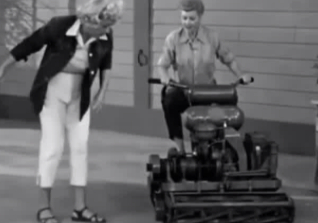
Lucy notices the power mower.
And one of I Love Lucy’s simplest suburban problems suddenly becomes a perfect Lucille Ball disaster.
In “Lucy Raises Tulips,” Lucy is determined to defeat neighbor Betty Ramsey in a local garden competition. What begins with flowers, pride, and a little friendly rivalry escalates into a runaway lawn mower, destroyed tulips, fake replacements, and one final visual payoff that proves Lucy’s attempts to repair a catastrophe are often even funnier than the catastrophe itself. The episode originally aired on April 29, 1957 during the sixth season of I Love Lucy.

Lucy Wants the Perfect Garden — and Betty Ramsey Gives Her a Reason to Obsess
By this point in I Love Lucy, the Ricardos have traded their Manhattan apartment for suburban life in Westport, Connecticut.
That move gave the show an entirely new collection of ordinary problems for Lucy to turn into extraordinary ones.
Gardening is one of them.
Lucy has thrown herself into the local garden competition and wants to unseat Betty Ramsey, played by Mary Jane Croft, whose garden has already established her as serious competition. Episode guides describe Betty as a repeat winner, which gives Lucy exactly the ingredient she needs to make a simple hobby dangerous: someone to beat.
Everything about Lucy’s garden looks ready for judging.
Almost everything.
The lawn still needs work.
Ricky begins mowing it, but stops halfway and leaves for a baseball game.
For a normal person, this might mean waiting until later.
For Lucy Ricardo, it means learning how to operate a power mower immediately.
That decision is where the episode changes.
The machine is bigger than Lucy expects.
The controls are less cooperative than she expects.
And once it starts moving, getting it to stop becomes a completely different problem.
The brilliance of the sequence is not complicated writing.
It is physical escalation.
Lucy gets on the mower because she believes she can finish a simple household job herself.
Then the mower begins dictating the scene.
Her body tightens.
Her expressions change.
The confidence disappears.
The machine keeps moving.
Lucille Ball was especially effective when an everyday object gradually became her enemy because she gave the audience enough time to understand the danger before the character fully accepted it.
You can see the problem coming.
Lucy cannot.
Then she cannot stop it.
The Mower Is Funny — but What Lucy Does Afterward Is Even Better
The runaway ride eventually produces the worst possible result.
Lucy destroys Betty Ramsey’s tulips.
Now the physical gag becomes a deception comedy.
Lucy knows exactly what she has done.
Ethel knows exactly what she has done.
And they need the garden to look normal again before anyone discovers the truth.
The solution?
Replacement tulips.
Not Lucy’s tulips, of course.
When Ethel suggests giving Betty some of Lucy’s flowers, Lucy’s response shows exactly how competitive she still is even while feeling guilty.
She feels terrible.
Just not terrible enough to sacrifice her own potential victory.
Instead, Betty’s destroyed flowers are replaced with artificial ones. Everything Lucy documents the replacements as wax tulips, setting up the episode’s second major payoff.
This is classic Lucy construction.
The original mistake is bad.
The cover-up is worse.
And the audience knows that the more elaborate Lucy’s solution becomes, the more spectacularly it will eventually fail.
Then the story adds another layer.
Ricky returns.
Lucy still needs the rest of her lawn mowed.
He finishes the job later when visibility is poor.
And without realizing it, Ricky destroys Lucy’s own tulips.
Now Lucy and Betty have essentially suffered the same disaster.
And Ricky reaches almost exactly the same solution.
Lucy’s real flowers are replaced too.
The garden competition is suddenly being judged between two women whose most important flowers are not flowers at all.
Then the Sun Delivers the Final Punchline
The next morning, the judges arrive.
Lucy wants the prize.
Betty wants the prize.
Both gardens appear ready.
Then the weather starts doing what Lucy’s secrets always seem to do eventually.
It exposes everything.
The artificial tulips cannot survive the heat.
They begin to soften and wilt.
The judges discover Betty’s fake flowers.
Then they move on to Lucy.
And Lucy’s flowers have exactly the same problem.
The ending works because the episode does not simply punish Lucy for destroying Betty’s garden.
It creates symmetry.
Lucy cheats to save Betty’s flowers.
Ricky unknowingly forces the same cheat into Lucy’s garden.
Neither woman gets the clean victory she wanted.
The rivalry ends with both gardens revealing their secrets in front of the people they were trying hardest to impress.
That is why “Lucy Raises Tulips” still feels so recognizably I Love Lucy.
The stakes are tiny.
Nobody is saving the world.
Lucy wants a garden prize.
Ricky wants to go to a baseball game.
Betty wants to keep her neighborhood bragging rights.
But Lucille Ball’s performance makes those small stakes feel enormous.
The lawn mower sequence gives her physical comedy.
The destroyed flowers give her panic.
The cover-up gives Lucy and Ethel a scheme.
And the melting tulips give the audience a visual ending that needs almost no explanation.
The episode was filmed at Ren-Mar Studios on March 28, 1957, with William Asher directing and Madelyn Davis/Martin, Bob Carroll Jr., Bob Schiller, and Bob Weiskopf credited as writers in episode references. Mary Jane Croft’s appearance as Betty Ramsey was also her final appearance in that role on I Love Lucy.
More than six decades later, the basic joke remains wonderfully simple.
Lucy wants everything perfect.
One unfinished lawn stands in her way.
She gets on the mower.
And from that moment forward, the flowers never really had a chance.
One lawn.
One power mower.
Two gardens full of tulips.
And Lucille Ball turning suburban yard work into exactly the kind of beautifully controlled disaster she did better than almost anyone.
I Love Lucy — “Lucy Raises Tulips”