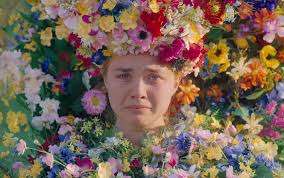
Some horror films frighten audiences with darkness, sudden noises, and terrifying creatures. Midsommar (2019), directed by Ari Aster, takes a very different approach. Set beneath the endless daylight of a remote Swedish countryside, the film transforms a seemingly peaceful summer festival into an unsettling psychological nightmare. At the center of this disturbing story is Florence Pugh, whose extraordinary performance as Dani Ardor turns a tale of grief, isolation, and belonging into one of modern horror cinema’s most memorable experiences.
A Journey Begins with Grief
Dani Ardor is a young American woman struggling with devastating personal tragedy. After a traumatic family loss, she finds herself emotionally dependent on her increasingly distant boyfriend, Christian Hughes, played by Jack Reynor. Their relationship has been deteriorating for some time, yet neither seems willing to make the difficult decision to end it.
When Christian and his friends plan a trip to Sweden, Dani unexpectedly joins them. The journey takes the group to a remote rural community where they are invited to participate in a traditional midsummer celebration. Initially, the destination appears almost idyllic. The landscape is filled with green fields, colorful flowers, traditional buildings, and an unusual amount of sunlight.
However, the welcoming atmosphere gradually becomes more disturbing. The community follows unfamiliar customs, and the visitors begin witnessing rituals that challenge their understanding of life, death, and human behavior. What begins as an unusual cultural experience slowly turns into a desperate struggle to understand what is happening around them.
Florence Pugh’s Powerful Performance
Florence Pugh delivers the emotional foundation of Midsommar. Rather than portraying Dani simply as a frightened woman trapped in a horror story, Pugh presents a complex character whose grief influences nearly every decision she makes.
Her performance captures the exhausting experience of trying to appear emotionally stable while feeling completely overwhelmed inside. Dani frequently searches for reassurance from Christian, but his responses leave her feeling increasingly isolated. Their conversations reveal a relationship in which emotional needs remain unspoken, misunderstood, or deliberately avoided.
Pugh communicates much of Dani’s suffering through subtle expressions, nervous movements, and moments of silence. When Dani breaks down emotionally, the intensity feels painfully genuine. Her grief is not presented as a brief dramatic moment; it becomes an ongoing presence that shapes the entire film.
One of the film’s most memorable aspects is the way Dani’s emotional state changes as the story progresses. At first, she appears desperate to maintain a relationship that no longer provides the support she needs. As the Swedish community gradually welcomes her, she begins experiencing a strange form of acceptance that she has struggled to find elsewhere.
This transformation makes Pugh’s performance especially compelling. Dani’s journey is simultaneously heartbreaking, unsettling, and difficult to interpret. The audience can understand her desire for connection while remaining deeply disturbed by the circumstances surrounding her growing sense of belonging.
Horror in Broad Daylight
Ari Aster builds tension through contrast. Unlike traditional horror films that rely heavily on darkness, Midsommar places much of its story in bright daylight. The open fields, cheerful decorations, and beautiful scenery initially suggest safety.
Yet the brightness makes the disturbing events even more uncomfortable. There are few shadows in which the characters can hide, and the community’s rituals unfold openly, surrounded by flowers and smiling faces. The cheerful atmosphere becomes increasingly threatening because the people participating in these customs often appear completely comfortable with what outsiders find horrifying.
The film also uses carefully composed images, unsettling music, and prolonged silences to create psychological tension. Instead of constantly delivering shocks, it allows uncomfortable situations to develop slowly. Viewers are given time to notice details, question the characters’ choices, and anticipate consequences.
This approach gives Midsommar a distinctive visual identity. Its horror does not depend solely on what the audience sees, but also on the growing realization that the people surrounding Dani may understand the world according to rules that she cannot easily escape.
Love, Isolation, and the Need to Belong
Beneath its disturbing rituals, Midsommar explores the emotional consequences of loneliness. Dani is not simply searching for physical safety; she wants someone who will acknowledge her pain and respond to it with genuine compassion.
Christian’s inability to provide that support becomes an important part of the film’s emotional conflict. Their relationship is complicated rather than entirely straightforward, but its imbalance leaves Dani feeling alone even when she is surrounded by people.
The Swedish community offers her something different. Its members participate in collective emotional experiences, responding to one another’s distress in ways that contrast sharply with the emotional distance Dani has experienced in her relationship. That apparent empathy creates an unsettling question: what happens when the desire to be understood becomes so powerful that acceptance begins to outweigh independent judgment?
The film never offers an entirely comfortable answer. Its final developments can be interpreted as a moment of personal release, a disturbing form of manipulation, or a combination of both. That ambiguity is central to its lasting impact.
A Horror Film That Stays with You
Midsommar is not designed to provide easy entertainment or straightforward explanations. It asks viewers to sit with uncomfortable emotions and consider how grief can influence vulnerability, relationships, and personal identity.
Florence Pugh’s performance gives the film its human center. Even as the surrounding events become increasingly surreal and frightening, Dani remains recognizable as someone searching for stability after profound loss. Her emotional journey makes the film more than a collection of shocking images.
Ultimately, Midsommar stands out because it combines psychological horror with a visually striking world and