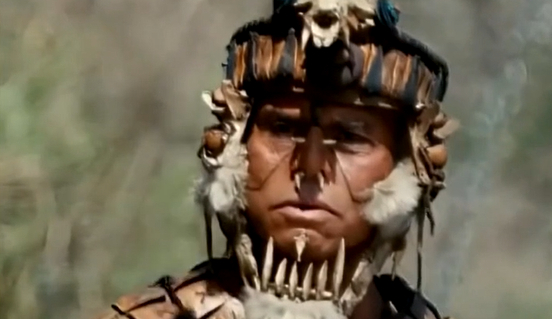
One Man Became Too Weak to Continue… And Apocalypto Revealed the Brutal Price of Survival! 😱🔥
One dangerous journey. A group of exhausted captives. And a terrifying decision that reveals how little mercy exists in a world ruled by fear and violence. In Mel Gibson’s Apocalypto (2006), a brief confrontation between warriors becomes a chilling reminder that survival is never guaranteed.
A Journey Where Every Step Could Be the Last
Few films capture the raw intensity of survival quite like Apocalypto.
Directed by Mel Gibson, the 2006 historical action thriller follows Jaguar Paw, a young hunter whose peaceful village is attacked by a violent group of raiders.
His world changes in a single morning.
His community is destroyed.
His people are captured.
And he is forced into a terrifying journey through unfamiliar territory.
The captives have little control over their fate.
They must follow their captors, regardless of exhaustion, injury, or fear.
For Jaguar Paw, the journey is especially desperate because his wife and young son are still waiting for him.
He knows that every moment spent in captivity takes him farther away from the family he has promised to protect.
The Dangerous Crossing
The scene unfolds during the captives’ exhausting journey.
The group has been moving through difficult terrain, where even experienced travelers must remain alert.
A dangerous crossing tests their strength and endurance.
The captors shout instructions.
The prisoners struggle to keep moving.
And the physical demands of the journey become increasingly apparent.
For a moment, the scene focuses on the effort required simply to survive the crossing.
But the danger does not end once the group reaches safer ground.
One exhausted captive is no longer able to continue.
And his condition creates a new problem for the men controlling the group.
When a Human Life Becomes a Burden
The most disturbing element of the sequence is not a dramatic fight or a spectacular act of violence.
It is the way the captors discuss another person’s fate.
A man has become too weak to keep pace.
Instead of responding with compassion, the warriors evaluate what his condition means for their journey.
One captor explains that the prisoner was becoming a burden and had nearly endangered others.
The discussion is brief.
But its meaning is chilling.
The captive is no longer being treated as a person with a family, a history, or a future.
He is being judged according to whether he remains useful.
That cold calculation gives the scene much of its emotional power.
The Moment the Warriors Disagree
As the conversation continues, tension develops between the captors.
One warrior questions what has happened to his prisoner.
Another explains that he let the weakened man go.
The response is not welcomed.
The first warrior challenges the decision, revealing the importance of authority and control within the group.
This disagreement exposes a dangerous hierarchy.
The captives have almost no power.
Their lives depend on the decisions of men who may disagree about what should happen next.
Even among the captors, individual choices can provoke anger and confrontation.
The scene shows that violence is not the only source of danger.
Power struggles within the group can be just as threatening.
Jaguar Paw Watches a Terrifying Reality Unfold
Throughout the journey, Jaguar Paw must observe the behavior of his captors while trying to remain alive.
He is surrounded by men who have already demonstrated their willingness to use violence.
Every new confrontation gives him another reason to fear what lies ahead.
The treatment of the exhausted captive reinforces a terrible reality.
There is no guarantee that cooperation will lead to safety.
There is no promise that weakness will be forgiven.
And there is no reason to assume that the captors will show mercy when someone can no longer keep moving.
Jaguar Paw’s determination to survive becomes even more meaningful against this backdrop.
He is not merely trying to escape physical danger.
He is fighting against a system in which his life is controlled by others.
Why Apocalypto Feels So Intense
One of the film’s greatest strengths is its ability to create tension through physical movement and human expressions.
The camera frequently stays close to faces.
Sweat, dirt, exhaustion, and fear are visible.
The jungle feels enormous.
The terrain is unforgiving.
And the characters appear vulnerable to dangers that can emerge without warning.
Rather than relying entirely on dialogue, the film communicates much of its story through action and reaction.
A glance can suggest suspicion.
A pause can create fear.
And a disagreement between warriors can become more unsettling than a lengthy speech.
The sequence demonstrates how effective that approach can be.
The Difference Between Strength and Power
The scene also raises an important question about survival.
Does physical strength determine who deserves to live?
The captors behave as though a person’s value depends on usefulness and obedience.
But the film repeatedly challenges the idea that power and strength are the same thing.
Jaguar Paw does not possess the weapons or numbers of his enemies.
He cannot control the group holding him prisoner.
Yet he has something that continues to drive him forward.
He has a reason to survive.
His determination comes from the family he hopes to see again.
That emotional purpose eventually becomes one of his greatest strengths.
A Film About Fear and Determination
Although Apocalypto is remembered for its intense action sequences, its story is also deeply concerned with fear.
Characters fear death.
They fear losing their families.
They fear the people who control their lives.
And sometimes, they fear the possibility that resistance may be hopeless.
Jaguar Paw’s journey becomes a struggle to overcome those fears.
The film places him in increasingly desperate circumstances.
Each new obstacle tests his ability to think, endure, and keep moving.
The exhausted captive’s fate offers a disturbing contrast.
It shows what can happen when someone no longer has the strength or opportunity to continue.
Why This Short Scene Stays With Viewers
The power of the moment comes from its simplicity.
A group has completed a dangerous part of its journey.
One man cannot continue.
A captor makes a decision.
And another challenges his authority.
There is no need for an elaborate battle.
The audience already understands the stakes.
These prisoners are trapped in a world where their fate can change without warning.
The confrontation reveals the captors’ attitudes toward weakness and obedience while preparing viewers for the dangers still ahead.
It is a small scene within a much larger story.
But it captures the film’s atmosphere of uncertainty and fear.
Some Hearts Refuse to Give Up
At its center, Apocalypto is the story of a man who refuses to surrender his hope of returning home.
Jaguar Paw faces overwhelming danger.
He witnesses cruelty.
He experiences exhaustion and fear.
Yet his determination remains tied to the people he loves.
That is what makes the film more than a relentless survival thriller.
Its most powerful moments remind viewers that the will to survive can come from love, loyalty, and the refusal to abandon hope.
ONE MAN WAS TOO WEAK TO CONTINUE… AND THE WARRIORS SHOWED HOW BRUTAL THEIR WORLD COULD BE! 😱💀🔥
👀 WAS THE WARRIOR RIGHT TO LET THE EXHAUSTED CAPTIVE GO, OR WAS IT A DANGEROUS DECISION? 👇
#Apocalypto #MelGibson #JaguarPaw #SurvivalThriller #EpicMovies #MovieScenes #AncientWarriors #NeverGiveUp