One piano. One legendary voice. One unforgettable street party. When Ray Charles begins performing “Shake a Tail Feather” in The Blues Brothers (1980), an ordinary visit to a music store transforms into one of the most joyful musical sequences in movie history.
Some film scenes are remembered for their dramatic dialogue. Others become famous for spectacular action or emotional storytelling. But occasionally, a scene captures something even more universal: the irresistible feeling of hearing music so good that everyone wants to dance.
That is exactly what happens when Ray Charles appears in The Blues Brothers.
With John Belushi and Dan Aykroyd bringing their signature comic energy to the screen, the scene celebrates the extraordinary power of rhythm and blues.
Decades after the film’s release, the performance remains a favorite among audiences who appreciate classic music, unforgettable choreography, and legendary entertainers.
The Moment Ray Charles Takes Over
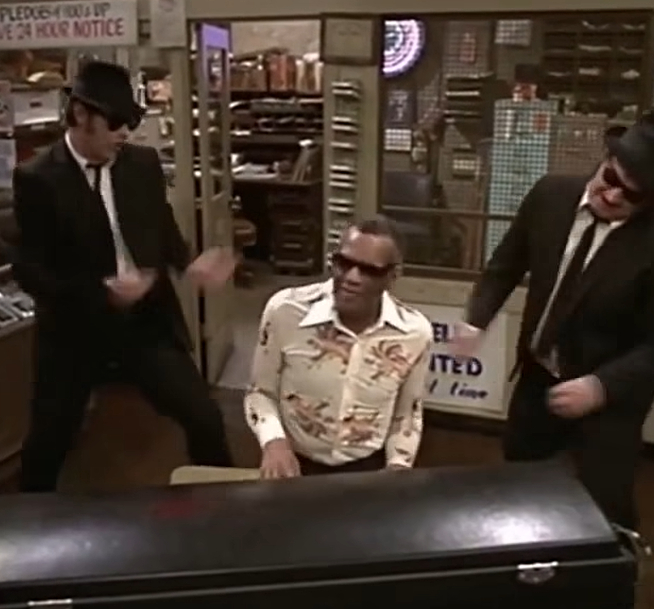
The scene begins inside Ray’s Music Exchange, a Chicago music store.
Jake and Elwood Blues, played by John Belushi and Dan Aykroyd, are assembling the musicians they need to get their band back together.
During their visit, Ray Charles appears as the owner of the store.
What starts as a conversation about musical equipment quickly becomes something much more exciting.

Ray demonstrates the power of the instruments by sitting down at an electric piano.
Then the music begins.
The moment his performance gathers momentum, the atmosphere changes completely.
Jake and Elwood respond to the rhythm, and the film moves beyond the store to reveal an entire street filled with dancers.
It is one of the movie’s most memorable transitions from ordinary conversation to spectacular musical celebration.
The Magic of Shake a Tail Feather
“Shake a Tail Feather” is a lively rhythm-and-blues song originally recorded by the Five Du-Tones in 1963.
Over the years, it has been performed by numerous artists.
But Ray Charles’s version in The Blues Brothers introduced the song to a new generation of moviegoers.
Its infectious rhythm and playful lyrics make it an ideal choice for a large dance sequence.
The music encourages movement from the opening notes.
The beat is energetic, the performance is confident, and the arrangement creates a feeling of celebration.
In the film, the song becomes more than a musical number.
It becomes an event.
The audience watches the energy spread from the performers to the people outside.
Before long, the entire neighborhood seems to be participating.
Ray Charles: A Musical Legend
Ray Charles was one of the most influential musicians of the twentieth century.
His extraordinary career helped shape the development of soul music by combining elements of rhythm and blues, gospel, jazz, and country.
He possessed a distinctive voice and an unmistakable piano style.
His recordings demonstrated remarkable emotional range, moving effortlessly between heartfelt ballads and upbeat performances.
By the time he appeared in The Blues Brothers, Charles was already an established musical icon.
His presence brought authenticity and star power to the film.
Rather than merely appearing in a brief cameo, he delivers a performance that becomes a centerpiece of the movie.
The scene reminds audiences why his music had such an enduring impact.
John Belushi’s Incredible Comic Energy
John Belushi plays Jake Blues, the energetic and unpredictable half of the Blues Brothers duo.
Jake’s dark suit, sunglasses, black hat, and expressive movements became essential parts of the character’s identity.
Belushi was known for his physical comedy and larger-than-life performances.
In this musical sequence, those qualities work perfectly with the rhythm.
He does not need an elaborate joke to entertain the audience.
His movements, expressions, and enthusiasm are enough.
The combination of comedy and music gives the scene a distinctive personality.
Jake seems completely absorbed in the performance, and his excitement helps invite viewers into the celebration.
Dan Aykroyd as Elwood Blues
Dan Aykroyd’s Elwood Blues provides an important contrast to Belushi’s Jake.
Elwood is usually more restrained and deliberate.
He often maintains a serious expression even when the situation around him becomes ridiculous.
That contrast is central to the Blues Brothers’ appeal.
The characters look almost identical in their black suits, hats, and sunglasses.
Yet their personalities are different.
When the music starts, both characters become part of the excitement.
Their coordinated appearance and distinctive dance movements create an image that audiences instantly recognize.
Together, Belushi and Aykroyd bring a wonderful balance of comedy and musical enthusiasm to the film.
The Street Dance That Makes the Scene Unforgettable
One of the sequence’s greatest achievements is the transition from an intimate musical performance to a large outdoor celebration.
The camera reveals crowds of people dancing beneath Chicago’s elevated railway.
The street becomes a stage.
Dancers fill the road, move in formation, and respond to the song’s energetic beat.
The choreography creates a sense of spontaneity, even though the sequence is carefully staged.
People of different ages and backgrounds appear united by the music.
The visual effect is joyful and expansive.
What began with one musician at a piano now seems to involve an entire community.
This transformation is one reason the sequence remains so memorable.
Chicago Becomes a Character in the Movie
Chicago plays an essential role in The Blues Brothers.
The film makes extensive use of the city’s streets, neighborhoods, bridges, and recognizable architecture.
Rather than treating the location as a generic backdrop, director John Landis places the action within a distinctive urban environment.
The “Shake a Tail Feather” sequence uses that setting brilliantly.
The elevated train tracks and surrounding buildings create a vivid street scene.
The dancers fill the available space with color and movement.
The location makes the musical performance feel connected to the city itself.
Chicago is not simply where the scene happens.
It becomes part of the celebration.
Director John Landis Blends Music and Comedy
John Landis directed The Blues Brothers with an unusual combination of musical spectacle, physical comedy, and large-scale action.
The film follows Jake and Elwood as they attempt to reunite their band and raise money to save the orphanage where they grew up.
Along the way, they encounter musicians, police officers, unusual characters, and increasingly chaotic situations.
The story provides opportunities for both outrageous comedy and outstanding musical performances.
Landis allows the music to take center stage when necessary.
The Ray Charles sequence is a perfect example.
Rather than rushing through the song, the film gives the performance room to develop.
The choreography, editing, and camera movement work together to emphasize the rhythm.
The result feels like a genuine celebration of music.
A Film Filled With Musical Legends
Ray Charles was not the only major musician featured in The Blues Brothers.
The film also includes memorable appearances by Aretha Franklin, James Brown, Cab Calloway, and John Lee Hooker.
Each performer contributes a different musical personality.
Aretha Franklin delivers a powerful performance of “Think.”
James Brown brings gospel energy to a church sequence.
Cab Calloway performs the classic “Minnie the Moocher.”
These appearances give the film an extraordinary musical identity.
Rather than using famous songs merely as background music, The Blues Brothers makes the performers essential to its storytelling.
Their music drives the action, reveals character, and creates unforgettable cinematic moments.
Why the Scene Still Makes People Smile
Great musical performances often create an immediate emotional response.
A familiar melody can bring back memories.

An energetic rhythm can improve someone’s mood.
And a joyful dance sequence can make viewers want to move along with the performers.
The Ray Charles scene succeeds because it captures all of those experiences.
It is playful without feeling forced.
It is spectacular without losing its musical focus.
And it gives audiences the pleasure of watching extraordinary entertainers enjoying what they do best.
Even viewers who have never seen the entire film can appreciate the sequence.
The music and movement communicate the excitement immediately.
The Legacy of The Blues Brothers
Released in 1980, The Blues Brothers developed an enduring reputation as a distinctive musical comedy.
Its combination of memorable characters, energetic performances, and elaborate action scenes made it unlike many other films of its era.
The Blues Brothers themselves began as a musical act associated with Saturday Night Live.
John Belushi and Dan Aykroyd developed Jake and Elwood into recognizable performers with a genuine appreciation for blues and soul music.
The movie expanded those characters into a full cinematic adventure.
Its soundtrack helped introduce classic rhythm-and-blues artists to audiences who might otherwise have been unfamiliar with their work.
The film remains a celebration of musical history as well as a comedy.
Why Ray Charles’s Performance Is Timeless
The most remarkable quality of the “Shake a Tail Feather” sequence is its sense of joy.
Ray Charles commands attention with his voice and piano playing.
Jake and Elwood add humor and personality.
The dancers transform the surrounding streets into a spectacular celebration.
Every element contributes to the same feeling: music brings people together.
That message remains understandable regardless of when the film is watched.
Styles may change, and popular music may evolve, but the excitement of an irresistible rhythm never disappears.
This is why the sequence continues to attract new viewers.
It captures a moment when the performers, the music, and the audience seem completely connected.
Final Thoughts: When One Song Gets Everyone Dancing
Ray Charles’s performance of “Shake a Tail Feather” in The Blues Brothers is much more than a memorable musical cameo.
It is a celebration of rhythm and blues, classic comedy, and the extraordinary energy of live performance.
John Belushi and Dan Aykroyd provide the perfect comic partnership.
Ray Charles supplies the musical brilliance.
And the dancers turn a Chicago street into one of cinema’s most joyful musical settings.
More than four decades later, the scene still has the power to make audiences smile, tap their feet, and remember why great music never gets old.
Could you resist dancing if Ray Charles started playing right in front of you?
#TheBluesBrothers #RayCharles #JohnBelushi #DanAykroyd #ShakeATailFeather #ClassicMovies #MusicLegends