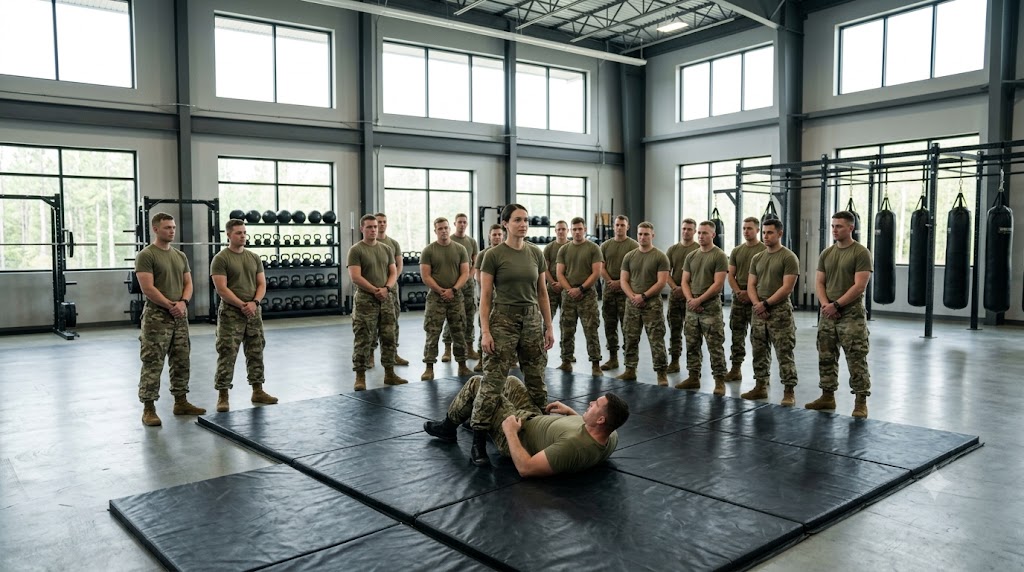
CHAPTER 1 – PART 1: THE MAN WHO DROPPED HIS LEFT HAND
“You think you can take me?”
Sergeant Cole Barrett smiled when he asked it.
I didn’t.
“I know I can.”
Twenty soldiers erupted.
The laughter hit the walls of the training room and came back louder.
Boots shifted along the edge of the mat.
Somebody slapped the padded wall.
One of the younger soldiers actually bent forward with
his hands on his knees,
laughing like I had just volunteered to fight a tank with a spoon.
I let them have it.
Laughter had never bothered me.
Silence was worse.
I had learned that eight years ago.
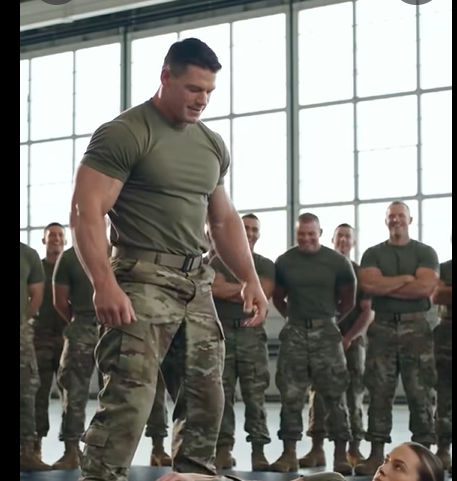
Barrett rolled his shoulders.
He was one of the largest instructors in the room,
maybe six foot three, broad enough that his uniform pulled tight across his upper back.
He had at least forty pounds on me. Former infantry.
Several combat rotations. Years of close-combat instruction.
He carried himself like a man
who had spent a long time being
the strongest person in whatever room he entered.
Men like that weren’t automatically arrogant.
But arrogance liked them.
Five minutes earlier,
he had thrown me hard enough that my right shoulder struck first,
then my hip, then the side of my head.
I had slid nearly six feet across the mat.
Everyone laughed then too.
Barrett had offered me a hand.
I hadn’t taken it.
I had rolled to my knees, stood,
adjusted the sleeves over the thin scars on my forearms,
and stepped back into position.
That was when his smile changed.
Not much.
Most people wouldn’t have noticed.
I did.
It had gone from amused to irritated.
People disliked it when pain failed to produce the reaction they expected.
Barrett tilted his head.
“You sure about that?”
“Yes.”
Someone behind him muttered, “This ought to be good.”
Barrett heard it.
He grinned wider.
“Alright, Sergeant Cross.”
That was the name on my paperwork.
Sergeant Maya Cross.
No unit history included in the packet.
No prior instructor evaluations.
No operational record.
No explanation for the scars.
The file had been intentionally thin.
Command had called it an administrative necessity.
I called it what it was.
A ghost file.
Barrett raised his hands.
“Show me.”
I looked at his stance.
The weight distribution.
His right foot angled too far outward.
The slight hitch in his shoulder.
The left glove dropping half an inch when he prepared to drive forward.
I had noticed all of it within thirty seconds of watching him demonstrate earlier.
“You drop your left hand,” I said.
Barrett laughed.
“You’ve been watching too many movies.”
“You telegraph your right shoulder too.”
The room changed.
The laughter faded into a few uncertain chuckles.
Barrett’s smile remained, but his eyes didn’t.
He stepped closer.
“Then stop me.”
I looked directly at him.
For a fraction of a second, the training room disappeared.
Different floor.
Different year.
Different man.
Same shoulder.
Same mistake.
A voice from memory:
Again.
Again.
Again.
If you see it, use it.
I blinked.
The room returned.
Barrett attacked.
Fast.
Hard.
He drove forward behind a right hand that
would have staggered me if it landed clean.
But the shoulder moved first.
It always did.
I shifted outside his line.
My left forearm redirected his arm.
My palm struck high against his chest, not hard enough to injure him,
only enough to break his posture.
Then I hooked his forward ankle.
One movement.
One turn.
One sweep.
His feet disappeared beneath him.
Barrett hit the mat flat on his back.
The impact cracked through the room.
Nobody laughed.
For two seconds, I heard only the fluorescent lights humming overhead.
Then one soldier whispered, “I didn’t even see it.”
Neither had Barrett.
That was the problem.
He scrambled upright.
His face had gone red.
“You got lucky.”
I lowered my hands.
“You’ve said that twice.”
He froze.
His brow tightened.
“I’ve never fought you before.”
There it was.
I should have said nothing.
I should have let it pass.
That was why I had been sent here under a restricted personnel profile.
Keep the past buried.
Complete the assessment.
Do the job.
Leave.
Simple.
Except some mistakes survive longer than orders.
I looked at Barrett’s stance again.
Then at his face.
Eight years hadn’t changed muscle memory.
Not where it mattered.
“No,” I said.
Something pulled tight behind my ribs.
“But your old instructor did.”
Barrett frowned.
“My instructor?”
I didn’t answer.
Because suddenly I could hear his voice again.
Not Barrett’s.
Someone else’s.
A man barking at me in the rain while both of us were too tired to feel our hands.
Your left hand, Cross.
Keep it up.
Again.
If you can still complain, you can still fight.
Again.
I shut the memory down.
Barrett took one step toward me.
“Who are you talking about?”
Before I could answer, a voice came from behind the formation.
“Viper Six?”
Every muscle in my body locked.
The room seemed to narrow.
I turned.
An older master sergeant had entered through the side door without anyone noticing.
Gray at his temples.
Heavy lines at the corners of his eyes.
A slight stiffness in his left knee.
His uniform was immaculate.
His face was not.
It had gone completely white.
For one second, neither of us moved.
I knew him.
Of course I knew him.
Some faces live in you even after you learn how to stop dreaming about them.
Master Sergeant Daniel Harlan.
Eight years earlier, he had been Staff Sergeant Harlan.
My instructor.
My sparring partner.
My closest thing to a brother in a place where attachment could get people killed.
And one of the last men I had seen before the world decided I was dead.
His mouth opened.
Nothing came out.
Then he whispered, “That’s impossible.”
Barrett looked between us.
“What the hell is Viper Six?”
Harlan didn’t take his eyes off me.
His throat moved as he swallowed.
“It was her callsign.”
Silence.
One of the soldiers shifted behind me.
Barrett frowned.
“So?”
Harlan finally looked at him.
Whatever Barrett saw on the older man’s face erased the remaining anger from his own.
Harlan’s voice dropped.
“Viper Six died eight years ago.”
Nobody moved.
My pulse beat once.
Twice.
Three times.
There are moments when you can feel a room deciding what you are.
A soldier.
A liar.
A ghost.
A problem.
Twenty pairs of eyes settled on me.
Barrett’s lips parted.
Harlan stepped forward.
“Maya?”
I hated the way he said my name.
Not because of him.
Because it sounded exactly like it had over the radio.
Eight years earlier.
Broken by static.
Buried beneath gunfire.
Cross, answer me.
Maya.
Answer me.
Viper Six, respond.
I had heard that voice until the building came down.
I looked at him now.
“You still drop your left hand too,” I said.
Harlan stared.
Then something in his face cracked.
Not quite a smile.
Not quite grief.
“You always were a terrible student.”
“You were a worse teacher.”
Barrett looked completely lost.
“Master Sergeant, what is going on?”
Harlan ignored him.
He walked until only a few feet separated us.
His eyes moved over my face, searching for differences.
He found plenty.
Eight years leaves evidence.
So does fire.
So does concrete.
So does waking up in a medical station with no name attached to your bed.
His gaze dropped briefly toward my sleeves.
He remembered the scars before he saw them.
I could tell.
“What happened to you?” he asked.
I almost laughed.
It was too large a question.
Instead I said, “Not here.”
His eyes sharpened.
“Maya, they told us you were dead.”
“I know.”
“I saw the report.”
“I know.”
“There was a body recovery list.”
“I know.”
His voice rose.
“I signed your memorial record.”
That one landed.
I looked away.
On the far wall, an American flag hung motionless above the equipment racks.
I had spent years imagining what people had been told.
I had never imagined Harlan’s signature under my name.
Barrett spoke quietly.
“You knew her?”
Harlan turned to him.
“She taught me half the things I taught you.”
Barrett stared at me.
His embarrassment from the fight vanished beneath something closer to disbelief.
I understood now why his flaws had felt familiar.
Harlan had spent years correcting mine.
I had spent years exploiting his.
Apparently, somewhere along the way, he had passed some of his bad habits to Barrett too.
Harlan looked toward the soldiers.
“Training is suspended.”
No one moved.
“That means leave.”
The room emptied faster than I expected.
Soldiers filed past without speaking.
A few glanced at me.
Most tried not to.
Barrett stayed.
Harlan noticed.
“Sergeant.”
Barrett squared his shoulders.
“With respect, Master Sergeant, I think I deserve an explanation.”
“No.”
“She just—”
“No.”
Barrett looked at me.
I expected anger.
Instead I saw something more complicated.
Humiliation.
Curiosity.
And the first hint of respect.
“You knew my instructor,” he said.
I nodded.
“Better than he probably wants you to know.”
Harlan almost smiled.
Almost.
Then Barrett’s expression hardened again.
“You said he fought you.”
“A lot.”
“Did he win?”
I looked at Harlan.
Harlan sighed.
“Don’t.”
I looked back at Barrett.
“Sometimes.”
Harlan pointed toward the door.
“Out.”
Barrett left.
The door closed behind him.
Then Harlan and I were alone.
For several seconds, neither of us spoke.
He was the first to break.
“I went to your funeral.”
My chest tightened.
“There wasn’t a body.”
“There was a coffin.”
“I’m guessing it was closed.”
His jaw moved.
“Yes.”
I nodded.
“Then you went to a coffin’s funeral.”
“That isn’t funny.”
“I wasn’t joking.”
Harlan crossed the space between us so quickly I almost raised my guard.
Instead he grabbed both my shoulders.
He stared into my face.
Then he pulled me into him.
I stopped breathing.
Harlan had never been sentimental.
He had once watched me split my lip during training and said, Good. Maybe now you’ll shut up.
But his arms shook around me.
I kept mine at my sides.
For eight years, I had practiced surviving without this.
Without being remembered.
Without belonging anywhere I had been before.
Finally, slowly, I raised one hand and pressed it between his shoulder blades.
“I’m here,” I said.
He released me immediately, almost angrily.
“Apparently.”
His eyes were wet.
He looked away and wiped them before pretending he hadn’t.
“What happened?”
I glanced toward the closed door.
“You don’t want the short version.”
“I spent eight years believing you were buried under a classified gravestone.”
“They gave me one?”
“Harlan.”
“Sorry.”
“No, you’re not.”
“No.”
That finally earned the smallest smile from him.
Then it disappeared.
He looked at me again.
Really looked.
“You vanished during extraction.”
“Yes.”
“The eastern structure collapsed.”
“Yes.”
“We searched.”
“I know.”
His expression changed.
“How?”
Because I had heard them.
That was the part I had never told anyone.
I had heard the search teams above me.
I had heard boots.
Voices.
Metal being cut away.
I had screamed until blood filled my throat.
They had been less than thirty feet away.
Then the second explosion happened.
The rescue teams withdrew.
And I remained beneath what was left of the building.
For thirty-one hours.
“I was deeper than they thought,” I said.
Harlan’s face tightened.
“Thirty-one hours.”
His eyes closed.
“How did you get out?”
“Not by myself.”
“Who?”
I hesitated.
That answer came with classifications I was still technically required to respect.
So I gave him what I could.
“Local partner forces found a service tunnel beneath the structure. They recovered me from the south side.”
“And nobody told us?”
“I wasn’t exactly carrying identification.”
“What about your tags?”
“Gone.”
“Biometrics?”
“The field station that received me was hit before they completed intake.”
His face went still.
This part he had never known.
“Jesus.”
“I woke up nine days later in another facility.”
“Then why didn’t you contact us?”
That was the question.
Not how.
Why.
I had asked myself the same thing so many times that the answer had changed depending on the year.
At first, I couldn’t.
Then I was told not to.
Then I was afraid.
Then I was angry.
Then too much time had passed.
“They didn’t know who I was at first,” I said. “By the time they did, the operation had already been sealed. Casualty reports were final. The people who recovered me were attached to a compartmented program.”
Harlan stared.
“They kept you classified?”
“They kept the circumstances classified.”
“For eight years?”
“No.”
I looked at the mat.
“That part was my choice.”
The words hurt more out loud.
Harlan stepped back.
“What?”
“I could’ve corrected the record three years later.”
His expression hardened.
“You chose not to?”
“Yes.”
“Why?”
I looked at him.
“Because by then everybody had buried me.”
“That’s your excuse?”
“No.”
My voice stayed calm.
“It’s the truth.”
“That is not the same thing.”
“I know.”
He turned away.
I let him.
His anger was earned.
After a moment, he said, “You let us believe you were dead.”
“I know.”
“You let me believe—”
“I know.”
“Stop saying that.”
“What do you want me to say?”
“I want you to tell me why.”
The answer had scars.
Some visible.
Most not.
I pulled my sleeves up.
Harlan turned.
His face changed when he saw my forearms.
Thin pale lines crossed both of them from wrist to elbow.
Glass.
Wire.
Concrete.
Surgery.
History.
“The woman they pulled out of that building didn’t know whether she was going to keep both hands,” I said. “She couldn’t stand without blacking out. She couldn’t sleep unless the lights were on. For almost a year, loud noises put her back under the rubble.”
Harlan said nothing.
“I learned to walk properly again. Then run. Then fight. Then hold a weapon without my hands shaking.”
I lowered my sleeves.
“And when they finally told me I could go back, I realized I didn’t know where back was.”
“Maya—”
“I had watched the casualty file.”
His brow tightened.
“You watched it?”
“They showed me everything when they confirmed my identity. Statements. After-action reports. Memorials.”
I swallowed.
“Your statement too.”
Harlan’s eyes dropped.
He knew which one.
His voice had cracked during the recording.
I remembered that more clearly than the words.
“I saw people move on,” I said. “I decided not to tear the grave open just because I had crawled out of it.”
“That wasn’t your decision to make for us.”
“No.”
It was the first time I admitted that without defending myself.
Harlan exhaled through his nose.
“Why now?”
I looked toward the door Barrett had disappeared through.
“Because apparently someone decided a ghost still has useful qualifications.”
“That’s not an answer.”
“It’s the only one I have.”
He studied me.
“You’re here for the advanced instructor billet.”
“Yes.”
“Under a restricted record.”
“Yes.”
“Command knows?”
“The people who need to.”
“And everyone else thinks Sergeant Maya Cross is just some transfer with missing paperwork.”
“That was the idea.”
Harlan gave a humorless laugh.
“You lasted what? Two hours?”
“Three.”
“That’s almost impressive.”
“I was doing fine until your student tried to break my spine.”
“He was demonstrating.”
“He enjoyed it.”
“He does that.”
“I noticed.”
Harlan rubbed his face.
Then he looked toward the door.
“You realize Barrett is going to investigate.”
“He can’t access the file.”
“That has never stopped an infantry sergeant from being nosy.”
“No.”
“And he hates being embarrassed.”
“I noticed that too.”
Harlan looked at me for a long moment.
Then he said something that turned the floor cold beneath my boots.
“He’s not the only one here who knows the name Viper Six.”
I stared at him.
“Who?”
Harlan hesitated.
“That depends.”
“On what?”
“On whether you came here by accident.”
The old instinct returned immediately.
Every nerve sharpened.
“I was assigned.”
“By whom?”
“I can’t give you that.”
He nodded slowly.
“That’s what I was afraid of.”
“Harlan.”
He stepped closer and lowered his voice.
“Three weeks ago, someone requested the archived training records from our old program.”
My heartbeat changed.
“Who?”
“Request was sealed.”
“What records?”
His eyes held mine.
“Viper team evaluations.”
The room suddenly felt too small.
“Mine?”
“All of ours.”
I said nothing.
Harlan continued.
“I thought it was routine historical review. Then you walk into my training facility under a ghost file.”
A pressure I hadn’t felt in years settled between my shoulder blades.
The same feeling I used to get before an ambush.
I had come here believing I was being evaluated.
Maybe I still was.
But not for the reason I had been given.
Harlan saw the realization in my face.
“What aren’t you telling me?”
I looked toward the door.
Then back at him.
“Probably the same thing someone isn’t telling both of us.”
And for the first time since I had entered that training room, being recognized wasn’t what frightened me.
It was the possibility that somebody had expected it.
CHAPTER 2 – PART 2: THE NAME ON THE DEAD
By sunrise the next morning, every soldier in the building knew.
Nobody said anything to my face.
That was how I knew.
Rumors move differently through military spaces than they do anywhere else. They don’t spread in loud gossip. They travel in unfinished sentences, quick glances, suddenly quiet rooms.
When I entered the dining facility, conversations dipped.
When I crossed the courtyard, two lieutenants stopped talking.
When I signed for equipment, the specialist behind the counter looked at my name three times.
Maya Cross.
Then my face.
Then the name again.
I let him.
A dead woman learns patience.
I carried my coffee outside and found Barrett leaning against the concrete barrier beside the training hall.
He had a bruise forming along his shoulder blade.
He saw me notice.
“Don’t.”
“I didn’t say anything.”
“You were thinking it.”
“I was thinking your breakfall needs work.”
His jaw tightened.
Then, unexpectedly, he smiled.
A little.
“You really did train with Harlan?”
“Yes.”
“How long?”
“Long enough to learn all his bad habits.”
“He says those are tactical improvisations.”
“He lies.”
Barrett studied me.
The morning air was cold enough that steam lifted from my coffee.
Finally he said, “I looked you up.”
“I assumed you would.”
“There’s almost nothing.”
“That’s intentional.”
“There’s a Sergeant Maya Cross listed on an old casualty archive.”
I took a drink.
He waited.
I said nothing.
He continued.
“Same first name. Same last name. Same approximate age.”
“Interesting.”
“She died eight years ago.”
“So I’ve heard.”
His expression hardened.
“You don’t have to treat me like an idiot.”
“I don’t.”
“You knocked me down in front of half my class and then my former instructor walked in and called you the name of a dead operator.”
“You’re leaving out the part where you knocked me down first.”
“I was demonstrating a takedown.”
“And I demonstrated one back.”
“You enjoyed that.”
“A little.”
He almost laughed.
Then his face became serious again.
“What happened?”
I watched soldiers moving across the courtyard.
Some wore training gear.
Some carried range bags.
Normal morning.
Normal base.
Normal life.
I had forgotten how strange normal could feel.
“Ask Harlan.”
“I did.”
“And?”
“He told me if you wanted me to know, you’d tell me.”
“That sounds like him.”
“So I’m asking.”
I looked at Barrett.
Yesterday I had dismissed him as exactly what he looked like: strong, confident, proud.
That hadn’t been fair.
People usually deserved more than one impression.
Even the bad ones.
Especially soldiers.
“I was listed as killed during an operation,” I said.
“But you weren’t.”
“Excellent observation.”
He sighed.
“You always like this?”
“Only before breakfast.”
“You’re drinking coffee.”
“That isn’t breakfast.”
He folded his arms.
“How does somebody stay officially dead for eight years?”
“That’s more complicated.”
“Classified?”
“Some of it.”
He nodded.
Then surprised me.
He stopped asking.
Instead he said, “Harlan taught me that shoulder entry.”
“I know.”
“You recognized it.”
“Yes.”
“That’s why you said he fought you.”
“Yes.”
Barrett looked down at the pavement.
“He never talked about you.”
“He wouldn’t.”
“He talked about everyone else.”
That hit harder than he realized.
I looked away.
“What did he say about the old team?”
“Not much. Names occasionally. Stories without details.”
“And Viper Six?”
Barrett watched me.
“He said Viper Six was the fastest person he’d ever seen read a fight.”
I stared at him.
“He said that?”
“More than once.”
I tried not to react.
Failed.
Barrett noticed.
“He also said she was stubborn, disrespectful, reckless, and physically incapable of following a simple instruction.”
“That sounds more accurate.”
“He said she saved his life.”
The coffee cup stopped halfway to my mouth.
I remembered.
Rain.
Mud.
A narrow alley.
Harlan moving too fast around a corner.
A muzzle flash where one shouldn’t have been.
My hand catching his vest and dragging him backward before rounds chewed the wall in front of his face.
He had called me an idiot afterward.
Then bought me terrible coffee.
I lowered the cup.
“We saved each other.”
Barrett nodded.
For the first time since meeting him, he looked almost embarrassed.
“About yesterday.”
I raised an eyebrow.
He took a breath.
“I pushed harder than I needed to.”
“Yes.”
“I thought you were trying to make a point.”
“I was.”
“That doesn’t help my apology.”
“No.”
He stared at me.
“You gonna let me finish?”
“I’m considering it.”
His mouth twitched.
Then he said, “I underestimated you.”
“Most people do.”
“That sounds arrogant.”
“It’s an observation.”
“So you’re not accepting the apology?”
“I didn’t say that.”
“Then?”
“I accept it.”
Barrett nodded.
We stood in silence.
Then he asked, “Was I really that obvious?”
“Yes.”
“Damn.”
“You tense your right shoulder before you commit.”
“Harlan does that.”
“I know.”
“You caught him with the same sweep?”
“Many times.”
“How many?”
“Enough that he should’ve fixed it.”
Behind us, the training hall door opened.
Harlan stepped out.
He looked at us, then at Barrett.
“Why are you bothering her?”
“I’m learning.”
“That would be a first.”
Barrett gave him a look.
“You two really are related somehow.”
“No,” Harlan and I said at the same time.
Barrett raised both hands.
“Fine.”
Harlan’s attention settled on me.
“We need to talk.”
The tone changed everything.
I set my coffee on the barrier.
“What happened?”
“Office.”
Barrett straightened.
Harlan glanced at him.
“You too.”
We followed him inside.
His office smelled exactly like every senior enlisted office I had ever known: coffee, paper, dust, boot polish, and frustration.
He closed the door.
On his desk sat a folder.
Physical paper.
That alone bothered me.
Most records existed digitally.
Sensitive material was sometimes printed to limit traceable access.
Harlan opened the folder.
Inside was a photocopy of an old training roster.
I recognized the format immediately.
Viper selection.
Names had been blacked out.
Except mine.
CROSS, MAYA R.
Beside it, handwritten in faded ink:
V-6.
I stared.
“Where did you get this?”
“Someone slid it under my office door last night.”
Barrett’s posture changed.
“Security cameras?”
“Nothing useful.”
I looked at the page.
My stomach tightened.
There was a second note beneath my name.
Different ink.
Recent.
Ask her what she remembers.
Barrett read it aloud.
“What’s that supposed to mean?”
“I don’t know.”
Harlan looked at me.
“Yes, you do.”
“No.”
“Maya.”
“I said I don’t.”
He tapped the note.
“Someone knows you’re alive.”
“Obviously.”
“And knows you’re here.”
“That doesn’t mean I know who.”
“What are you supposed to remember?”
I looked at the roster.
Memory is a strange thing after trauma.
People talk about it as though the mind records life like video.
It doesn’t.
It keeps fragments.
Sounds.
Smells.
Pressure.
A hand.
A door.
The shape of light through dust.
Eight years ago, I remembered everything until the building collapsed.
After that, the timeline became broken glass.
I remembered waking beneath concrete.
I remembered my left arm trapped.
I remembered blood in one eye.
I remembered calling on a radio that no longer worked.
Then flashes.
Someone shouting in a language I barely understood.
Hands dragging me.
A tunnel.
A vehicle.
A ceiling spinning above me.
A face behind a mask.
Then nine days gone.
“I don’t remember the recovery clearly,” I said.
Harlan’s eyes narrowed.
“The people who found you?”
“Fragments.”
“Could this be about that?”
“Maybe.”
Barrett looked at the roster again.
“What was Viper?”
Harlan and I exchanged a glance.
“You can answer that,” I said.
Harlan leaned against his desk.
“Small advisory and reconnaissance element. Joint personnel. Training-focused on paper.”
Barrett caught the qualification.
“On paper.”
“Most units look cleaner on paper.”
“What did Viper Six mean?”
“It meant she was sixth in the original roster.”
Barrett looked at me.
“Not team leader?”
“No.”
Harlan smirked.
“She argued like she was.”
“I was usually right.”
“You were frequently unbearable.”
“Those things aren’t mutually exclusive.”
Barrett shook his head.
“What happened on the last mission?”
Harlan’s expression darkened.
“We were supporting an extraction.”
“Whose?”
“Not relevant.”
I said, “A local liaison team.”
Harlan looked at me.
I shrugged.
“That much isn’t classified anymore.”
I turned to Barrett.
“The route changed after we were already committed. We had to cross through an industrial district. Intelligence said the eastern structures were clear.”
“They weren’t,” Barrett said.
“No.”
The memory came too easily.
Concrete walls.
Open windows.
Dust.
The metallic smell before rain.
A child’s bicycle lying on its side in an alley.
A dog barking behind a gate.
Then the first shot.
“We took contact from three sides,” I said. “The extraction vehicles couldn’t reach us. We moved into a reinforced building and tried to hold until an alternate route opened.”
Barrett’s eyes stayed on mine.
“What went wrong?”
“Everything.”
Harlan looked at the floor.
I continued.
“An explosive charge took the north entrance. We shifted east. Then part of the upper floor collapsed.”
“You were separated?”
“Yes.”
I remembered Harlan grabbing my wrist.
I remembered pushing him toward the stairwell.
Go.
Cross, move.
Go.
Then another explosion.
“I was cut off,” I said.
Harlan’s jaw tightened.
“We tried to get back.”
“I know.”
“We could hear her radio for four minutes,” he told Barrett.
I looked at him.
That was new.
“What?”
Harlan looked at me.
“Your radio was transmitting.”
“I thought it was dead.”
“It wasn’t.”
My mouth went dry.
“What did you hear?”
“Mostly debris. Breathing.”
He hesitated.
“Then you said something.”
I stared.
“What?”
Harlan’s face had lost color again.
“You said, ‘The route was wrong.’”
A chill went through me.
I didn’t remember saying it.
Barrett looked from him to me.
“What did that mean?”
I closed my eyes.
The route.
The mission route.
It had changed less than twenty minutes before movement.
I saw the briefing room.
A map.
A finger tracing streets.
The original southern approach crossed open ground.
The revised eastern approach went through the industrial block.
Who had changed it?
I couldn’t see the face.
Couldn’t hear the voice.
Only the map.
A red grease-pencil line.
I opened my eyes.
“I don’t know.”
Harlan leaned forward.
“You said something else.”
My heartbeat climbed.
“What?”
He looked almost reluctant.
“‘Somebody knew.’”
Barrett went completely still.
I stared at Harlan.
“You never put that in the report.”
“Yes, I did.”
“No.”
“Yes.”
“I read your report.”
“Then they removed it.”
The room became very quiet.
I picked up the roster.
Ask her what she remembers.
Suddenly, the words felt less like a question.
More like a warning.
“Harlan,” I said.
He understood immediately.
“Yeah.”
Barrett frowned.
“What?”
I looked at him.
“The report I saw wasn’t the report he submitted.”
Harlan nodded.
“And somebody knows it.”
Barrett looked at the note again.
“So what now?”
I folded the paper carefully.
“Now we find out what else disappeared.”
Harlan’s expression hardened.
“You’re not cleared to access the old files.”
“I was there.”
“That isn’t how clearance works.”
“It should be.”
“It doesn’t.”
Barrett pointed at me.
“She can’t access them.”
“No.”
He pointed at Harlan.
“You can?”
“Some.”
Barrett nodded.
“Then we start with what you can access.”
Harlan stared at him.
“We?”
Barrett looked offended.
“You dragged me into the office.”
“That was apparently a mistake.”
“I’m already involved.”
“How?”
Barrett pointed at the roster.
“That showed up after she put me on my back in front of twenty witnesses. Whoever sent it knew she’d been recognized.”
I looked at him.
He had a point.
Harlan clearly disliked that.
Finally he said, “This stays between us.”
Barrett nodded.
I didn’t.
Harlan noticed.
“Maya.”
“If somebody altered your report eight years ago and knew I walked into this facility yesterday, keeping this between three people won’t make it safe.”
“What do you suggest?”
“I suggest we stop treating this like a ghost story.”
I placed the roster back on his desk.
“Somebody buried information.”
Barrett looked at me.
“And now?”
“Now somebody wants it dug up.”
A knock sounded at the door.
All three of us turned.
Harlan closed the folder.
“Yes?”
The door opened.
A captain I had seen during in-processing stood outside.
“Master Sergeant. Sergeant Cross.”
His expression was too formal.
“Colonel Mercer wants to see both of you.”
Harlan glanced at me.
“Why?”
The captain looked straight at me.
“He said it concerns Viper Six.”
And just like that, my grave opened a little wider.
CHAPTER 3 – PART 3: WHAT THE REPORT LEFT OUT
Colonel James Mercer had aged.
I recognized him before he recognized me.
That hurt more than I expected.
Eight years earlier, he had been Major Mercer, the operations officer who stood in the back of our briefings with a paper cup in one hand and a notebook in the other.
Quiet.
Precise.
Never raised his voice.
He had approved our final mission.
Now silver cut through his dark hair.
A colonel’s eagle sat on his uniform.
He stood behind a conference table when Harlan and I entered.
Barrett had been ordered to remain outside.
Mercer looked first at Harlan.
Then at me.
Nothing happened.
No recognition.
Not immediately.
His eyes moved over my face the way people look at a stranger they think they should know.
Then his attention dropped to the scars visible near my wrist.
His face emptied.
“Maya.”
I hated hearing my name like that.
Harlan closed the door.
Mercer slowly sat.
For several seconds, he said nothing.
Finally:
“They told me this morning.”
“That I’m alive?”
“Yes.”
“Surprise.”
Harlan gave me a warning glance.
Mercer didn’t react.
He looked older now than he had ten seconds ago.
“I signed the loss confirmation.”
“So did a lot of people.”
“I wrote the letter to your mother.”
That stopped me.
My mother had died four years ago.
I had seen her only once after my recovery.
From across a parking lot.
I hadn’t approached.
I had told myself it was protection.
At least at first.
Later, I stopped having excuses.
I looked at Mercer.
“She kept it.”
“You saw it?”
“Yes.”
He didn’t ask how.
Maybe he understood that some answers hurt more than silence.
Mercer folded his hands.
“I owe you an explanation.”
I almost laughed.
“I’ve collected a few of those lately.”
Harlan placed the copied roster on the table.
“This was left outside my office.”
Mercer read the note.
His expression changed.
“Where did this come from?”
“We were hoping you’d tell us.”
“I’ve never seen it.”
“Someone requested the Viper archives three weeks ago,” Harlan said.
Mercer looked sharply at him.
“What?”
“You didn’t know?”
“No.”
That answer came too quickly to be fabricated.
I watched people for a living long before anyone paid me to teach it.
Mercer was surprised.
Genuinely.
I sat across from him.
“Who still has authority to access the files?”
“Very few people.”
“Names.”
He looked at me.
“I can’t give you that.”
I leaned back.
“Eight years ago, your operation put me under a building for thirty-one hours. After I survived, somebody removed parts of the after-action record. Yesterday, someone made sure Harlan knew I was here.”
Mercer’s jaw tightened.
“You think I had something to do with that?”
“I think I asked for names.”
Harlan stepped between the conversation before it became something else.
“Sir, the original report included two radio statements from Cross.”
Mercer looked at him.
“What statements?”
Harlan repeated them.
The route was wrong.
Somebody knew.
Mercer sat very still.
“You’re certain?”
“I wrote them myself.”
“They weren’t in the archive copy Maya reviewed.”
Mercer looked at me.
“When did you review it?”
“Three years after the operation.”
“And those lines were missing?”
“Yes.”
He stood and walked to the window.
Outside, soldiers crossed the courtyard.
Normal life again.
Always happening just beyond rooms where the past was being reopened.
Mercer said, “The route change was investigated.”
I stood.
“By whom?”
“Operational review.”
“That isn’t a name.”
He turned.
“Military intelligence, command staff, partner representatives.”
“And their conclusion?”
“That the compromise could not be traced.”
“Compromise.”
His eyes held mine.
“You know what I mean.”
“I know you mean someone was waiting for us.”
Harlan looked between us.
Mercer sighed.
“Yes.”
The word landed heavily.
Harlan’s face hardened.
“You never told us that.”
“You weren’t cleared for the findings.”
“We were the ones being shot at.”
“I know.”
“No, sir. With respect, you knew from an office.”
Mercer absorbed that without argument.
I remembered why I had respected him.
He didn’t defend himself from truths he deserved.
“Why did the route change?” I asked.
Mercer returned to the table.
“The original route was considered exposed. An intelligence update indicated surveillance along the southern corridor.”
“Where did the update come from?”
“A partner source.”
“Which partner?”
“I can’t—”
“Harlan, leave.”
Harlan stared at me.
“No.”
Mercer said, “Master Sergeant.”
“With respect, sir, I’m staying.”
Mercer looked tired.
“Fine.”
I placed both hands on the table.
“Someone changed our route. Someone was waiting on the changed route. I said somebody knew before I disappeared. Then that line vanished from the report.”
Mercer looked at me.
“What are you asking?”
“Whether you believe the mission was deliberately compromised.”
He didn’t answer immediately.
That was answer enough.
Harlan swore quietly.
Mercer sat again.
“We never established intent.”
“But you suspected it.”
“Yes.”
“Who?”
“No individual.”
“Then what?”
“A leak.”
The room went silent.
Mercer continued.
“The revised route passed through several coordination channels. Too many. We couldn’t isolate the source.”
“And my statement?”
“I never saw it.”
I looked at Harlan.
He believed Mercer.
So did I.
That made things worse.
“Who compiled the final archive?” I asked.
“Operations records.”
“Names.”
Mercer rubbed his forehead.
“One of the officers responsible retired years ago. Two transferred. One died.”
“Which one handled our report?”
“I don’t remember.”
“Find out.”
His eyes sharpened.
“That sounded like an order.”
“It wasn’t.”
“Good.”
“It was worse.”
Harlan made a small choking sound that might have been a laugh.
Mercer ignored him.
“You haven’t changed.”
“Yes, I have.”
My voice came out quieter than I intended.
The room changed with it.
Mercer looked at the scars on my arms.
“You’re right.”
He paused.
“I’m sorry.”
I looked away.
Apologies are strange.
Sometimes you spend years imagining them.
Then one arrives and you discover it cannot reach the place that wanted it.
Mercer opened a secure terminal.
“I can pull the archival access history.”
Harlan moved beside him.
“How far back?”
“Depends on whether the old logs migrated.”
I waited.
The minutes dragged.
Mercer entered credentials.
Opened directories.
Called a records officer on an encrypted line.
Requested permissions.
While he worked, memory pressed at me again.
The briefing room.
The map.
Red line.
A gloved finger tracing the route.
A voice.
I almost had it.
Then it vanished.
I closed my eyes.
Don’t force memory.
That had been one of the first things the recovery psychologist taught me.
Memory under trauma protects itself.
Force it and the mind starts filling gaps.
Let it come.
I opened my eyes.
Mercer said, “Here.”
Harlan leaned closer.
I came around the table.
A list of archived access events filled the screen.
Most were years old.
Routine audits.
Migration checks.
Then a recent entry.
Three weeks earlier.
A request for Viper records.
Authorized through personnel recovery review.
Mercer frowned.
“That office shouldn’t need tactical training records.”
“Who requested them?” I asked.
He opened the entry.
A name appeared.
DR. ELAINE WARD.
I stared.
I knew the name.
Not from Viper.
From the hospital.
After I woke.
“She treated me.”
Mercer looked at me.
“What?”
“Ward. She was on the medical recovery team.”
Harlan’s eyes narrowed.
“She knew you survived.”
“Yes.”
Mercer leaned back.
“Why would a physician access Viper operational files?”
“She wasn’t just a physician.”
The memory surfaced slowly.
Elaine Ward had sat beside my bed on the twelfth day after I woke.
Civilian clothes.
Gray eyes.
Low voice.
She had asked questions about what I remembered.
Not about pain.
Not about my injuries.
About the route.
About the briefing.
About who had been in the room.
I had assumed she was part of the investigation.
Maybe she was.
“She interviewed me,” I said.
“About the mission?”
“Yes.”
“What did you tell her?”
“That I remembered the route changing.”
Mercer’s face tightened.
“Anything else?”
I closed my eyes.
Ward’s voice returned.
Did anyone object to the eastern route?
I don’t remember.
Who presented the update?
I don’t know.
Did you see the source report?
No.
Was anyone absent from the briefing?
I don’t know.
I opened my eyes.
“She asked who presented the intelligence update.”
Harlan looked at Mercer.
“Did Maya know?”
“No.”
“I still don’t.”
Mercer studied the access log.
“Ward requested the files three weeks ago.”
“Then I get assigned here,” I said.
Harlan frowned.
“You think she arranged it?”
“I don’t know.”
Mercer typed again.
“Your assignment orders originated through training command. Standard process.”
“Recommended by?”
He checked.
His expression changed.
“What?”
He turned the monitor slightly.
The recommendation request had been initiated by a personnel rehabilitation liaison.
Dr. Elaine Ward.
Harlan whispered, “Well, there’s your coincidence.”
I stared at the screen.
Ward had put me here.
Not directly.
Not obviously.
But deliberately.
“Call her,” I said.
Mercer hesitated.
“I’ll request—”
“No. Call her.”
He looked at me for a moment.
Then picked up the secure phone.
The number in Ward’s personnel file rang once.
Twice.
Three times.
A recording answered.
Disconnected.
Mercer tried another number.
No response.
Then he contacted personnel.
The conversation lasted less than a minute.
When he hung up, his face had changed.
“What?” Harlan asked.
Mercer looked at me.
“Dr. Ward retired six months ago.”
I frowned.
“Then how did she submit a recommendation three weeks ago?”
“She didn’t.”
He turned the screen.
The credentials used were hers.
But the access certificate had been generated after her retirement.
Someone had used her identity.
Harlan said, “Can we trace the terminal?”
Mercer did.
The originating system was local.
This installation.
Our building.
Barrett was right.
Whoever had placed the roster had known I was recognized almost immediately.
Because they were here.
A knock struck the door.
All three of us turned.
Barrett stepped in before anyone answered.
Harlan snapped, “I told you to wait outside.”
“I did.”
“For ten minutes.”
“Twenty-seven.”
“What do you want?”
Barrett held out a plastic evidence sleeve.
Inside was a photograph.
My photograph.
Taken yesterday.
Outside the training hall.
I was standing alone near the equipment cages.
On the back, written in black ink, were four words.
SHE DOESN’T REMEMBER YET.
I stared at it.
“Where did you get that?”
“My locker.”
Mercer stood.
“Did you touch it?”
“With gloves.”
Harlan looked almost proud.
“Finally taught you something.”
Barrett ignored him.
He watched me.
“What don’t you remember?”
My pulse beat harder.
The map returned in fragments.
The red line.
The changed route.
Somebody leaning over the table.
A hand.
A ring.
No.
Not a ring.
A class ring.
Dark stone.
An emblem.
I pressed my fingers to my temple.
“Maya?” Harlan said.
“I’m fine.”
“You don’t look fine.”
“I said I’m fine.”
Barrett stepped closer.
“You remembered something.”
I looked at Mercer.
“What academy did the operations staff come from?”
He frowned.
“Different places.”
“Did anyone in the briefing wear a class ring?”
Mercer went still.
Harlan looked at him.
“What?”
The image sharpened.
A hand tapping the eastern route.
A dark red stone.
Gold edge.
A voice saying:
Updated source confirms surveillance south.
We go east.
My mouth went dry.
Mercer spoke carefully.
“Major Peter Vale wore his academy ring every day.”
The name hit something buried deep.
Vale.
Deputy operations officer.
The man who had compiled our movement packet.
The man who had briefed the route change.
I saw him.
Not clearly.
But enough.
“Vale changed the route.”
Mercer shook his head.
“He presented the update. That doesn’t mean—”
“I remember his hand.”
Harlan stepped closer.
“Maya.”
I looked at him.
“Vale was in the room.”
“Yes.”
“He gave us the eastern route.”
“Yes.”
Barrett asked, “Where is he now?”
Mercer didn’t answer.
I looked at him.
“Colonel.”
His face had gone pale.
“Peter Vale is here.”
The words chilled me.
“On this installation?”
Mercer nodded.
“He’s civilian now. Senior contractor supporting doctrine development.”
Barrett swore.
Harlan stared at the photograph.
SHE DOESN’T REMEMBER YET.
Then he looked at me.
“Someone is trying to make you remember Vale.”
I shook my head.
“Or someone is trying to make us think it was Vale.”
Mercer looked at me sharply.
I continued.
“Eight years ago, I remembered the route was wrong. If I remembered Vale clearly, I would’ve named him then.”
“You were severely injured,” Mercer said.
“Exactly.”
I picked up the photograph.
“Trauma leaves gaps. Whoever is doing this knows that.”
Barrett frowned.
“So they’re feeding you clues.”
“Yes.”
“To help?”
“Maybe.”
“Or manipulate,” Harlan said.
I nodded.
Barrett looked between us.
“How do we find out?”
I turned the photograph over again.
Yesterday.
Outside the hall.
The angle came from above.
Second-floor corridor.
Training administration wing.
I walked to the window and looked across the courtyard at the opposite side of the building.
Three windows overlooked the equipment cages.
“One step at a time,” I said.
I pointed.
“Starting with whoever took this photograph.”
An hour later, we found the room.
Empty office.
Unused for months.
Dust on the desk.
A chair positioned near the window.
Nothing else.
Almost nothing.
Barrett found the paper beneath the radiator.
A torn corner from an old personnel file.
One line remained legible.
RECOVERY STATUS: UNCONFIRMED.
Below it was my service number.
Harlan looked at me.
“This isn’t random.”
“No.”
Mercer picked up the fragment carefully.
“There’s something on the back.”
He turned it.
Three handwritten numbers.
4-17-08.
Harlan frowned.
“A date?”
“No.”
I knew immediately.
“Grid reference.”
The others looked at me.
My heart began pounding.
Eight years disappeared.
I was underground again.
Darkness.
Blood.
Dust.
A voice near me.
Not Ward.
Not Harlan.
Someone whispering while they dragged me through the tunnel.
Four-seventeen-zero-eight.
Remember.
I staggered backward.
Barrett caught my arm.
“Maya?”
The room tilted.
The memory came harder.
A hand pressed something into mine.
Metal.
Small.
Cold.
Then a voice.
If you live, remember.
Four-seventeen-zero-eight.
I pulled away from Barrett.
“I’ve heard those numbers before.”
Harlan’s face tightened.
“When?”
“When they pulled me out.”
The room went silent.
Mercer said, “What are they?”
“I don’t know.”
But that wasn’t entirely true.
Because deep beneath the broken memory, I remembered one more thing.
The person who gave me those numbers had been bleeding.
And before I lost consciousness, he had said five words.
The route came from inside.
CHAPTER 4 – PART 4: THE GHOST IN THE FILE
We did not confront Peter Vale.
That was my decision.
Harlan argued.
Barrett argued louder.
Mercer agreed with me.
Which annoyed both of them.
If Vale had compromised the route eight years ago, walking into his office with half a recovered memory would accomplish nothing.
If he hadn’t, then whoever was feeding us clues wanted exactly that.
I had spent enough of my life being moved by other people’s plans.
I was done walking where someone pointed.
Grid reference 4-17-08 led to an archived storage index.
Not a battlefield coordinate.
At least not directly.
Mercer discovered it after searching the legacy mission system.
Archive cabinet four.
Drawer seventeen.
File eight.
The original physical recovery packet.
“Why physical?” Barrett asked.
“Digital systems failed during the transfer period,” Mercer said. “Some documents were scanned later.”
“Some?”
Mercer looked at me.
“Apparently not all.”
The archive sat beneath an administrative building on the far side of the installation.
We went after dark.
Not because darkness was tactically necessary.
Because I wanted fewer people watching a dead woman walk into records storage.
Mercer had authorization.
Harlan had seniority.
Barrett had refused to leave.
I had history.
The archivist brought us the cabinet.
Drawer seventeen stuck halfway.
Barrett pulled harder.
Metal screeched.
I said, “Subtle.”
He glanced at me.
“I’m an infantryman.”
“That isn’t an excuse.”
“It is for most things.”
Harlan muttered, “Unfortunately.”
File eight was thinner than it should have been.
I knew that immediately.
A recovery packet for a presumed casualty should have contained dozens of pages.
This one had eleven.
Mercer put on gloves.
So did the rest of us.
Inside were photographs of the collapse.
Medical summaries.
Search timelines.
Radio logs.
Then a handwritten field note.
I knew the handwriting.
Not the person.
The shape.
The memory.
The person in the tunnel had written those numbers on something.
My hands began to shake.
I hated that.
I put them flat against the table until they stopped.
Harlan noticed.
He didn’t say anything.
Mercer read the note aloud.
“Female casualty recovered south utility tunnel, approximately zero-four-thirty local. No identification. Severe crush injuries. Repeated phrase during transport.”
He stopped.
“What phrase?” Barrett asked.
Mercer looked at me.
Then continued.
“‘Inside changed route. Vale saw packet after.’”
The room became silent.
Harlan leaned forward.
“Read that again.”
Mercer did.
Inside changed route.
Vale saw packet after.
I closed my eyes.
The distinction mattered.
Vale had presented the route.
But according to whoever recovered me, Vale saw the packet after.
After what?
After the route had already been changed?
After it had leaked?
Barrett understood first.
“If this note is accurate, Vale may not have been the source.”
I opened my eyes.
“No.”
Harlan frowned.
“Then why do you remember him briefing it?”
“Because he did brief it.”
Mercer stared at the note.
“Someone gave him the update.”
“Who?” Barrett asked.
Mercer searched the remaining pages.
Nothing.
Then I saw something near the bottom of the folder.
A narrow strip of paper stuck beneath the binding.
I pulled gently.
A carbon copy slid free.
Routing slip.
Names.
Initials.
Times.
A document’s path through an office.
I traced the entries.
Intelligence desk.
Operations.
Command review.
Partner coordination.
Then one set of initials appeared twice.
E.W.
Harlan said, “Elaine Ward?”
“No.”
Mercer pointed lower.
The full name was typed beside the initials.
Ethan Weller.
Civilian intelligence liaison.
I had forgotten him completely.
Then the memory hit.
A thin man with glasses.
Soft voice.
Always carrying folders.
Never present for full briefings, only appearing before or after to deliver updates.
He had been in the room that morning.
Not at the table.
At the door.
Holding a packet.
I whispered, “Weller.”
Mercer looked at me.
“You remember him?”
“Yes.”
“Where?”
“The briefing.”
Harlan said, “I don’t remember him.”
“You wouldn’t. You came in late.”
He stared at me.
“I came in exactly on time.”
“For you, that was late.”
“Focus.”
I closed my eyes.
Weller entering.
Passing a folder to Vale.
Vale opening it.
Reading.
Frowning.
Then changing the route.
Mercer asked, “What happened?”
“Weller gave Vale the update.”
“That tracks with procedure.”
“But the field note says Vale saw the packet after.”
“After what?”
“I don’t know.”
Barrett leaned over the routing slip.
“There are two times.”
He pointed.
Weller had signed the document at 0612.
Vale at 0621.
The route briefing began at 0630.
Nothing unusual.
Then Mercer found another page.
Radio intelligence message.
Timestamp 0558.
Surveillance reported south.
Recommended east.
The source identifier had been blacked out.
But the distribution code included Weller’s desk.
Harlan exhaled slowly.
“So Weller received it first.”
“Yes.”
I stared at the page.
Something bothered me.
Not the time.
The wording.
Recommended east.
Too specific.
Intelligence usually described threat.
Operations chose route.
This message did both.
“Who generated this?” I asked.
Mercer looked at the blacked-out line.
“Source identifier removed.”
“Can you recover it?”
“Maybe from digital archives.”
Barrett crossed his arms.
“And whoever’s feeding us this information already knew we’d find it.”
I looked at the handwritten note again.
Maybe.
Or maybe not.
Something was missing from our assumption.
The photograph.
The roster.
The grid reference.
They had all pushed us toward the archive.
But why not simply leave the recovery packet itself?
Because whoever was doing this could not access it.
Or wanted us to establish the chain independently.
I said, “Ward.”
Harlan frowned.
“What about her?”
“Dr. Ward knew I survived. She questioned me about the route. Someone used her credentials three weeks ago.”
Mercer nodded.
“You think it was actually her?”
“I think we assumed retirement meant she wasn’t involved.”
Barrett said, “Her phone is disconnected.”
“That doesn’t mean she disappeared.”
Mercer looked at me.
“What are you suggesting?”
“Find her.”
This time, it took forty minutes.
Elaine Ward lived two states away.
Retired.
Seventy-one years old.
No military affiliation.
No current clearance.
Mercer reached her through an emergency contact.
He put the call on speaker.
A woman answered.
“Hello?”
Mercer introduced himself.
There was a long pause.
Then Ward said, “Is Maya there?”
Every person in the room looked at me.
I moved closer to the phone.
“Yes.”
Ward inhaled sharply.
“Oh, thank God.”
My skin prickled.
“You knew I was here.”
“Yes.”
“You accessed Viper files.”
“No.”
“Someone used your credentials.”
“I know.”
“How?”
Another pause.
Then:
“Because I gave them to him.”
Harlan swore.
“Who?”
Ward ignored him.
“Maya, listen carefully. I was contacted four weeks ago by Peter Vale.”
The room went still.
I said, “Why?”
“He asked whether you had ever recovered memories from the extraction.”
My eyes moved to Mercer.
“What did you tell him?”
“Nothing.”
“Then why give him your credentials?”
“I didn’t give him access to the system. I gave him an old recovery case identifier. He used something else to impersonate me.”
Mercer asked, “Why would Vale contact you now?”
Ward’s voice changed.
“Because Ethan Weller died five weeks ago.”
I felt something cold move through me.
“How?”
“Cancer.”
Not murder.
Not conspiracy.
Just time.
That somehow made it worse.
Ward continued.
“Before he died, Weller mailed Vale a packet.”
“What was in it?”
“I don’t know. Vale called me afterward. He sounded terrified.”
Harlan asked, “Terrified of what?”
Ward answered softly.
“Of what Weller had done.”
I looked at the routing slip.
Ethan Weller.
The man who received the intelligence update.
The man who handed it to Vale.
“What did he do?”
Ward hesitated.
“Maya, Weller was the man who found you.”
The archive room disappeared.
Tunnel.
Hands.
Blood.
A face.
Glasses cracked down one lens.
I remembered.
Not clearly.
Enough.
Weller.
He had been with the local team that reached the utility tunnel.
I saw him kneeling beside me.
His shirt soaked dark at the shoulder.
He pressed something metal into my palm.
If you live, remember.
The route came from inside.
I grabbed the edge of the table.
Harlan stepped toward me.
“I’m fine.”
Nobody believed me.
Ward continued.
“Weller was injured during the rescue. He was transferred separately. By the time investigators spoke to him, he had already decided he couldn’t tell them everything.”
“Why?” I asked.
“Because he believed the leak was inside the investigative chain.”
Mercer’s face hardened.
“Did he have evidence?”
“Yes.”
“What?”
“A copied source message. And a routing record.”
I looked at the papers in front of us.
“We found the routing record.”
“Then Vale is helping you.”
Barrett frowned.
“What?”
Ward said, “Peter contacted me because Weller’s packet contained instructions. If Maya Cross ever resurfaced, certain records were to be placed where she would find them.”
The photograph.
The roster.
The numbers.
I whispered, “Vale did this.”
“Yes.”
I felt anger rise.
“He could have walked up and spoken to me.”
“No.”
Ward’s answer came hard.
“Weller specifically told him not to.”
“Why?”
“Because the moment Maya Cross became officially alive again, anyone connected to the old compromise might start watching.”
Harlan looked toward the door instinctively.
Ward continued.
“Vale needed to know what you remembered before revealing himself.”
I clenched my jaw.
“So he manipulated me.”
“Yes.”
At least she didn’t soften it.
“But he did it because Weller believed your memory was the one piece nobody could alter.”
I laughed once.
It sounded ugly.
“My memory was barely functional.”
“Which is why Weller left records to support it.”
Mercer leaned toward the phone.
“Dr. Ward, who compromised the route?”
Silence.
Then Ward said, “I don’t know.”
Harlan slammed one palm on the table.
“Then what the hell are we doing?”
“Weller knew.”
“Then why didn’t he report it?”
“He tried.”
That stopped us.
Ward’s voice lowered.
“Twice.”
I stared at the phone.
“What happened?”
“First report disappeared.”
Exactly like Harlan’s radio statements.
“And the second?”
“He was warned.”
“By whom?”
“I don’t know.”
Ward took a breath.
“He stopped trusting the system. So he created copies outside it.”
Mercer looked sick.
“Where?”
“Vale has the final packet.”
I straightened.
“Where is he?”
Ward paused.
“He should have contacted you by now.”
The lights went out.
Complete darkness.
Barrett moved instantly.
I heard the scrape of his boots.
Harlan swore.
Mercer reached for his phone.
Emergency lights flickered on three seconds later, painting the archive room red.
The secure phone line was dead.
Barrett went to the door.
Locked.
“Power failure?” Harlan asked.
“No,” I said.
The emergency system had activated.
That meant main power was gone but building backup worked.
The phone line shouldn’t have died.
Barrett tried the handle again.
“Electronic lock failed closed.”
Mercer pulled out his mobile.
“No signal.”
My heartbeat slowed instead of rising.
Old training.
Danger makes the body fast.
Experience teaches the mind to get quiet.
I looked around.
No windows.
One door.
Ventilation.
Shelving.
No immediate threat.
Harlan watched me.
“You’re doing the face.”
“What face?”
“The one you used to make right before something terrible happened.”
“That’s helpful.”
Barrett said, “Can we reminisce after we get out?”
A metallic click sounded outside.
All of us froze.
Footsteps.
One person.
Slow.
Then a sheet of paper slid beneath the door.
Barrett crouched and picked it up.
One sentence.
STOP DIGGING UP THE DEAD.
Harlan looked at me.
“Well.”
I reached for the paper.
“So much for Vale being the only person who knows.”
Barrett moved beside the door.
“Could still be him.”
“No.”
“How do you know?”
I looked at the handwriting.
Block letters.
Different from the roster note.
Different from the photograph.
Whoever had guided us here and whoever had just locked us inside were not the same person.
One wanted the truth found.
The other wanted it buried.
And suddenly the past wasn’t history anymore.
It was standing on the other side of the door.
CHAPTER 5 – PART 5: VIPER SIX
The person outside didn’t try to enter.
That told me almost everything I needed to know.
They weren’t there to kill us.
They were there to frighten us.
Twenty minutes later, security restored power and opened the archive.
No intruder appeared on the nearest camera.
One stairwell camera had gone offline thirty seconds before the outage.
Professional enough to plan.
Not professional enough to remain invisible everywhere.
A maintenance camera two floors above caught a partial image.
Gray jacket.
Base credential.
Male.
Face turned away.
Mercer froze the frame.
“I know him.”
So did Harlan.
Chief Warrant Officer Martin Keene.
Retired from active service five years earlier.
Now working in installation security compliance.
Eight years ago, Keene had served in communications support for Viper operations.
Not a commander.
Not an intelligence officer.
Not someone any of us had considered important.
Which was precisely why he had been able to touch almost everything.
Routing systems.
Radio relays.
Secure message traffic.
Access logs.
My stomach went cold.
“The leak wasn’t in operations,” I said.
Mercer stared at the frozen image.
“It was communications.”
Harlan whispered, “Keene.”
The memory moved.
Not a face.
A voice.
Morning of the mission.
A man entering the briefing room before Weller.
Vale asking, Has the source message been verified?
A voice from the back:
Comms authenticated it.
I had never turned around.
I had been checking my equipment.
I remembered now because Harlan had stolen my coffee at the same moment.
A meaningless detail had preserved the sound.
“Keene authenticated the intelligence update,” I said.
Mercer looked at me.
“You’re sure?”
“No.”
I refused to lie just because certainty would be easier.
“I remember a voice. I think it was his.”
“That won’t hold.”
“I know.”
Barrett pointed at the archive papers.
“Weller’s packet might.”
Exactly.
We needed Vale.
This time, we went to him.
No games.
No clues.
No waiting.
Peter Vale’s office was on the third floor of the doctrine building.
When we entered, he stood behind his desk.
He looked at me and closed his eyes.
Not surprise.
Relief.
“Sergeant Cross.”
I stayed near the door.
“You’ve been leaving me presents.”
Vale looked at Mercer.
“You told her?”
“She figured it out.”
“I should’ve expected that.”
Harlan stepped forward.
“No more riddles.”
Vale nodded.
He opened a locked drawer.
Removed a brown envelope.
Placed it on the desk.
Ethan Weller’s name was written across the front.
My hands went cold.
Vale said, “He made me promise not to open this unless you were alive.”
“You opened it.”
“Yes.”
“Then your promises haven’t improved.”
A flash of shame crossed his face.
“No.”
I approached.
“What’s inside?”
“Copies. Statements. Authentication logs.”
“Why didn’t Weller release them?”
“He didn’t know who to trust.”
“And you?”
Vale looked at me.
“I spent eight years thinking my decision got you killed.”
“You changed the route.”
“Yes.”
“Because Weller brought you intelligence.”
“Yes.”
“Authenticated by Keene?”
His eyes sharpened.
“You found that?”
“Answer.”
“Yes.”
The room became quiet.
Vale pushed the envelope toward me.
“The source report was false.”
I stared at him.
“He proved it?”
“Eventually.”
“How?”
“The alleged partner source had never transmitted the warning.”
Mercer cursed under his breath.
Vale continued.
“Someone created the message internally, attached a valid source identifier, then authenticated it through communications.”
Harlan said, “Keene.”
Vale nodded.
“Weller believed so.”
“Believed?”
“He never found proof of motive.”
I opened the envelope.
Inside were photocopies.
The first was the source message.
The second, an authentication record.
The third, a statement handwritten by Weller.
I read it.
My hands remained steady until the final paragraph.
Then they didn’t.
I read it again.
On the morning of the Viper incident, I received an intelligence message indicating surveillance along the planned southern route. Authentication was verified by communications officer M. Keene. I forwarded the message to Major Vale, who altered the route in accordance with standard risk procedure.
Following the attack, I attempted to verify the originating partner source. The named source denied sending the message.
I reported this discrepancy.
No formal response followed.
Three days later, I was instructed that the source had become unavailable and that further inquiry would compromise partner operations.
I did not believe this explanation.
The next section was dated months later.
I learned Keene had significant personal debt during the period preceding the operation. I found no proof connecting the debt to the false message. I cannot establish whether he knowingly compromised Viper or whether his credentials were used by another person.
I looked up.
“That’s it?”
Vale nodded.
“No confession. No payment record. No direct proof.”
Barrett said, “Then we still don’t know.”
“No,” I said.
“We know more than we did.”
Harlan looked furious.
“Enough to confront him.”
Mercer shook his head.
“Not alone.”
I looked at him.
“He already knows we found the archive.”
“Exactly.”
“So he’ll run.”
“Maybe.”
Vale spoke quietly.
“He won’t.”
We turned.
“How do you know?” I asked.
“Because Keene has spent eight years believing the matter was buried. Running now would look like guilt.”
“Locking four people in an archive and threatening them wasn’t exactly subtle.”
Vale stared.
“What?”
I watched him.
He genuinely didn’t know.
That removed the last doubt that there were two actors.
Vale had guided us.
Keene had tried to stop us.
Mercer immediately contacted installation security through a channel Keene could not access.
This time, we didn’t move toward him.
We made him move toward us.
The plan was simple.
Which meant I distrusted it immediately.
Mercer scheduled an emergency records review in the same training hall where Barrett and I had fought.
Limited attendees.
The official explanation: discovery of discrepancies in legacy Viper records.
Keene was summoned because of his former communications role.
He arrived at 2100.
I watched from behind the observation glass.
Eight years ago, I had barely noticed him.
Now I studied everything.
Sixty or so.
Medium build.
Gray hair.
Measured movements.
Nothing threatening.
That was the point.
Danger rarely looks like the version people imagine afterward.
Harlan sat at the table with Mercer.
Vale beside them.
Barrett stood near the wall.
I remained unseen.
Mercer began calmly.
“We’re reviewing the authentication chain for a message transmitted on the morning of the Viper incident.”
Keene looked at the document.
His expression didn’t change.
“That’s been closed for years.”
“Correct.”
“Why reopen it?”
“New material.”
Keene’s eyes moved to Vale.
A fraction too long.
Vale noticed.
“So,” Keene said, “what do you need from me?”
Mercer slid the authentication log across the table.
“Is that your signature?”
Keene looked.
“Yes.”
“You authenticated the message?”
“Apparently.”
“You don’t remember?”
“It was eight years ago.”
Vale said, “I remember.”
Keene looked at him.
“You were closer to the event.”
“So were you.”
Harlan spoke.
“The source denied sending the warning.”
Keene’s face remained calm.
“That isn’t what the final investigation concluded.”
“What did it conclude?”
“Compromise unverified.”
Harlan leaned back.
“Interesting choice of words.”
Keene looked irritated.
“Master Sergeant, I’m not sure what you’re implying.”
“I’m not implying anything.”
That was Harlan’s version of a lie.
Mercer placed Weller’s statement on the table.
Keene saw the name.
There.
For the first time, something shifted.
Not panic.
Recognition.
Then control returned.
“Ethan’s dead.”
“Yes,” Mercer said.
“He was sick.”
“Yes.”
“Then he can’t verify any of this.”
Barrett spoke from the wall.
“He already did.”
Keene glanced at him.
“You’re Sergeant Barrett.”
Barrett frowned.
They had never been introduced.
Keene realized the mistake.
Too late.
Barrett pushed away from the wall.
“How do you know my name?”
“I work security compliance.”
“Do you know every instructor?”
“I review personnel lists.”
“Did you review Sergeant Cross?”
Silence.
Keene looked at Mercer.
“I don’t understand.”
Mercer said, “Answer him.”
Keene’s voice cooled.
“I saw her transfer packet.”
“When?”
“I don’t recall.”
Barrett stepped closer.
“Before or after she threw me yesterday?”
Harlan almost smiled.
Keene didn’t.
“Is that relevant?”
“Yes.”
“Why?”
Because that was my cue.
I opened the door.
Keene saw me.
Everything stopped.
There are reactions people can fake.
Surprise.
Grief.
Joy.
Fear.
But not always quickly enough.
Keene’s face went blank.
Not confused.
Not shocked.
Blank.
The face of a man whose mind had just abandoned every prepared answer.
I walked into the room.
He whispered, “You.”
One word.
Not Who are you?
Not Sergeant Cross?
You.
I stopped across the table.
“Hello, Mr. Keene.”
He pushed back slightly in his chair.
Vale watched him.
Mercer watched him.
Harlan looked ready to break the table in half.
I placed the photograph in front of Keene.
“Did you take this?”
“No.”
The answer came immediately.
I placed the threat beneath it.
STOP DIGGING UP THE DEAD.
“How about this?”
“No.”
“Interesting.”
“What is?”
“I didn’t ask whether you wrote it.”
His mouth tightened.
Barrett looked at me.
I continued.
“You knew my name before you entered this room.”
“I told you, I reviewed—”
“You knew Barrett’s too.”
“Personnel—”
“You cut power to the archive.”
“No.”
“You disabled the camera.”
“No.”
“You slid a warning beneath the door.”
“No.”
I nodded.
“Then you won’t mind if security compares the access logs to your credential.”
For the first time, fear appeared.
Small.
Real.
Mercer saw it.
So did everyone.
Keene stood.
“I’m done with this.”
Two security investigators entered behind me.
Keene stopped.
Mercer said, “Sit down.”
“This is absurd.”
“Sit.”
Keene looked at the door.
Then at me.
Something changed.
His shoulders dropped.
Not surrender.
Calculation.
I recognized it because I had seen it in men about to fight.
“Barrett,” I said.
He moved before Keene did.
Keene grabbed the metal water pitcher from the table and swung it.
Barrett blocked.
Harlan came around the other side.
Keene shoved the table hard enough to knock chairs aside and lunged toward the door.
I stepped into his path.
For one absurd second, we faced each other on the same mat where Barrett had challenged me.
Keene looked at my size.
Then at the door.
He made the same mistake people had been making my whole life.
He assumed small meant movable.
He drove forward.
I shifted.
His arm passed my shoulder.
I caught the wrist.
Turned.
Swept.
One short movement.
One rotation.
His feet vanished beneath him.
Keene hit the mat.
Hard.
Barrett stared.
Harlan sighed.
“You really only know one trick?”
I put my knee between Keene’s shoulder blades while security cuffed him.
“It keeps working.”
Keene twisted beneath me.
“You don’t know what happened.”
I leaned closer.
“Then tell me.”
His breathing came fast.
“You think I wanted that team hit?”
Nobody spoke.
I felt the room tighten.
“Did you send the false message?”
Keene shut his eyes.
That was the moment.
Not a confession.
Not yet.
But the first collapse.
Mercer crouched nearby.
“Martin.”
Keene laughed bitterly.
“You all think this was some grand betrayal.”
I said nothing.
He turned his face toward me.
“I needed money.”
Harlan’s fists clenched.
Keene continued.
“I was giving route timing to an intermediary. That was all.”
Barrett whispered, “Jesus Christ.”
Keene’s voice rose.
“They said they wanted movement schedules. Convoys. Nothing operationally sensitive.”
“You believed that?” I asked.
He looked at me.
“No.”
At least he admitted it.
“I told myself I did.”
The words were barely audible.
Mercer said, “Who paid you?”
“I never knew.”
“Bullshit.”
“Electronic drops. Instructions. They asked me to authenticate one source message.”
“The false warning,” I said.
“Yes.”
The room went silent.
“Did you know it would redirect us east?”
“I knew it could.”
“Did you know someone would be waiting?”
“No.”
Harlan moved toward him.
Barrett caught his arm.
Keene flinched anyway.
I stayed over him.
“Why erase Harlan’s radio statements?”
“Because after the attack, I panicked.”
“Why?”
“You said somebody knew.”
My stomach turned.
He had heard my transmission.
He had known immediately what I meant.
“What else did you erase?”
“Nothing.”
I pressed his wrist slightly.
He winced.
“Don’t lie to me.”
“The recovery discrepancy.”
“What discrepancy?”
His face changed.
There it was.
The part I hadn’t expected.
Not a new crime.
The missing piece of mine.
“When Weller reported an unidentified female survivor from the tunnel, I delayed the message.”
My breath stopped.
Harlan went completely still.
“How long?” Mercer asked.
Keene didn’t answer.
I leaned closer.
“How long?”
“Six hours.”
Rage is not always hot.
Mine went cold.
Six hours.
Six hours in which people could have known.
Six hours before the field station was attacked.
Six hours before records scattered.
Six hours that helped turn a living soldier into a dead name.
“Why?” I whispered.
“Because I thought it was you.”
“You knew?”
“I suspected.”
“And if I woke up—”
“You might remember.”
There it was.
Not a conspiracy.
Not some mastermind who had planned every year of my disappearance.
A frightened man making one selfish decision after another.
Debt.
A false authentication.
A compromised route.
Then panic.
Then altered records.
Then silence.
Eight years of silence.
I stood slowly.
Security pulled Keene upright.
Harlan looked like he wanted to kill him.
I understood.
I also understood something else.
If I let Keene become the only reason for my lost years, I would be lying to myself.
He stole my chance to be found quickly.
He helped bury the truth.
But three years later, when I had the chance to correct my death status, Keene wasn’t standing beside me.
That choice had been mine.
The hardest truths usually arrive in pairs.
One belongs to someone else.
One belongs to you.
Keene was taken away.
No dramatic speech.
No final threat.
Just handcuffs.
Boots.
A door closing.
The room became quiet.
Harlan looked at me.
“You alright?”
“No.”
It was the first time I had answered that question honestly in years.
He nodded.
“Good.”
I frowned.
“That’s a strange response.”
“It means you’re finally not lying.”
Barrett sat on the edge of the table.
Vale looked exhausted.
Mercer gathered the documents.
There would be an investigation.
Formal statements.
Legal review.
Corrections to the historical record.
Keene’s confession would be verified against financial evidence, communications logs, and Weller’s preserved files.
Nothing would become simple because one man had finally spoken.
Real life rarely ends at the confession.
It begins another kind of work.
Three weeks later, my casualty status was formally amended.
Not erased.
Amended.
The old record remained part of the archive.
KILLED IN ACTION — PRESUMED.
Then beneath it:
STATUS CORRECTED FOLLOWING VERIFIED SURVIVAL.
I stared at the screen for a long time.
Harlan stood behind me.
“That bothering you?”
“Yes.”
“Want me to punch the computer?”
“That would help less than you think.”
“You underestimate me.”
I smiled.
A little.
My mother’s memorial record could not be changed.
Neither could the years she had believed I was dead.
That was a wound with no enemy left to punish.
I visited her grave alone.
I had been there before.
Always from a distance.
This time I stood directly in front of it.
The stone had her name.
Dates.
A short line beneath.
BELOVED MOTHER.
I put one hand against the cold granite.
“I’m sorry,” I said.
No speech.
No excuses.
Just the truth.
I stayed until sunset.
Then I went back.
Not to the hospital.
Not to some anonymous office.
Back to the training hall.
Barrett was there.
Of course he was.
He stood on the mat with six soldiers.
When he saw me, he folded his arms.
“You’re late.”
“I’m not assigned to you.”
“Harlan said you were taking over advanced close combat.”
“Harlan says many incorrect things.”
From behind me, Harlan said, “This one is official.”
I turned.
He held out a folder.
This one was thick.
My name printed across the front.
SERGEANT MAYA CROSS.
Full record restored where classification allowed.
Qualifications.
Evaluations.
Commendations.
Medical recovery.
Return-to-duty certification.
No ghost file.
I took it.
The weight surprised me.
Paper shouldn’t feel heavy.
History does.
“You staying?” Harlan asked.
I looked around the room.
The same mat.
The same fluorescent lights.
The same place where twenty soldiers had laughed after Barrett threw me.
The same place where a ghost had been recognized.
Barrett raised his eyebrows.
“Well?”
I walked onto the mat.
“Depends.”
“On what?”
I looked at his stance.
His left hand.
Still slightly low.
I shook my head.
“You haven’t fixed it.”
He glanced down instinctively.
The soldiers laughed.
Barrett groaned.
“That was cheap.”
“It worked.”
He raised his guard.
“You think you can take me?”
The room went quiet.
Same question.
Different day.
This time there was no arrogance in it.
Only challenge.
Respect.
Maybe friendship, though neither of us would have admitted that yet.
I felt Harlan watching from behind the formation.
Eight years ago, they had buried Viper Six.
In some ways, they had been right.
The woman who entered that building had never walked out.
Not completely.
She had left pieces of herself beneath concrete.
In hospitals.
In classified rooms.
At her mother’s grave.
Inside reports people altered and memories her own mind refused to return.
For years, I thought surviving meant becoming the person I had been before.
It doesn’t.
Survival is not reversal.
You don’t travel backward.
You carry what happened forward without letting it choose every direction.
I looked at Barrett.
Then at the soldiers around us.
Nobody was laughing now.
I raised my hands.
“I already did.”
Barrett smiled.
Then attacked.
His right shoulder moved first.
I slipped outside.
But this time I didn’t sweep him.
I stopped my fist an inch from his jaw.
Barrett froze.
I lowered my hand.
“Better.”
He blinked.
“That’s it?”
“No.”
I tapped his left glove.
“Keep this up.”
Behind him, Harlan laughed.
Barrett turned.
“You taught me that.”
“And apparently badly.”
I looked at Harlan.
For eight years, I had imagined what returning would feel like.
I thought there would be relief.
Or justice.
Or some clean moment when the past finally released me.
There wasn’t.
There was only this.
A training room.
An old friend.
An embarrassed instructor.
A group of soldiers pretending not to stare.
And my own name on a file that finally admitted I was alive.
Maybe that was enough.
One of the younger soldiers raised his hand.
I stared at him.
“This isn’t school.”
He lowered it immediately.
“Sorry, Sergeant.”
“What?”
He hesitated.
“Is it true?”
I knew what he meant.
I could have made him say it.
Instead I nodded.
“Yes.”
“You were Viper Six?”
Harlan stopped smiling.
Barrett looked at me.
I thought about the callsign.
About the mission.
About Weller bleeding in a tunnel while trying to preserve a truth he didn’t trust the system to protect.
About Vale carrying guilt that wasn’t entirely his.
About Mercer signing a death record.
About Harlan standing at a coffin with nothing inside it.
About my mother reading a letter that told her the world had ended.
About Keene, whose fear had turned one corrupt act into years of damage.
Then I thought about the woman beneath the rubble.
Thirty-one hours in the dark.
No certainty anyone was coming.
No reason to believe the next breath mattered.
Still breathing anyway.
“Yes,” I said again.
The soldier swallowed.
“But everyone says Viper Six died.”
I looked around the room.
No laughter.
No whispers.
Just waiting.
I smiled.
Not because the question was funny.
Because for the first time, I knew exactly how to answer it.
“They were right.”
Confusion crossed his face.
I stepped to the center of the mat.
“Viper Six died eight years ago.”
Harlan’s eyes met mine.
He understood before anyone else.
I continued.
“She died in a building that should have been safe. She died in reports that were changed. She died in a coffin that was never opened.”
The room remained perfectly still.
“But Maya Cross survived.”
I tapped the restored personnel folder against my palm.
“And she has a class to teach.”
Barrett groaned.
“Oh, this is going to be bad.”
“For you?”
I looked at his left hand.
“Probably.”
The soldiers laughed.
This time, I laughed with them.
Then I took my place on the mat.
For years, people had called me a ghost.
They were wrong.
Ghosts belong to the places they died.
I had spent eight years learning how to leave mine.
And when Sergeant Cole Barrett raised his guard again, I saw his shoulder twitch.
I smiled.
“Again.”