The British Thought They Controlled Everything… Until One Rebel Became Their Worst Nightmare! ⚔️🔥
An army of British redcoats. Powerful officers who believe they control the battlefield. And a dangerous rebellion that refuses to disappear. In The Patriot (2000), every military confrontation reveals a growing struggle between imperial power and a determined group of American colonists.
The British Army Arrives With Confidence
In The Patriot, the British military is presented as a formidable fighting force.
Its soldiers wear distinctive red uniforms, march in organized formations, and operate under an established command structure.
The officers expect discipline, obedience, and respect for their authority.
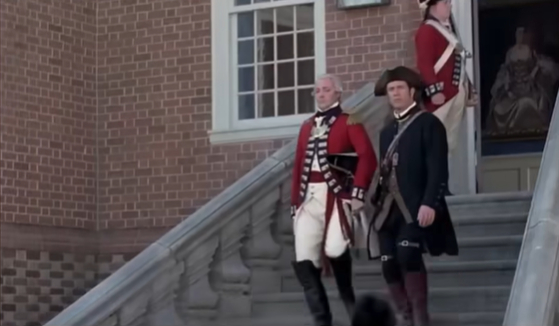
This atmosphere is evident in the scenes surrounding the British military headquarters.
Uniformed commanders move through the compound while mounted soldiers patrol the grounds.
Armed guards stand watch.
Prisoners remain under military control.
Everything suggests an army accustomed to exercising power.
But beneath that appearance of order, serious problems are developing.
The British are facing an enemy that refuses to fight according to their expectations.
A War That Becomes Increasingly Personal
The film follows Benjamin Martin, played by Mel Gibson.
A veteran of an earlier war, Benjamin initially wants nothing more than to raise his children peacefully.
He understands the terrible consequences of violence and hopes to avoid another conflict.
But the American Revolutionary War eventually reaches his home.
After a brutal encounter with British troops results in tragedy for his family, Benjamin abandons his peaceful existence.
He joins the resistance and becomes a militia leader.
His knowledge of warfare makes him particularly dangerous.
Rather than confronting British troops in conventional battles, he uses surprise attacks, mobility, and his understanding of the countryside.
The British soon discover that defeating him will not be easy.
The Officers Who Represent British Power
Two of the film’s most important British characters are Lord General Charles Cornwallis and Colonel William Tavington.
Cornwallis, portrayed by Tom Wilkinson, represents the established military leadership.
He values discipline, reputation, and the traditions of conventional warfare.
Tavington, played by Jason Isaacs, represents a much more ruthless approach.
He is ambitious, aggressive, and willing to use intimidation to achieve his objectives.
Their contrasting personalities create tension within the British command.
Cornwallis wants victory without destroying the principles he believes should govern military conduct.
Tavington increasingly sees brutality as an effective weapon.
Their disagreements reveal the growing difficulty of controlling a conflict that has become deeply personal.
A Military Outpost Filled With Tension
The setting of a British-controlled compound creates an atmosphere of intimidation.
Soldiers move through the grounds.
Officers exchange serious looks.
Mounted troops arrive beneath the watchful eyes of the garrison.
And the presence of prisoners serves as a reminder that the consequences of resistance can be severe.
The scene’s strength comes from its visual storytelling.
The uniforms, military architecture, and controlled movements communicate authority before anyone needs to explain the situation.
Yet the tension suggests that authority is being challenged.
The British may control the fort, but they cannot control every development beyond its walls.
Somewhere outside their defenses, the rebellion continues.
Why Benjamin Martin Is So Dangerous
Benjamin Martin does not command the same resources as the British Army.
He lacks its enormous military infrastructure.
His fighters are often ordinary men who know the local terrain.
But he possesses something that makes him a serious threat.
He understands how his opponents think.
Benjamin recognizes that British commanders depend on organized formations, supply routes, and predictable military engagements.
By disrupting those expectations, he creates confusion.
His militia attacks unexpectedly and disappears before the British can respond effectively.
These tactics make him a persistent problem for the officers trying to defeat him.
As his reputation grows, the British begin referring to him as the Ghost.
The nickname reflects their frustration with an enemy who seems capable of striking and vanishing at will.
When Military Pride Becomes a Weakness
One of the film’s recurring themes is the danger of underestimating an opponent.
The British commanders possess professional training, superior equipment, and confidence in their military traditions.
But those advantages do not guarantee victory.
Benjamin understands that pride can influence decisions.
Commanders who believe themselves invincible may become careless.
Officers concerned with protecting their reputations may overlook unconventional threats.
And soldiers accustomed to conventional warfare may struggle against an enemy who refuses to follow the same rules.
The conflict becomes a contest of strategy as much as strength.
It also raises an important question.
Can a powerful army defeat an opponent who understands its weaknesses better than it understands his?
Why The Patriot Remains So Memorable
Released in 2000 and directed by Roland Emmerich, The Patriot combines large-scale battle sequences with a personal story about family, sacrifice, and revenge.
Mel Gibson brings emotional intensity to Benjamin Martin.
Jason Isaacs delivers a chilling performance as Tavington.
And Tom Wilkinson gives Cornwallis a commanding presence.
Together, these performances create a conflict that feels larger than a conventional battlefield confrontation.
The film is a fictionalized historical drama rather than a documentary, but its characters and military confrontations continue to captivate audiences.
Its most memorable moments often arise when personal determination challenges overwhelming authority.
The Battle Is Far From Over
The British officers may stand confidently behind the walls of their military headquarters.
Their soldiers may appear disciplined and powerful.
But the rebellion they are fighting cannot be measured only by the number of troops on either side.
Benjamin Martin has become a symbol of resistance.
And every attempt to defeat him makes the conflict more dangerous.
The tension between British authority and colonial determination drives the story toward its unforgettable confrontations.
THE BRITISH HAD THE ARMY, THE WEAPONS, AND THE POWER… BUT ONE MAN REFUSED TO BE BROKEN! ⚔️🔥
👀 WHO ELSE THINKS BENJAMIN MARTIN WAS ONE OF MEL GIBSON’S MOST INTENSE CHARACTERS? AND WHO WAS THE MOST INTIMIDATING BRITISH OFFICER IN THE PATRIOT? 🇺🇸👇
#ThePatriot #MelGibson #JasonIsaacs #TomWilkinson #BenjaminMartin #RevolutionaryWar #EpicWarMovies #ClassicCinema