
There are Saturday Night Live sketches that make perfect sense from beginning to end.
“The Killer Bees: Home Invasion” is not one of them.
And that is exactly why it is so memorable.
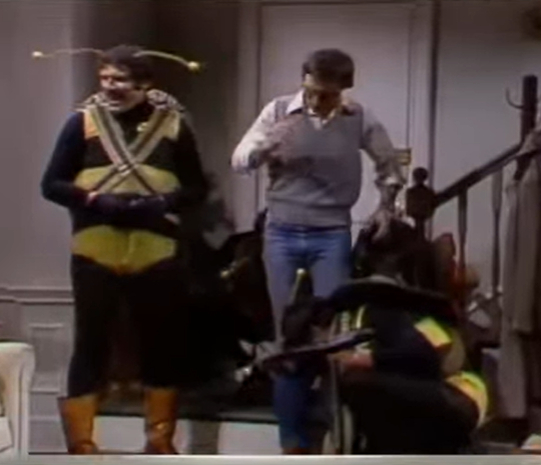
A suburban couple hears a warning about dangerous killer bees moving into the area. Moments later, enormous human-sized bees appear outside their home. They break in, threaten everyone, demand pollen, and behave less like insects than a gang of desperate bandits from an old Western.
That would already be enough for a strange comedy sketch.
But then the camera seems to stop cooperating.
The performers begin acknowledging the production.
The director gets involved.
Lorne Michaels appears.
Suddenly, the audience is no longer simply watching a sketch about killer bees. The entire television show itself seems to be collapsing in front of them.
Nearly 50 years later, “The Killer Bees: Home Invasion” remains one of the best examples of how unpredictable the earliest era of Saturday Night Live could be.
It Starts Like a Bad Horror Movie
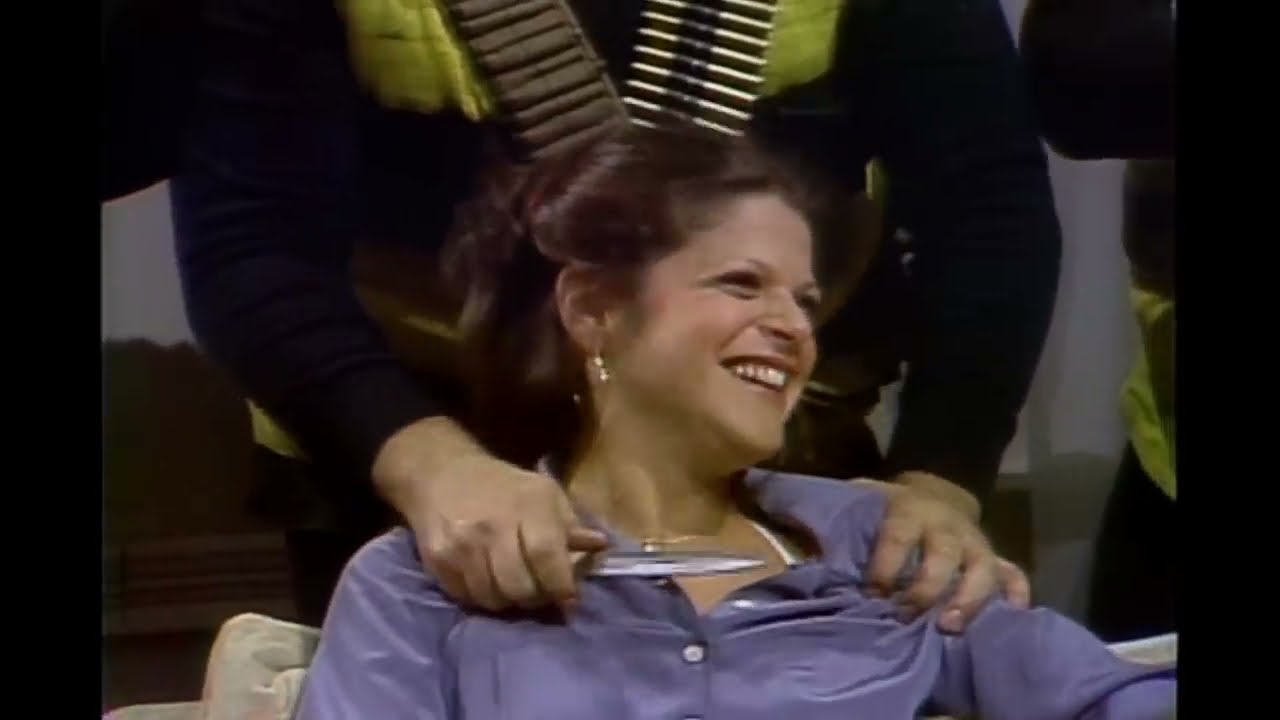
The opening is wonderfully simple.
Chevy Chase and Gilda Radner play a couple relaxing at home while the radio reports that dangerous South American killer bees have been spotted nearby.
The warning is serious.
The situation is supposedly dangerous.
And then SNL immediately destroys any possibility of genuine suspense by revealing the bees.
These are not realistic insects.
They are grown adults wearing striped costumes, wings, and ridiculous antennae.
That visual alone tells the audience everything it needs to know.
The sketch is not trying to create a believable world. It is taking a piece of contemporary anxiety and turning it into complete nonsense.
Killer bees had become a subject of public fascination and fear during the 1970s. Stories about aggressive bees moving north from South America generated sensational headlines and plenty of nervous speculation.
SNL saw comedy waiting inside that fear.
What if the bees finally arrived?
And what if they acted like armed criminals?
John Belushi Treats the Absurdity Seriously
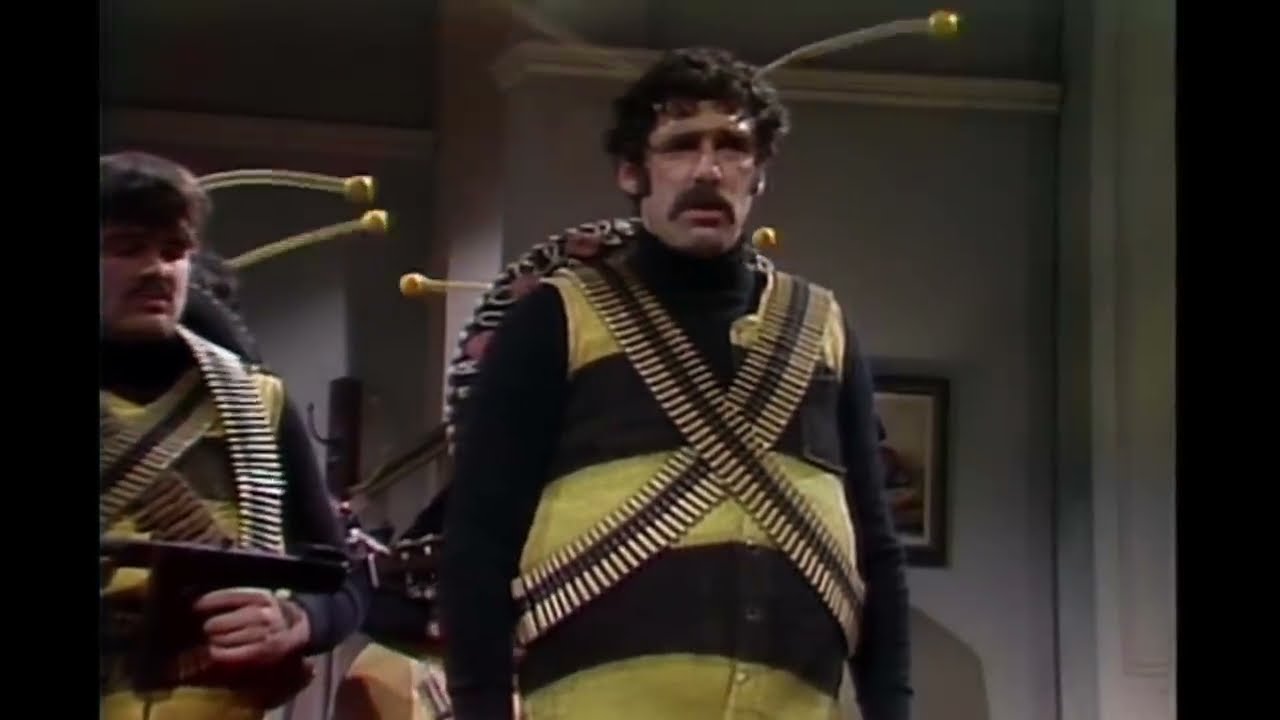
One of the reasons the original SNL cast became legendary was their ability to commit completely to ridiculous material.
John Belushi is especially effective here.
Nothing about his costume should be threatening. He is dressed like a giant bee. He has antennae bouncing above his head. The whole image is inherently silly.
Yet Belushi behaves as if he is playing a dangerous outlaw.
That contrast is the joke.
The bees do not enter the house buzzing around lamps or searching for flowers. They behave like bandits conducting a robbery. Their target is pollen, but their attitude suggests they could just as easily be demanding money from a bank teller.
Elliott Gould, Garrett Morris, and Dan Aykroyd join the invasion, creating what may be one of the least convincing but most entertaining criminal gangs ever shown on television. The original sketch featured Gould alongside several members of SNL’s first cast, while Chase and Radner played the homeowners caught in the bizarre invasion.
Everyone plays the premise just seriously enough.
That is important.
If the performers constantly laughed at the costumes, the scene would fall apart. Instead, they behave as though a gang of six-foot bees demanding pollen is an entirely reasonable emergency.
The Bees Became an Early SNL Tradition
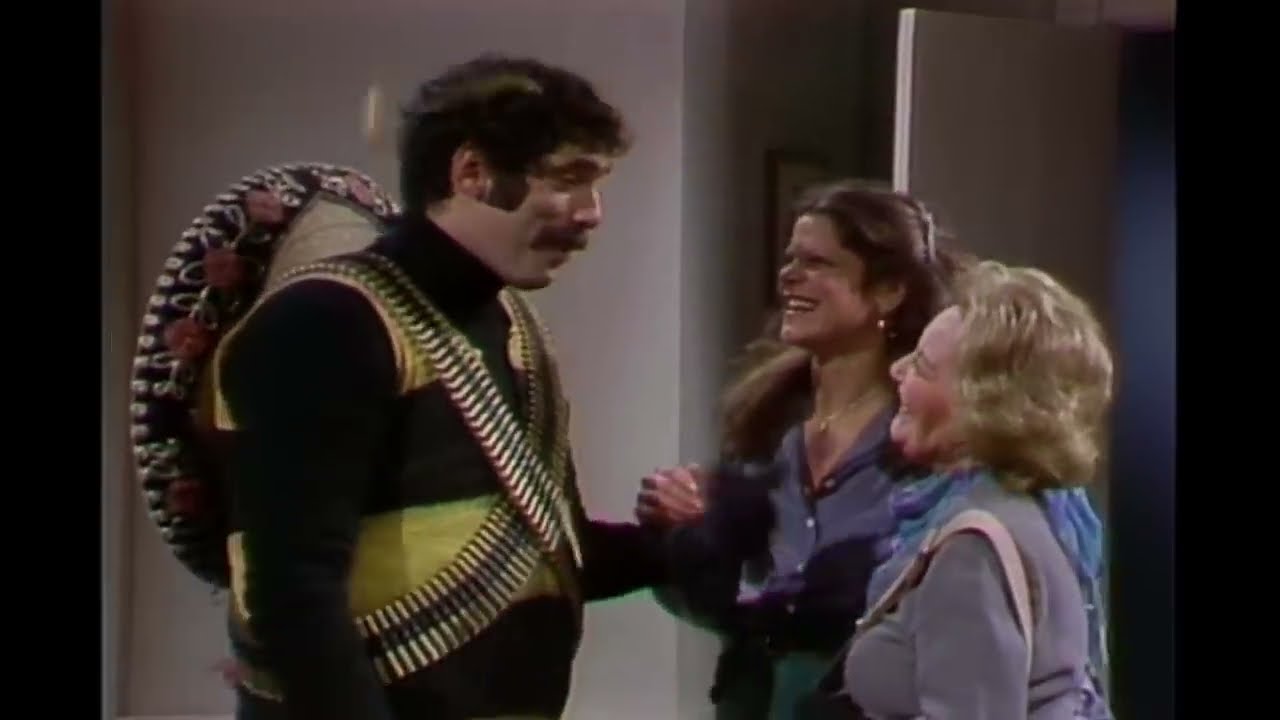
To understand why this sketch matters, it helps to remember how young Saturday Night Live was at the time.
The January 10, 1976 episode was only the ninth episode of the show’s first season. Elliott Gould was the host, and Anne Murray was the musical guest.
SNL was still figuring out what it wanted to be.
The familiar rules had not been established yet.
There was no decades-long history of famous characters and celebrity impressions behind it. The cast and writers were essentially inventing the identity of the program week by week.
The Killer Bees became part of that experimentation.
They were among SNL’s earliest recurring characters, appearing repeatedly during the first season. According to accounts of the show’s early history, NBC had not been particularly enthusiastic about the bee material, which only encouraged the writers to keep bringing the characters back.
That rebellious attitude tells you a lot about early SNL.
If someone said the bees were a bad idea, the response was apparently to make more bees.
Then the Sketch Starts Falling Apart
At some point, “Home Invasion” stops being merely a parody about killer bees.
The production itself becomes part of the joke.
The camera appears to be showing the wrong thing. Instead of quietly hiding the supposed mistake, the sketch draws attention to it.
Now the performers are aware of the television production.
The audience is aware of the cameras.
The illusion disappears.
What looked like a normal scripted scene begins turning into something closer to controlled chaos.
This is where the sketch becomes especially interesting.
Modern television audiences are used to comedy breaking the fourth wall. Characters look into cameras. Shows make jokes about their writers. Movies acknowledge that they are movies.
But in 1976, watching a live network comedy program appear to malfunction in real time carried a different energy.
Was something actually going wrong?
Was this scripted?
Should the audience be laughing?
SNL intentionally blurred those boundaries.
The result feels dangerous in a way polished prerecorded comedy often cannot.
Lorne Michaels Enters His Own Show
The escalating production disaster eventually brings producer Lorne Michaels into the sketch.
Today, seeing Michaels appear on SNL is hardly shocking. After decades associated with the program, viewers recognize him immediately.
But this sketch marked Michaels’ first on-camera SNL appearance.
That makes the moment particularly fascinating in retrospect.
Here is the producer of a brand-new television show suddenly appearing because the program seems to be breaking down around him.
The backstage world becomes entertainment.
Instead of maintaining the fiction that everything on television is smooth and controlled, SNL invites the audience behind the curtain.
The people producing the show become characters.
The technical problems become jokes.
Even the authority figure responsible for keeping the program together becomes part of the comedy.
This kind of self-awareness would eventually become a major part of SNL’s identity.
Cast members would break character.
Hosts would acknowledge cue cards.
Sketches would joke about budgets, ratings, producers, and NBC itself.
But “Killer Bees: Home Invasion” shows that experimental instinct was present almost from the beginning.
The Messiness Is Part of the Appeal
If someone created this sketch today, the production would probably be much cleaner.
The costumes might look better.
The camera movements would be carefully rehearsed.
The transition into the backstage material would probably be edited more smoothly.
And it might actually be less funny.
Part of the charm of early SNL is that the show sometimes feels like a group of talented people discovering what live television can do while the cameras are already rolling.
There is a looseness to it.
A danger.
Anything seems possible.
The performers are not separated from the audience by layers of digital editing. They are standing a few feet away, wearing ridiculous bee costumes, trying to maintain control of a sketch that is pretending to lose control.
That energy is difficult to reproduce.
You are not simply watching jokes.
You are watching people attempt something.
Why the Bad Costumes Actually Help
The Killer Bees would probably not be nearly as funny if they looked realistic.
Their costumes are intentionally ridiculous.
The stripes are obvious.
The wings are cheap-looking.
The antennae move around.
Nobody could possibly mistake these performers for actual insects.
And that becomes the point.
The sketch is not asking the viewer to suspend disbelief.
It is constantly reminding you that this is a television comedy show.
That makes the later fourth-wall-breaking material feel almost natural. The production was already artificial, so exposing even more of the machinery behind it simply pushes the same joke further.
The Killer Bees look like performers in costumes because they are performers in costumes.
Early SNL often embraced that theatrical quality rather than trying to hide it.
It Also Captures the Comedy of the 1970s
Watching the sketch today is like opening a time capsule.
The pacing is different from modern comedy.
Jokes are allowed to breathe longer.
Scenes wander into unexpected territory.
The performers are willing to spend time on strange character behavior without immediately racing toward another punch line.
Even the idea of turning killer bees into something resembling Mexican bandits reflects the pop-culture parody style of the period. Decades later, Los Angeles Times readers still singled out the sketch for the way its bee invasion transforms into a Western-style parody.
Some parts inevitably feel dated.
But the basic comedic instinct still feels surprisingly modern.
Take something audiences recognize.
Make it absurd.
Then destroy the format holding the sketch together.
That structure could easily appear in an experimental comedy show today.
The Original Cast Makes Chaos Look Easy
It is also impossible to watch the sketch without appreciating the performers involved.
Chevy Chase and Gilda Radner give the audience ordinary characters to follow before everything becomes ridiculous.
Dan Aykroyd and Garrett Morris throw themselves into the bee invasion.
Elliott Gould fits comfortably into the strange world of the show.
And Belushi has the kind of presence that can make even the stupidest costume seem somehow dangerous.
The cast does not behave like people protecting their dignity.
That may be one of the most important qualities of great sketch performers.
They are willing to look ridiculous.
They are willing to commit to bad wigs, strange voices, cheap costumes, absurd premises, and jokes that might fail in front of millions of people.
When it works, the risk becomes part of the excitement.
Why “Killer Bees” Still Matters
Nobody needs to understand 1970s killer-bee panic to laugh at a giant insect behaving like a criminal.
Nobody needs to know the history of NBC to enjoy watching a television sketch pretend to collapse behind the scenes.
And nobody needs to be an SNL historian to recognize the joy of talented performers committing completely to a ridiculous idea.
That universality helps explain why “The Killer Bees: Home Invasion” continues to be remembered decades later. It has appeared in retrospective discussions of memorable SNL sketches, and the Killer Bees remain one of the recognizable symbols of the show’s strange experimental first season.
The sketch also represents something SNL has spent half a century trying to preserve: the feeling that because the show is happening live, something unexpected could happen at any moment.
Most weeks, everything works.
But the possibility of disaster is always there.
“Killer Bees: Home Invasion” takes that possibility and turns it into the entire joke.
It begins with two people worried about insects.
Then giant bees invade their home.
Then the bees start behaving like outlaws.
Then television itself seems to malfunction.
Then the people running the show enter the story.
By the end, the original premise barely matters anymore.
The sketch has eaten itself.
And somehow, that is what makes it great.
Fifty years later, the costumes still look ridiculous. The premise is still absurd. The whole thing still feels slightly out of control.
But that is early Saturday Night Live at its best.
Not polished.
Not predictable.
Not afraid to let the audience wonder whether what they are watching was actually supposed to happen.
Sometimes all you need for memorable television is a live studio, a fearless cast, a few cheap bee costumes, and absolutely no concern about how strange things are about to get.