No Fences. No Fear. No Backing Down. When Justice Becomes a Fight for Survival
Few modern Western films capture the raw intensity of frontier justice quite like Open Range (2003). Directed by and starring Kevin Costner, alongside legendary actor Robert Duvall, this gripping Western explores loyalty, freedom, violence, and the difficult choices men must make when powerful enemies threaten everything they believe in.
At the center of the story are two free-grazing cattlemen, Charley Waite and Boss Spearman, whose peaceful existence is shattered by an encounter with a ruthless landowner determined to control the open country.
Two particularly memorable sequences illustrate the film’s emotional power: a confrontation about justice and revenge, followed by an explosive gunfight that turns an ordinary frontier town into a deadly battlefield.
Together, these moments demonstrate why Open Range remains one of the most respected Westerns of the twenty-first century.
Two Cowboys Who Refuse to Surrender Their Freedom
The story follows Boss Spearman, played by Robert Duvall, and Charley Waite, portrayed by Kevin Costner.
The two men travel across the American frontier with their cattle, relying on the traditional practice of free grazing.
They believe the open land should remain accessible to independent cattlemen rather than being controlled entirely by wealthy ranch owners.
Their lifestyle is simple.
They work hard, respect each other, and follow a personal code built around honesty and loyalty.
But their journey brings them into conflict with Denton Baxter, a powerful rancher who considers free grazers an unwelcome threat to his authority.
Baxter uses intimidation, hired gunmen, and corrupt local law enforcement to maintain control over the surrounding territory.
What begins as a disagreement about cattle grazing quickly becomes something far more dangerous.
Boss and Charley discover that Baxter is willing to use deadly force to drive them away.
A Tragedy That Changes Everything
The conflict escalates when members of Baxter’s organization attack Boss and Charley’s camp.
One of their companions, Mose Harrison, is killed, while the young Button is seriously wounded.
The attack leaves Boss devastated and pushes Charley toward a confrontation he had hoped to avoid.
For Boss, the murder of an innocent companion represents an unforgivable violation of the basic moral principles he has lived by.
For Charley, the incident awakens painful memories of his own violent past.
He has spent years attempting to leave that part of his life behind.
But now, faced with the death of a friend and the suffering of another, he must decide whether violence is the only remaining answer.
The tragedy transforms the story from a peaceful cattle-driving adventure into a tense examination of justice, revenge, and moral responsibility.
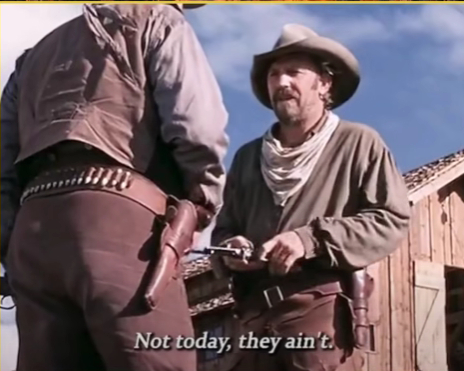
Video One: The Difference Between Justice and Revenge
One of the film’s most powerful confrontations centers on the difference between seeking justice and acting out of revenge.
Charley understands that Baxter’s men cannot be allowed to escape responsibility.
His anger is understandable.
A friend has been murdered, another has been wounded, and the authorities appear unwilling to deliver justice.
Yet Boss Spearman refuses to let grief become an excuse for uncontrolled brutality.
He reminds Charley that their purpose must remain clear.
They are not looking for violence simply because they enjoy it.
They want accountability for the wrongs committed against their companions.
This distinction gives the scene its emotional weight.
Robert Duvall portrays Boss with the quiet authority of a man who has witnessed hardship and understands the consequences of reckless decisions.
Kevin Costner, meanwhile, gives Charley an intensity that reveals the dangerous conflict growing inside him.
Neither man doubts that Baxter must be confronted.
The question is how far they should go.
Their disagreement offers an important reminder that even in a violent world, the reasons behind an action still matter.
Charley Waite: A Dangerous Man Trying to Escape His Past
Charley is one of the film’s most complicated characters.
On the surface, he appears to be a quiet, hardworking cowboy who prefers simple pleasures and peaceful surroundings.
However, his reserved personality conceals a past shaped by violence.
He has considerable experience with firearms and understands the realities of killing.
Unlike inexperienced gunfighters who imagine violence as something heroic, Charley knows its terrible consequences.
That knowledge makes him reluctant to return to his old ways.
Yet the situation involving Baxter forces him toward the very life he has been trying to abandon.
Costner portrays this internal struggle through restrained dialogue, expressions, and deliberate movements.
Charley’s greatest challenge is not merely defeating his enemies.
It is deciding whether he can use violence without allowing it to destroy the person he has become.
Video Two: The Gunfight That Shook an Entire Town
The film’s climactic confrontation is widely remembered for its explosive realism.
After negotiations and warnings fail, Charley and Boss prepare to face Baxter’s hired gunmen.
The confrontation takes place in the frontier town of Harmonville, where ordinary buildings, muddy streets, and wooden walkways become the setting for a deadly showdown.
Unlike many traditional Westerns, the scene does not rely on an extended ritual of gunfighters slowly reaching for their weapons.
Instead, violence erupts suddenly.
Charley demonstrates the skills he has spent years trying to suppress.
His movements are fast, deliberate, and frighteningly effective.
Boss fights alongside him despite his wounds and the overwhelming danger surrounding them.
Gunshots echo through the town as the conflict spreads.
Men dive for cover, bullets strike buildings, and the atmosphere becomes increasingly chaotic.
The scene emphasizes how unpredictable a real armed confrontation can feel.
Nobody has complete control once the shooting begins.
Robert Duvall’s Boss Spearman Refuses to Back Down
Boss Spearman is far more than Charley’s employer or traveling companion.
He is a father figure, loyal friend, and moral guide.
Throughout the film, Boss demonstrates that courage does not require constant aggression.
He understands when to show restraint, but he is equally willing to stand his ground when innocent people are threatened.
During the final confrontation, his bravery becomes especially meaningful.
Despite suffering injuries and facing formidable enemies, he refuses to abandon Charley.
Their friendship gives the gunfight emotional significance beyond its spectacular action.
They are not fighting for wealth, fame, or control over territory.
They are fighting for their companions and for the right to live without intimidation.
Duvall’s performance gives Boss a natural dignity that makes his determination particularly compelling.
Why Open Range’s Gunfight Feels So Real
One of the greatest achievements of Open Range is its approach to firearm violence.
The gunshots are loud and startling, and the physical consequences are presented with unusual force.
Rather than depicting gunfighters as invincible heroes, the film emphasizes confusion, vulnerability, and the speed with which confrontations can become deadly.
Director Kevin Costner uses the town’s geography to create tension.
Buildings provide temporary shelter, while open streets expose characters to immediate danger.
The audience must follow multiple movements as the confrontation intensifies.
This visual approach makes the action feel unpredictable.
More importantly, the gunfight is grounded in the film’s emotional story.
Because viewers understand why Charley and Boss are fighting, every exchange carries personal significance.
The action is not merely exciting.
It represents the culmination of injustice, grief, and long-suppressed anger.
A Western About Honor, Not Just Revenge
Although Open Range contains considerable violence, its central themes are surprisingly thoughtful.
The film repeatedly asks whether justice can exist in a society where powerful individuals control the law.
Baxter believes his wealth and influence give him the right to dictate how others live.
Boss and Charley reject that assumption.
Their resistance reflects a broader Western ideal: the belief that personal freedom should not depend entirely on wealth or political authority.
Yet the movie also recognizes that independence comes with responsibilities.
Boss insists that actions must be guided by principle rather than uncontrolled hatred.
Charley’s struggle illustrates how difficult that ideal becomes when grief and anger take over.
Their relationship forms the moral center of the entire story.
Kevin Costner Revives the Spirit of Classic Western Cinema
Released in 2003, Open Range arrived at a time when traditional Westerns were no longer dominating Hollywood.
Nevertheless, Kevin Costner demonstrated that the genre could still deliver powerful storytelling.
The film combines sweeping landscapes, carefully developed characters, emotional relationships, and explosive action.
Its supporting cast includes Annette Bening as Sue Barlow and Michael Gambon as Denton Baxter.
Their performances enrich a story that explores both the brutality and humanity of frontier life.
Costner’s direction allows quiet conversations to matter as much as spectacular confrontations.
This balance makes the violence more meaningful when it finally erupts.
Open Range is not simply a story about two cowboys defeating dangerous enemies.
It is a film about men trying to preserve their dignity in a world that increasingly rewards cruelty.
The Legacy of Open Range: When Good Men Are Forced to Fight
More than two decades after its release, Open Range remains a favorite among fans of traditional Western cinema.
Its memorable dialogue, realistic gunfights, and powerful performances continue to attract new audiences.
The two featured sequences reveal why the film remains so effective.
The confrontation about justice reminds viewers that the reasons behind violence matter.
The final gunfight demonstrates the terrifying consequences when peaceful solutions become impossible.
Together, they tell a story about loyalty, personal responsibility, and the courage required to defend one’s principles.
Charley Waite and Boss Spearman never wanted to become legends.
They simply wanted to live freely, protect their companions, and refuse to surrender to intimidation.
But when powerful men crossed the line, the two cowboys made their decision.
No fences. No fear. No backing down.
And in Open Range (2003), that decision leads to one of the most unforgettable showdowns in modern Western cinema.