The Good, the Bad and the Ugly is remembered for gunfights, unforgettable characters, sweeping landscapes, and Ennio Morricone’s legendary music.
But some of the movie’s most powerful moments don’t involve a duel at all.
Sometimes the most memorable scenes come from the contrast between what we hear and what we know is happening.
The interrogation of Tuco at the Union prison camp is a perfect example.
Inside a small room, Tuco is being brutally questioned about a fortune in Confederate gold.
Outside, a group of prisoners is ordered to play music.
The melody continues.
But everyone understands why they are being forced to play.
The music isn’t entertainment.
It’s camouflage.
And the musicians know it.
That realization makes this sequence much more disturbing than a conventional interrogation scene.
Earlier, Tuco and Blondie had learned about $200,000 in Confederate gold from a dying soldier named Bill Carson.
Carson revealed that the money had been buried at Sad Hill Cemetery.
But through a strange accident of timing, the information was divided between the two men.
Tuco learned the name of the cemetery.
Blondie learned the name written on the grave.
Neither possessed everything.
That meant neither man could easily find the gold without the other.
Their shared secret created an uneasy partnership.
Then Angel Eyes discovered that there was a fortune waiting to be found.
And once Angel Eyes wanted information, he was willing to do almost anything to get it.
Tuco became his first target.
At first, Angel Eyes approached the situation with characteristic calm.
That’s part of what makes him such an intimidating villain.
He rarely needs to behave wildly.
He doesn’t have Tuco’s explosive emotions.
He doesn’t need to constantly raise his voice.
Angel Eyes prefers control.
He asks questions.
He watches reactions.
He waits.
But when Tuco refuses to cooperate completely, the interrogation becomes violent.
Corporal Wallace takes over.
And outside the room, the musicians begin playing.
That is where Sergio Leone transforms what could have been a straightforward scene of violence into something much more emotionally complicated.
The prisoners aren’t simply background characters.
They understand.
They hear enough.
They know that another prisoner is suffering while they are being forced to create beautiful music.
The contradiction is painful.
Music is normally associated with expression.
Emotion.
Celebration.
Sometimes mourning.
Here, it becomes a tool used to conceal brutality.
The musicians cannot stop what is happening.
They cannot openly protest.
They cannot rescue Tuco.
They can only continue playing.
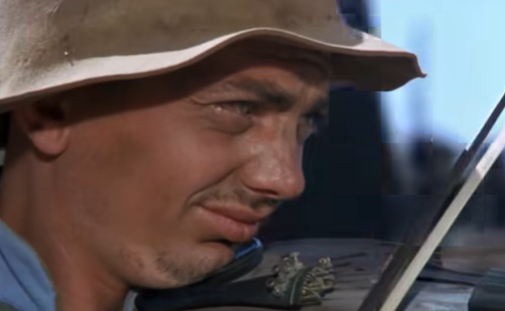
One musician’s reaction makes the scene especially powerful.
As the music continues, tears appear.
He tries to keep playing.
The instrument remains in position.
The performance continues.
But his face reveals everything the music is being ordered to hide.
He knows what is happening.
And he hates it.
That brief reaction adds humanity to the entire sequence.
Tuco is far from an innocent man.
Throughout the movie, he lies, steals, threatens, betrays people, and commits violence.
He’s introduced as a wanted criminal with a long list of accusations attached to his name.
Yet in this moment, the film doesn’t ask the audience to think about whether Tuco deserves punishment.
Instead, we watch a helpless prisoner being beaten for information.
And we watch other helpless prisoners forced to pretend nothing is happening.
That creates sympathy in an unexpected place.
Eli Wallach’s performance is crucial.
Tuco is normally one of the loudest characters in the movie.
He talks constantly.
He complains.
He threatens.
He jokes.
He schemes.
Even when he’s in danger, his personality fills the screen.
During the interrogation, that energy is gradually stripped away.
Corporal Wallace keeps hitting him.
Tuco tries to resist.
But eventually his body begins to fail.
The man who has survived hangings, shootouts, abandonment, and the desert is suddenly trapped in a room where cleverness cannot immediately save him.
There’s nowhere to run.
His revolver isn’t available.
Talking his way out isn’t working.
For once, Tuco’s survival instincts have reached a situation where there are very few options.
Meanwhile, the music continues.
That’s what makes the editing so effective.
We don’t remain entirely focused on the beating.
The film repeatedly reminds us that another group of men is being forced to participate indirectly.
Every return to the musicians changes how we experience the violence.
They don’t need to see everything.
They understand enough.
And because they understand, the audience feels the weight of the scene through them.
Their performance becomes almost a form of shared suffering.
They cannot openly acknowledge Tuco.
But emotionally, they are connected to him.
This also fits the film’s broader portrayal of the Civil War.
The Good, the Bad and the Ugly takes place against a massive historical conflict, but Leone rarely presents war as glorious.
Instead, the war often appears wasteful, destructive, and absurd.
Soldiers fight over positions that seem almost meaningless.
Men die for objectives that will soon be forgotten.
Armies move through devastated landscapes.
Blondie and Tuco aren’t patriotic heroes trying to influence the outcome of the war.
They’re simply trying to survive it while searching for gold.
Again and again, the Civil War interrupts their personal treasure hunt.
But those interruptions also expose them to the suffering surrounding the conflict.
The prison camp sequence is part of that larger theme.
People are trapped.
People are controlled.
People are ordered to participate in things they don’t want to participate in.
Even the musicians lack freedom.
They have instruments in their hands, but the music isn’t truly theirs.
They’re playing because they have been told to play.
That loss of control mirrors Tuco’s situation inside the room.
He is being forced to surrender information.
They are being forced to produce sound.
Everyone is under someone else’s authority.
Only Angel Eyes seems comfortable.
That is another reason he feels so threatening here.
He understands the system around him and uses it.
The prison camp gives him access to prisoners.
It gives him men like Wallace.
It gives him the ability to isolate Tuco.
And it gives him the opportunity to pursue the $200,000.
Angel Eyes is not interested in the morality of the situation.
He wants the gold.
Tuco is simply an obstacle between him and that goal.
Eventually, the violence works.
Tuco reveals what he knows.
The money is connected to Sad Hill Cemetery.
But Angel Eyes soon discovers another problem.
Tuco doesn’t know the entire secret.
The name of the grave was given to Blondie.
That means Blondie suddenly becomes essential.
It’s one of the film’s recurring ironies.
Information repeatedly saves people’s lives.
Earlier, Tuco was ready to let Blondie die in the desert.
Then Tuco discovered that Blondie knew the grave name.
Immediately, Blondie became too valuable to lose.
Now Angel Eyes reaches the same conclusion.
Blondie’s knowledge protects him.
The gold changes relationships.
Enemies become temporary partners.
Prisoners become valuable sources of information.
People who might otherwise be killed are kept alive because they know something.
But the emotional center of this particular sequence isn’t really the gold.
It’s the music.
Without the musicians, the interrogation would still be tense.
With them, it becomes tragic.
Their reactions remind us that violence affects more than the person receiving the blows.
Other people hear it.
Other people know.
Other people suffer because they are powerless to stop it.
And sometimes they are forced to continue behaving normally while something terrible happens only a few feet away.
The crying musician communicates all of that without delivering a speech.
He doesn’t need dialogue.
His face is enough.
He keeps playing because he has no choice.
But the tears reveal the truth.
That’s one of the reasons this scene remains memorable decades later.
It demonstrates how Sergio Leone could create emotion through contrast.
Beautiful music against brutal violence.
A public performance against private suffering.
A group of men playing together while another man is isolated and beaten.
The sound is supposed to hide the truth.
Instead, for the audience, it makes the truth impossible to ignore.
Tuco will survive.
The treasure hunt will continue.
Blondie, Tuco, and Angel Eyes will eventually move toward their legendary confrontation at Sad Hill Cemetery.
But for a few minutes, the search for gold becomes secondary.
The film shows us something darker.
Men forced to hurt.
Men forced to watch.
Men forced to play.
And one musician who simply cannot stop himself from crying.
The music keeps going.
The beating continues.
But his tears tell us everything the music was meant to conceal.