There are movie scenes that need explosions, armies, or pages of dialogue to create tension.
And then there is the final showdown in The Good, the Bad and the Ugly.
Three men.
Three guns.
A cemetery.
And several agonizing minutes in which almost nobody says anything.
Yet somehow, Sergio Leone turned that simplicity into one of the defining sequences of the Western genre.
Released in 1966, The Good, the Bad and the Ugly stars Clint Eastwood as Blondie, Lee Van Cleef as Angel Eyes, and Eli Wallach as Tuco. BFI lists the film as an Italian production directed by Sergio Leone, with a running time of 177 minutes.
By the time the story reaches Sad Hill Cemetery, all three men have been drawn toward the same objective: a fortune in Confederate gold.
But Leone does not rush toward the answer.
Instead, he slows everything down.
Tuco races through the cemetery searching desperately for the grave connected to the treasure.
This section is accompanied by Ennio Morricone’s extraordinary “The Ecstasy of Gold.”
Then the story gradually moves toward its ultimate confrontation.
Blondie.
Angel Eyes.
Tuco.
Three men positioned around the circular center of the cemetery.
Each watches the others.
Each understands that one movement could decide everything.
And Leone begins stretching time.
The camera moves between them.
A face.
A hand.
A gun.
Another face.
Another hand.
Another gun.

Nothing happens.
And that’s precisely why the scene becomes so tense.
Most action filmmaking is built around movement.
Leone builds this sequence around waiting.
The audience knows that someone eventually has to draw.
The characters know it.
The music knows it.
But nobody knows exactly when.
That anticipation becomes almost unbearable.
Film director Edgar Wright has described the climax as an example of Leone’s operatic filmmaking, emphasizing the marriage between visual storytelling and Morricone’s music.
That word — operatic — perfectly captures the scene.
Leone isn’t simply filming three cowboys preparing to shoot one another.
He is turning their confrontation into a ritual.
Every look matters.
Every cut matters.
Every musical cue matters.
The landscape itself seems to become part of the performance.
Morricone’s score is essential.
BFI notes that the composer and Leone developed distinct musical motifs associated with the film’s three central desperados: flute for Blondie, ocarina for Angel Eyes and human voices for Tuco.
That musical characterization helps give each man a distinct presence.
Then, during the climax, Morricone’s music pushes the tension higher.
“The Trio” accompanies the famous standoff, with guitars, trumpets and castanets interacting with Leone’s increasingly tight close-ups and precise editing. BFI specifically describes the resulting combination as an “operatic audiovisual effect.”
And those close-ups are crucial.
Leone loved faces.
Not glamorous faces.
Faces marked by dust, sweat, age and experience.
The camera doesn’t merely show us the gunslingers.
It studies them.
Clint Eastwood’s Blondie appears controlled.
Lee Van Cleef’s Angel Eyes radiates danger.
Eli Wallach’s Tuco carries a different energy entirely — nervous, unpredictable and intensely human.
Wallach’s performance is particularly important because Tuco prevents the movie from becoming emotionally cold.
He is greedy, dangerous, funny, frightened and resourceful, sometimes all within the same sequence.
BFI later described Tuco as one of Wallach’s signature roles and one of the great Western rogues.
Against him stands Eastwood.
Blondie rarely wastes movement.
He doesn’t need to explain what he is thinking.
His stillness is part of his power.
That restraint became central to the screen persona Eastwood developed through his collaborations with Leone.
Then there is Angel Eyes.
Lee Van Cleef’s character represents a colder kind of threat.
The three men therefore bring completely different energies into the circle.
Blondie’s control.
Angel Eyes’ menace.
Tuco’s unpredictability.
Leone positions those personalities against one another and allows the audience to study them.
Then the editing becomes faster.
Faces.
Eyes.
Hands.
Guns.
The music builds.
The camera moves closer.
Still nobody fires.
This is where Leone demonstrates one of cinema’s great lessons:
Action becomes more powerful when an audience is forced to wait for it.
If the three men immediately drew their weapons, the scene might last a few seconds.
Instead, Leone makes the anticipation the main event.
Director and BFI programmer Justin Johnson has highlighted exactly these elements when discussing the film: the wide shots, extreme close-ups of eyes and faces, minimal dialogue, and Morricone’s unconventional score.
That combination explains why the scene remains so recognizable.
Even viewers who have never watched the entire movie may recognize its visual language.
Extreme close-ups.
A gunslinger staring.
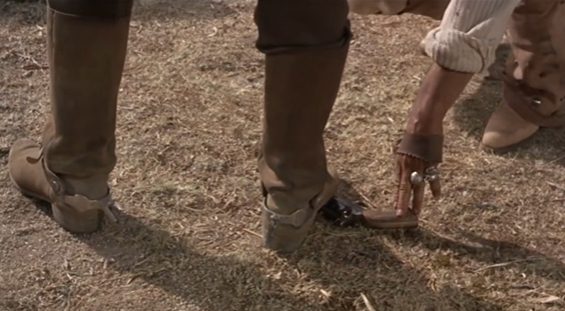
A hand hovering near a revolver.
Music slowly increasing the tension.
Countless later Westerns, action movies, television shows and parodies have borrowed variations of that language.
But imitation rarely reproduces the strange patience of Leone’s original.
The sequence also works because the treasure means something different to each character.
They have traveled through violence and the chaos of the American Civil War to reach this place.
Now the fortune seems almost close enough to touch.
But money has brought three dangerous men into the same circle.
Only after the confrontation will anyone be able to claim it.
That gives the standoff a wonderfully simple dramatic structure.
Everybody understands the stakes.
No lengthy explanation is required.
One fortune.
Three men.
Not enough trust.
Then comes the draw.
After minutes of preparation, the actual violence happens quickly.
That contrast is essential.
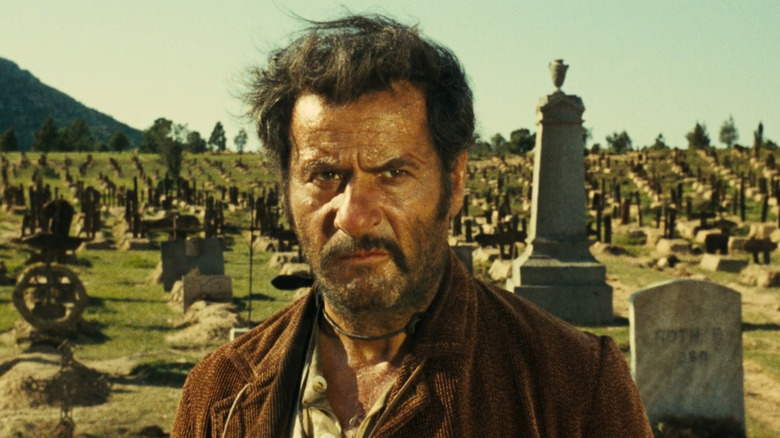
Leone spends an enormous amount of time preparing the audience for an event that lasts only moments.
The release of tension becomes far more powerful because of everything that came before it.
That technique is one reason the sequence continues to fascinate filmmakers and audiences almost sixty years later.
Modern movies have access to extraordinary technology.
Digital effects can create entire worlds.
Action sequences can involve hundreds of characters and enormous destruction.
Yet three actors standing in a cemetery can still generate extraordinary tension.
Why?
Because technology isn’t what creates suspense.
Information does.
Timing does.
Character does.
Music does.
Editing does.
And anticipation does.
Leone understood all of them.
Morricone understood them too.
Together they created a finale where image and music become almost impossible to separate.
Try imagining the sequence without Morricone’s score.
It immediately becomes something different.
Likewise, hearing “The Trio” can instantly evoke images of dusty faces, revolvers and three men waiting inside a cemetery.
That’s the mark of an extraordinary collaboration.
The Good, the Bad and the Ugly has survived far beyond its original 1966 release, and BFI’s 2022 critics’ poll placed it among its ranked Greatest Films of All Time selections.
But rankings aren’t necessary to understand why this particular scene survives.
Just watch it.
Three men enter a circle.
They look at one another.
The music begins to rise.
Hands move closer to guns.
The camera moves closer to their eyes.
And suddenly you’re waiting too.
That is Sergio Leone’s achievement.
He transformed waiting into action.
Silence into suspense.
And three men standing in a cemetery into one of the most enduring images of the Western.