Few moments in The Good, the Bad and the Ugly capture the danger of Angel Eyes as effectively as the sequence at the Union prison camp.
By this point in Sergio Leone’s 1966 Western masterpiece, Tuco and Blondie have already survived betrayals, gunfights, desert heat, and a brutal journey across a country being torn apart by the American Civil War.
But when Tuco arrives at Betterville prison camp and gives the name “Bill Carson,” he unknowingly puts himself directly in the path of one of the most dangerous men in the entire film.
Angel Eyes is waiting.
And he has been searching for that name.
The situation begins after Tuco and Blondie find themselves captured by Union soldiers while wearing Confederate uniforms.
They are taken to a Union prison camp, where captured Confederate soldiers are being held under miserable conditions.
For Tuco, being captured is already bad enough.
But things become much worse during roll call.
When his turn comes, Tuco identifies himself using the name “Bill Carson.”
It is not his real name.
But Tuco has a very good reason for using it.

Earlier in the story, he and Blondie encountered the dying Confederate soldier Bill Carson, who possessed crucial information about a stolen fortune in Confederate gold.
Carson revealed that the money had been buried at Sad Hill Cemetery.
But he divided the most important information between the two men.
Tuco learned the name of the cemetery.
Blondie learned the name written on the grave.
Neither man therefore has enough information to find the treasure alone.
They need each other.
What Tuco does not initially realize is that someone else has also been searching for Carson and the missing gold.
Angel Eyes.
Played with chilling calm by Lee Van Cleef, Angel Eyes has spent much of the film following the trail of the stolen money.
Unlike Tuco, who is emotional and unpredictable, Angel Eyes rarely appears hurried.
He watches.
He waits.
He asks questions.
And when someone has information he needs, he finds a way to get it.
That difference between the two characters makes their encounter at Betterville especially effective.
Tuco talks constantly.
Angel Eyes barely needs to.
Tuco reacts emotionally.
Angel Eyes remains controlled.
Tuco often survives through improvisation.
Angel Eyes survives through intimidation.
So when Angel Eyes hears the name “Bill Carson” during roll call, everything changes.
Suddenly Tuco is no longer simply another prisoner.
He is a potential path to the gold.
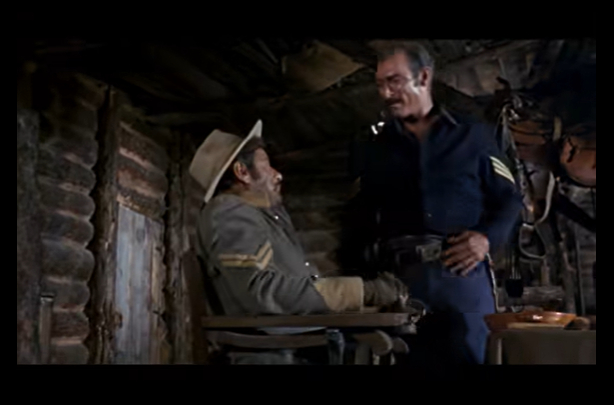
Angel Eyes has infiltrated the Union camp and is operating there under the appearance of military authority. This gives him exactly what he needs: control over Tuco and the ability to question him without interference.
When Tuco is brought before him, the atmosphere is immediately uncomfortable.
There is history between these men.
Tuco understands that Angel Eyes is dangerous.
Angel Eyes understands that Tuco knows something.
Neither needs a lengthy explanation.
That is one of Sergio Leone’s greatest strengths as a director.
He often allows faces to tell the story.
A look can replace a paragraph of dialogue.
A pause can create more tension than shouting.
Lee Van Cleef was perfectly suited to that style.
His face could appear almost completely still while still communicating menace.
Angel Eyes rarely needs to convince anyone that he is dangerous.
His calmness does the work.
Eli Wallach brings the opposite energy to Tuco.
Tuco is expressive.
His eyes move.
His face reacts.
His voice changes.
He is constantly calculating how much danger he is in and how he might escape it.
That makes the confrontation fascinating because the two actors approach tension from opposite directions.
Van Cleef removes emotion.
Wallach amplifies it.
And Leone places them across from one another.
Angel Eyes begins questioning Tuco about Bill Carson and the missing Confederate gold.
Tuco initially attempts to protect what he knows.
But Angel Eyes has no intention of relying only on conversation.
He has Corporal Wallace brought in to help extract the information.
What follows is one of the film’s darkest sequences.
Wallace brutally beats Tuco while a group of prisoners plays music outside.
The musicians understand what is happening.
Their expressions reveal it.
The music is not there because anyone is celebrating.
It is being used to cover the sounds of violence.
That detail changes the entire tone of the scene.
In many Westerns, violence is presented as spectacle.
Leone does something different here.
The beating is ugly.
The music is mournful.
The prisoners appear exhausted.
There is nothing heroic about what is happening.
The Civil War surrounding the main characters is increasingly shown not as an adventure, but as a tragedy.
This theme becomes more important as the film progresses.
Blondie, Tuco and Angel Eyes are chasing gold while thousands of soldiers around them are dying for causes that often seem distant from the ordinary men actually doing the fighting.
The prison camp sequence forces the treasure hunt to collide directly with that suffering.
Tuco eventually gives Angel Eyes part of the information.
The gold is buried at Sad Hill Cemetery.
But Angel Eyes soon discovers there is a problem.
Tuco does not know the exact grave.
Only Blondie knows that.
That revelation changes the balance of power once again.
Angel Eyes cannot simply eliminate everyone and take the money.
He needs Blondie alive.
This is one of the cleverest elements of the film’s plot.
The three central characters repeatedly hate, betray and threaten one another, yet they are also repeatedly forced to cooperate because each possesses something the others need.
Tuco needs Blondie.
Blondie needs Tuco.
Angel Eyes needs information from both.
That structure ultimately leads all three men toward the same destination:
Sad Hill Cemetery.
But the Betterville sequence is important for another reason.
It reveals exactly what separates Angel Eyes from the other two.
Blondie kills when necessary.
Tuco is capable of violence and betrayal.
But both characters retain moments of humor, loyalty and humanity.
Angel Eyes operates differently.
For him, violence is simply a tool.
He does not need to become angry before using it.
That makes him frightening.
The performance works precisely because Lee Van Cleef does not overplay the villainy.
There is no need for constant shouting.
No theatrical rage.
No elaborate speech explaining how evil Angel Eyes is.
He simply looks at Tuco and calmly continues asking questions.
The violence can be delegated to someone else.
That calmness is far more unsettling.
Eli Wallach, meanwhile, ensures that Tuco never becomes merely a victim.
Even under terrible circumstances, the character remains unmistakably Tuco.
His survival instinct is always active.
He observes people.
He searches for opportunities.
He adapts.
That ability to survive is one reason Tuco remains such a compelling character throughout the film.
He may not possess Blondie’s cool precision.
He may not have Angel Eyes’ frightening discipline.
But Tuco is extraordinarily difficult to defeat.
Every time circumstances seem to have finally trapped him, he finds another way forward.
That is also why the three characters complement one another so perfectly.
Blondie is controlled.
Angel Eyes is calculated.
Tuco is chaotic.
Clint Eastwood, Lee Van Cleef and Eli Wallach each embody a completely different type of Western character.
Sergio Leone then spends nearly three hours allowing those personalities to collide.
The result eventually becomes the legendary three-way showdown at Sad Hill Cemetery.
But that finale works because scenes like the Betterville confrontation have already established what is at stake.
Angel Eyes knows about the cemetery.

Tuco knows about the cemetery.
Blondie knows the grave.
Sooner or later, all three paths have to meet.
And Ennio Morricone’s music makes the prison sequence even more powerful.
Throughout The Good, the Bad and the Ugly, Morricone’s score does far more than simply accompany the action.
It helps define the characters and the emotional atmosphere of Leone’s world.
At Betterville, music takes on an especially disturbing role.
The prisoners play while Tuco is being beaten.
The contrast between the music and the violence creates a sadness that a conventional action score could never achieve.
For a few minutes, the film stops feeling like a treasure-hunting adventure.
It becomes something much darker.
And that darkness makes what comes later even more meaningful.
Eventually Tuco will escape.
Eventually Blondie and Tuco will reunite.
Eventually Angel Eyes will meet them again.
And eventually all three men will stand inside the enormous circular arena at Sad Hill Cemetery, watching one another and waiting to draw.
But before that legendary confrontation can happen, Angel Eyes needs to discover where the trail leads.
That is what makes this prison camp sequence so important.
Tuco thinks he has been captured by the Union Army.
Instead, he has accidentally walked straight into the hands of the one man who has been hunting the same fortune.
One false name changes everything.
“Bill Carson.”
Angel Eyes hears it.
Tuco realizes who is listening.
And suddenly the race for the gold becomes far more dangerous.