What happens when two friends accidentally put on each other’s trousers and cannot find a quiet place to change them back? For Laurel and Hardy, the answer involves suspicious policemen, embarrassing misunderstandings, and some of the funniest visual comedy of the silent film era.
Released in January 1929, Liberty remains one of the most inventive short films starring the legendary comedy duo Stan Laurel and Oliver Hardy.
Directed by Leo McCarey and produced by Hal Roach Studios, the film combines a simple comic problem with increasingly complicated attempts to solve it.
Stan and Ollie have escaped from custody and need to avoid attracting attention.
Unfortunately, they discover that they have accidentally exchanged trousers.
Stan’s are too large, while Ollie’s are too tight.
Fixing the mistake should take only a moment.
But nothing is ever simple when Laurel and Hardy are involved.
A Simple Clothing Mistake Starts the Trouble
The central joke of Liberty is wonderfully straightforward.
Two men are wearing the wrong trousers.
They need to switch them.
But every time they find a place to change, someone interrupts them.
This uncomplicated premise allows the filmmakers to build an extraordinary sequence of comic misunderstandings.
Stan and Ollie are not attempting an elaborate scheme.
They simply want their clothing to fit properly.
Yet their efforts become increasingly suspicious to the people around them.
The more desperately they search for privacy, the more attention they attract.
This contradiction is the foundation of the film’s humor.
The audience knows exactly what the characters are trying to accomplish.
The other characters do not.
That difference creates a constant sense of anticipation.
Viewers can see trouble approaching long before Stan and Ollie realize what is happening.
The Alleyway Encounter With the Policeman
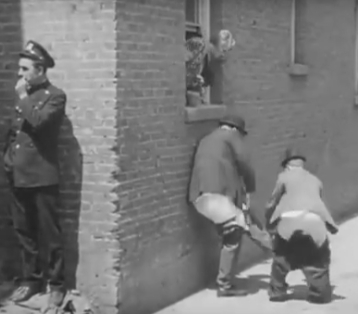
One of the funniest sequences takes place in a narrow city alley.
Stan and Ollie believe they have found somewhere quiet enough to exchange their trousers.
A uniformed policeman is nearby.
Naturally, their awkward movements and attempts to hide only make the situation more suspicious.
The policeman notices them and becomes curious.
The pair struggle to explain themselves through their expressions and gestures.
Their embarrassment is obvious.
Oliver attempts to maintain an appearance of dignity.
Stan looks increasingly confused.
The scene captures the contrast that made the duo famous.
Hardy tries to behave like a respectable gentleman, even when the situation has become ridiculous.
Laurel responds with innocent bewilderment, as though he cannot understand why everyone is making such a fuss.
Together, they turn a simple misunderstanding into a beautifully timed comic performance.
The Clever Trick With the Crates
As the action continues, Stan and Ollie attempt to hide behind a stack of crates.
The crates appear to offer the privacy they desperately need.
But the setting introduces another unexpected complication.
The boxes are positioned on a platform that can move below street level.
This creates an ingenious visual joke.
The policeman sees the crates, but the movement of the platform changes what is visible.
The audience understands the trick while the characters remain focused on their immediate problem.
The scene demonstrates how silent comedy could use the physical environment as part of the joke.
Walls, doorways, boxes, elevators, and sidewalks were not simply backgrounds.
They became essential parts of the action.
The moving platform transforms an ordinary street into a stage for perfectly coordinated confusion.
Stan Laurel’s Extraordinary Comic Innocence
Stan Laurel’s screen character was famous for his childlike innocence.
He often appeared genuinely puzzled by the problems surrounding him.
Even when he contributed to the chaos, he rarely seemed to understand how it had happened.
In Liberty, this personality becomes especially effective.
Stan is trying to solve a straightforward problem.
He does not see why exchanging trousers should be so difficult.
When other people react suspiciously, he appears surprised.
His wide-eyed expressions and uncertain movements make the situation even funnier.
Laurel’s performance demonstrates the power of understated physical comedy.
He did not need to move constantly or exaggerate every gesture.
Sometimes a brief pause or a confused look could produce the biggest laugh.
Oliver Hardy’s Famous Sense of Dignity
Oliver Hardy provided the ideal contrast to Laurel.
His screen character was determined to appear sophisticated, capable, and respectable.
Unfortunately, Stan’s mistakes and their shared adventures constantly undermined that image.
In Liberty, Hardy’s embarrassment is central to the comedy.
He knows how suspicious their behavior appears.
He understands that being discovered while changing trousers in public could create an awkward misunderstanding.
But he cannot find a way to escape the situation.
His nervous adjustments, embarrassed expressions, and attempts to regain control make the scene unforgettable.
Hardy was particularly skilled at reacting to disasters with wounded dignity.
He could communicate disappointment, frustration, and disbelief with a single glance.
The contrast between his self-importance and the ridiculous circumstances made him one of cinema’s greatest comic performers.
Why the Police Encounter Works So Well
The policeman’s role is important because he represents authority.
Stan and Ollie want to avoid trouble.
The policeman wants to understand their suspicious behavior.
Neither side fully understands the other.
This creates an escalating series of misunderstandings.
Every attempt by the duo to look innocent makes them appear more suspicious.
Their desire for privacy becomes increasingly difficult to satisfy.
The scene works because the audience knows the harmless explanation behind the strange behavior.
Stan and Ollie are simply trying to correct a clothing mistake.
But from the policeman’s perspective, their actions seem highly questionable.
This is classic situational comedy.
The humor does not depend on a complicated punchline.
It comes from the difference between what the audience knows and what the characters believe.
The Magic of Silent Film Storytelling
Liberty was released during the transition from silent cinema to sound.
Although it was presented with synchronized music and sound effects, the performances rely primarily on visual storytelling rather than spoken dialogue.
This makes the comedy remarkably accessible.
Audiences do not need to understand a particular language to enjoy the scene.
The characters’ movements and expressions communicate the story.
A policeman looks suspicious.
Two men become embarrassed.
They attempt to hide.
Something unexpected happens.
The joke is immediately understandable.
This universal quality helped Laurel and Hardy become internationally beloved performers.
Their humor could cross language barriers because it was rooted in recognizable human behavior.
Embarrassment, confusion, frustration, and surprise are emotions that everyone understands.
From a Narrow Alley to a Dangerous Skyscraper
The alleyway sequence is only one part of Liberty.
As the film continues, Stan and Ollie’s attempts to exchange trousers lead them into increasingly dangerous situations.
Eventually, they reach a construction site.
Their adventures take them high above the city, where unfinished steel girders create a spectacular setting for physical comedy.
The contrast between the opening problem and the later danger is extraordinary.
What began as a minor clothing mistake has become a potentially terrifying adventure.
The filmmakers use height, narrow platforms, and carefully staged movements to create suspense.
Audiences laugh at the characters’ mistakes while worrying about their safety.
This combination of comedy and danger was a hallmark of silent-era filmmaking.
The sequence also demonstrates the performers’ willingness to participate in elaborate physical routines.
Their commitment helped make the film memorable.
Leo McCarey’s Contribution to Classic Comedy
Director Leo McCarey played an important role in shaping the screen partnership of Laurel and Hardy.
His approach emphasized character relationships, carefully developed situations, and the gradual escalation of comic problems.
Rather than relying only on isolated jokes, the films allowed one mistake to create another.
That structure is particularly clear in Liberty.
The characters begin with a simple problem.
Each attempted solution introduces a new complication.
The story becomes more ridiculous while remaining connected to its original premise.
This method gives the film a satisfying sense of progression.
The audience never loses sight of what Stan and Ollie are trying to accomplish.
Even when the action reaches extraordinary heights, the original clothing mistake remains part of the comedy.
Why Liberty Still Makes Audiences Laugh
Nearly a century after its release, Liberty continues to demonstrate the timeless appeal of physical comedy.
The clothing styles and city streets belong to another era.
But the central situation remains familiar.
Everyone has experienced an embarrassing mistake.
Everyone knows the frustration of trying to solve a simple problem that somehow becomes more complicated.
And everyone understands the desire to avoid unwanted attention.
Laurel and Hardy exaggerate those experiences into a memorable adventure.
Their chemistry makes the characters endearing.
Their expressions make the misunderstandings clear.
And the carefully staged action creates a steady stream of comic surprises.
The result is a film that remains entertaining without depending on modern special effects or complicated dialogue.
The Lasting Legacy of Laurel and Hardy
Stan Laurel and Oliver Hardy became one of the most influential comedy partnerships in film history.
Their contrasting personalities created an unforgettable dynamic.
Laurel was innocent, confused, and unpredictable.
Hardy was proud, impatient, and constantly struggling to preserve his dignity.
Together, they transformed ordinary situations into extraordinary disasters.
Their influence can still be seen in comedy films and television programs today.
The combination of mismatched personalities, escalating mistakes, and perfectly timed reactions remains a foundation of popular humor.
Liberty is an excellent example of that tradition.
It shows how a simple problem can support an entire film when the performers and filmmakers understand the mechanics of comedy.
Final Thoughts: One Mistake, Two Friends, and Endless Trouble
The alleyway scene from Liberty is a wonderful reminder of Laurel and Hardy’s extraordinary talent.
Two men simply want to exchange their trousers.
A policeman notices their suspicious behavior.
A stack of crates offers temporary cover.
And the situation becomes increasingly ridiculous.
Stan Laurel and Oliver Hardy deliver a performance filled with expressive reactions, awkward movements, and unforgettable comic timing.
The film proves that the best comedy often begins with the smallest mistake.
Sometimes all it takes is the wrong pair of trousers and the worst possible place to change them.
Would you have been able to keep a straight face if you were the policeman?
#LaurelAndHardy #Liberty1929 #StanLaurel #OliverHardy #SilentComedy #ClassicComedy #VintageHollywood