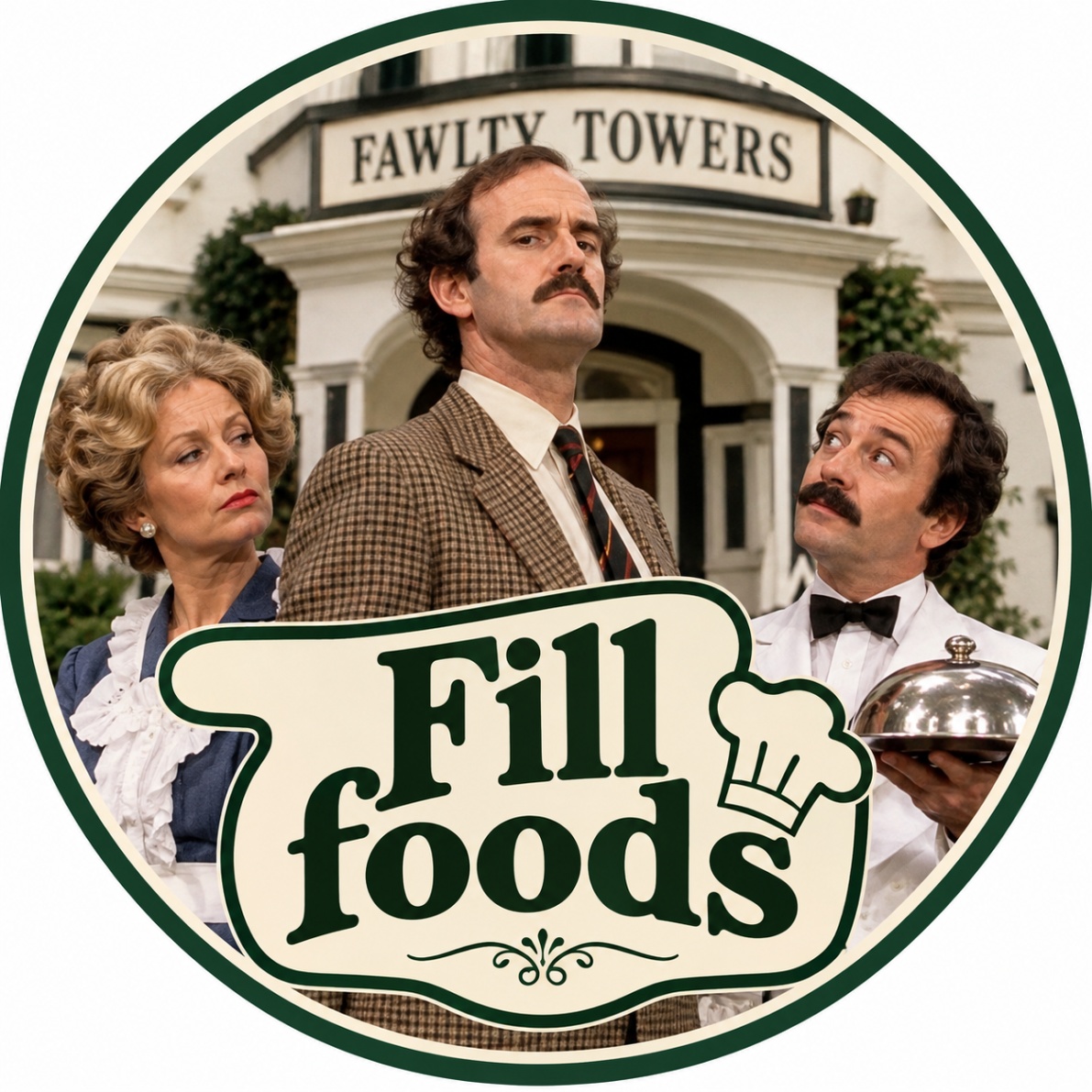
Welcome to Fawlty Towers, the hotel where a simple breakfast can become a disaster, an ordinary guest can trigger complete chaos, and owner Basil Fawlty somehow manages to turn even the smallest problem into a spectacular catastrophe.
First broadcast in Britain in 1975, Fawlty Towers became one of the most celebrated British sitcoms ever made. Remarkably, only twelve episodes were produced across two series, yet the programme left a legacy far greater than its short run might suggest.
At the centre of everything is Basil Fawlty, brilliantly played by John Cleese — an impatient, socially ambitious and frequently furious hotel owner whose greatest obstacle is usually himself.
Add Sybil, Manuel and Polly to the equation, and you have the perfect recipe for comedy chaos.
Welcome to the Most Chaotic Hotel in Britain
On paper, running a small hotel sounds straightforward.
Guests arrive. Rooms are prepared. Meals are served. Problems are solved.
At Fawlty Towers, none of those things happen without complications.
Basil desperately wants his hotel to appear sophisticated and respectable. He dreams of attracting important guests and escaping the ordinary people he believes are beneath his ambitions.
Unfortunately, Basil is perhaps the least suitable person imaginable to run a hotel.
He is impatient with guests, terrified of his wife, easily distracted and capable of transforming a minor misunderstanding into a full-scale emergency.
And that’s exactly why watching him is so entertaining.
Basil Fawlty Is a Comedy Masterpiece
John Cleese created one of British television’s most recognizable comedy characters with Basil Fawlty.
Basil wants control.
He almost never has it.
Every time he attempts to make himself look competent, circumstances expose exactly how chaotic he really is.
His physical comedy is particularly memorable.
Basil doesn’t simply become annoyed.
His entire body seems to participate in his frustration.
He marches through corridors, argues with guests, whispers desperately when Sybil is nearby and occasionally reaches levels of frustration that seem almost impossible.
The performance is exaggerated without completely losing the recognizable human emotions underneath.
Everyone has experienced irritation when a simple task becomes unnecessarily complicated.
Basil simply takes that frustration to an absurd extreme.
Sybil Knows Exactly How to Handle Basil
Of course, Basil doesn’t run the hotel alone.
His wife Sybil, played by Prunella Scales, is often far more capable of handling both the business and her husband.
Basil may attempt to act like the authority figure, but everyone understands who actually has the stronger personality.
Sybil barely needs to raise her voice.
Sometimes one look is enough.
Basil’s personality can change instantly when he realizes Sybil is watching.
Their relationship creates one of the funniest dynamics in the programme.
Basil complains about her constantly, yet he is also clearly intimidated by her.
Sybil understands him perfectly, which means his attempts to deceive her rarely go according to plan.
Manuel Creates Unforgettable Confusion
Then there is Manuel.
Played by Andrew Sachs, Manuel is the well-meaning waiter from Barcelona who frequently struggles to understand Basil’s instructions.
That language barrier becomes a constant source of misunderstandings.
Basil wants everything done immediately.
Manuel often has no idea what Basil wants.
The result is predictable chaos.
The brilliance of these scenes comes from escalation.
A tiny misunderstanding becomes a bigger misunderstanding.
Basil becomes increasingly frustrated.
Manuel becomes increasingly confused.
And instead of stopping to explain the situation calmly, Basil usually makes everything worse.
The phrase “I know nothing!” became one of the show’s most recognizable lines.
Polly Is Often the Voice of Reason
Polly, played by Connie Booth, frequently finds herself trying to rescue situations that Basil has destroyed.
She is intelligent, practical and much calmer than her employer.
That makes her an essential part of the comedy.
While Basil creates problems, Polly often tries to prevent them from becoming catastrophic.
Unfortunately, working at Fawlty Towers means catastrophe is difficult to avoid.
Her ability to think quickly becomes particularly important whenever Basil invents another ridiculous explanation to hide a mistake.
In many episodes, Polly isn’t simply an employee.
She’s practically part of the hotel’s emergency response system.
The Comedy of Things Going Wrong
One of the greatest strengths of Fawlty Towers is its ability to build comedy through escalation.
The stories often begin with something relatively ordinary.
A guest makes a request.
Someone arrives at the hotel.
A meal needs to be prepared.
Basil wants to impress somebody.
Then one thing goes wrong.
Basil attempts to fix it.
His solution creates another problem.
He lies to cover the first problem.
That lie creates a third problem.
Someone misunderstands what is happening.
And before long, the entire hotel seems to be collapsing around him.
The audience can often see disaster approaching long before Basil does.
That anticipation is part of the fun.
The Germans Became a Legendary Episode
Among the most famous episodes is “The Germans.”
Basil is determined that nobody should mention the war when German guests arrive at the hotel.
Naturally, Basil himself becomes the person completely incapable of following that instruction.
The episode became one of the most discussed and recognizable examples of Fawlty Towers’ uncomfortable, escalating comedy.
Its humour relies heavily on Basil’s inability to behave normally once he becomes obsessed with avoiding a particular subject.
The harder he tries to control himself, the worse the situation becomes.
That pattern appears repeatedly throughout the series.
Basil is frequently the architect of his own destruction.
The Hotel Inspector Panic
Another perfect example comes when Basil believes hotel inspectors may be visiting.
Suddenly, every guest becomes suspicious.
Could this person be an inspector?
What about that one?
Basil’s desperation to impress potentially important visitors completely changes the way he behaves.
Ordinary guests who previously irritated him suddenly receive extraordinary attention if he suspects they might have influence.
His social ambition becomes his weakness.
The more Basil tries to appear professional, the less professional he becomes.
The Car Scene Nobody Forgets
Perhaps one of the most iconic images from Fawlty Towers involves Basil and his unreliable car.
After the vehicle repeatedly refuses to cooperate, Basil finally loses patience.
Rather than accepting that shouting at a machine will accomplish nothing, he treats the car as though it has personally betrayed him.
The resulting explosion of frustration became classic physical comedy.
It works because viewers understand exactly what has happened.
Most people have experienced a moment when technology or machinery refuses to cooperate.
Most people don’t respond like Basil.
But perhaps, for a few seconds, they have wanted to.
Only Twelve Episodes — Yet a Huge Legacy
One of the most remarkable facts about Fawlty Towers is how little of it actually exists.
There are only twelve original episodes.
The first series aired in 1975, followed by the second in 1979.
That is an extraordinarily small catalogue compared with many successful sitcoms.
Yet those twelve episodes have been repeated, discussed and remembered for decades.
In some ways, the limited number of episodes may have helped preserve the programme’s reputation.
There was no long decline.
No endless series after the original idea had run out of energy.
Instead, viewers were left with a compact collection of carefully constructed comedy.
Why Fawlty Towers Still Works
The world depicted in Fawlty Towers belongs to another era.
The hotel looks different from modern establishments.
The technology is old.
Social attitudes have changed considerably since the 1970s, and some material is understandably viewed differently by contemporary audiences.
But the fundamental comedy remains recognizable.
Difficult customers still exist.
Workplace misunderstandings still happen.
People still pretend to know what they’re doing when they don’t.
Couples still argue.
Employees still misunderstand managers.
And people still make terrible decisions because they’re too embarrassed to admit they made a mistake.
Those situations are timeless.
John Cleese and Connie Booth Created Something Special
The writing of John Cleese and Connie Booth gave Fawlty Towers its distinctive structure.
Episodes rarely feel like collections of unrelated jokes.
Instead, situations build upon each other.
A detail introduced earlier can become important later.
Misunderstandings collide.
Separate problems suddenly become part of the same disaster.
By the final section of an episode, Basil may be attempting to manage several catastrophes simultaneously.
That structure gives the comedy momentum.
Once things begin going wrong, they rarely stop.
British Comedy at Its Most Chaotic
Fawlty Towers combines verbal humour, physical comedy, awkward situations and memorable characters.
Basil provides the explosive energy.
Sybil keeps him under pressure.
Manuel creates misunderstandings.
Polly attempts to restore sanity.
And the guests unknowingly walk directly into the madness.
Together, they created one of the most recognizable comedy ensembles in British television.
Welcome to Fawlty Towers
Perhaps the funniest thing about the hotel is that Basil wants everything to be perfect.
He wants respectable guests.
He wants sophistication.
He wants efficiency.
Most importantly, he wants control.
Instead, he gets exactly the opposite.
Every new guest brings another opportunity for disaster.
Every solution creates another problem.
And every attempt by Basil to regain control somehow pushes the hotel deeper into chaos.
That is the magic of the programme.
Welcome to Fawlty Towers — where the rooms may be ready, the guests may have arrived, and Basil may insist everything is under control…
but absolutely nothing goes according to plan.