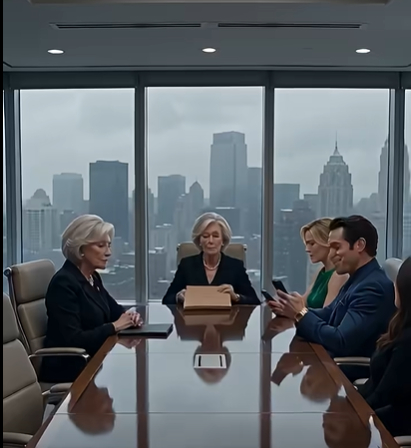
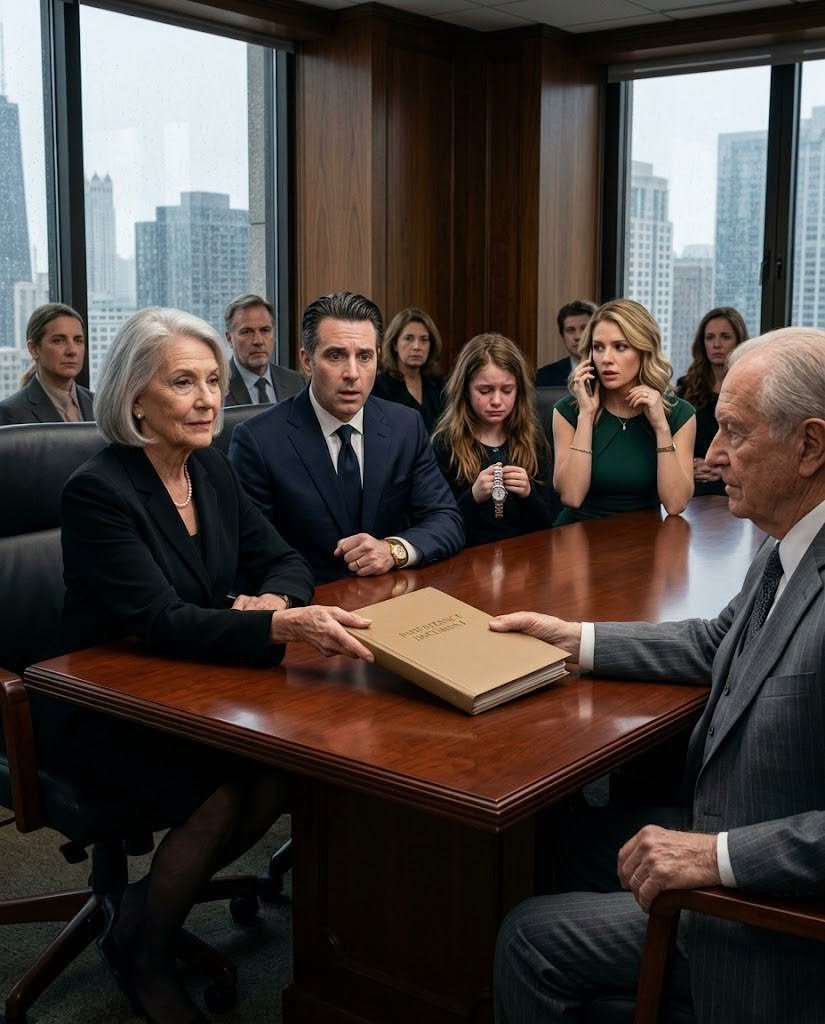
The mahogany conference room of Mitchell Shipping was designed to project absolute permanence. Sunlight poured through floor-to-ceiling glass windows, casting long, sharp shadows across the polished table where Walter Harrington stood with the documents in his hand. The silence in the room was absolute, so heavy that the hum of the central air conditioning sounded like a distant engine revving in an empty tunnel.
Thomas sat frozen in his high-backed leather chair, his hands gripping the armrests so tightly that his knuckles had turned the color of chalk. The relaxed, almost bored confidence he had worn when he sauntered into the room ten minutes late had completely evaporated. In its place was a rigid, sickly panic.
“Read it,” Thomas whispered, his voice cracking slightly before he cleared his throat and tried to regain his composure. “Just read what the clause says, Walter. You’re talking about legal technicalities. My father founded this company, but he left me as his only son, his primary heir. Everyone in this room knows the controlling shares belong to me by right of blood.”
Walter did not flinch. He looked down at the cream-colored paper bearing Richard Mitchell’s unmistakable, bold signature, and then slowly raised his eyes to meet Thomas’s gaze.
“A right of blood, Thomas, is not a right of character,” Walter said, his voice flat and devoid of the warmth he had shown our family for decades. “Your father spent the last forty years of his life sacrificing his health, his sleep, and his peace of mind to build Mitchell Shipping into a global titan. He did not do that so some ungrateful heir could trade his funeral for a champagne-soaked birthday party.”
Victoria, sitting beside Thomas in her glittering cocktail dress, shifted uncomfortably in her seat. Her phone lay neglected on the table screen-down. For the first time since they had swept into our lives, the casual entitlement that defined their marriage seemed completely out of place.
“This is absurd,” Victoria muttered, tossing her blonde hair over her shoulder. “Thomas is the CEO-in-waiting. We have meetings with the board next week. We have investments tied up in the upcoming Asian logistics expansion. You can’t just rewrite decades of corporate planning because Eleanor is emotional about a funeral.”
Jennifer, standing near the window with her hands clasped tightly in front of her, let out a sharp, incredulous breath. “Emotional?” she repeated, turning to face Victoria directly. “Richard was lowered into the ground in the freezing rain while you were cutting a birthday cake and posting pictures on Instagram. Mrs. Mitchell stood by that casket entirely alone, save for people who actually loved and respected your father. You don’t know the first thing about sacrifice, Victoria.”
Thomas shot Jennifer a venomous glare. “Stay out of this, Jennifer. You’re an employee. An assistant. You don’t speak at family matters.”
“She is speaking as a trustee of Richard’s legacy,” Margaret, Richard’s sister, interrupted sharply. She leaned forward, resting her elbows on the table. “And you, Thomas, are speaking to a woman who ran this company’s logistics backbone while you were busy crashing leased sports cars through the suburbs. Have you forgotten whose name is on the wall downstairs? Because it certainly isn’t yours anymore.”
The tension in the room ratcheted up another notch. Thomas looked around the table, seeking allies among the senior executives. But face after face turned away. The chief financial officer, a man who had known Thomas since he was a teenager, stared fixedly at his notepad. The head of human resources wouldn’t even look in his direction.
They all knew. They had all heard the rumors of Thomas’s mounting debts, his disastrous failed real estate ventures in Florida, and the quiet bailouts Richard had secretly funded behind my back to keep our family name out of financial scandals.
I remained silent at the opposite end of the table. I kept my hands folded neatly over my lap, watching my son grapple with the terrifying reality that his entire life of privilege was built on a foundation of sand, and that his father had pulled the rug out from under him right at the edge of the cliff.
“Mom,” Thomas finally said, his voice softening into a desperate, pleading whine that sounded entirely too much like the ten-year-old boy who used to lie about breaking windows. “Mom, look at me. Please. You know how much Dad loved me. I’m his only son. This is just a test, right? Some kind of dramatic final lesson he cooked up because he was angry about the funeral. Tell Walter to read the alternative directive. Tell him to hand over the keys.”
I looked at my son. I looked at the tailored Italian wool of his suit, the expensive Cartier watch glinting on his wrist—a gift Richard had bought him for his thirtieth birthday, which Thomas had pawned three years later during a gambling binge before Richard quietly bought it back and put it back in the box.
“Your father wasn’t giving you a lesson, Thomas,” I said quietly, my voice cutting through the silence like a scalpel. “He was giving you a mirror. And for the first time in your life, you don’t like what you see.”